Author: cxdig

Cell pelotons: A model of early evolutionary cell sorting, with application to slime mold Dictyostelium discoideum

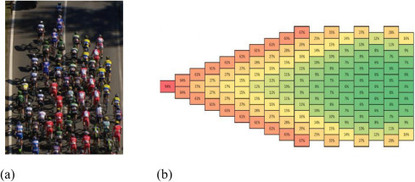
A theoretical model is presented for early evolutionary cell sorting within cellular aggregates. The model involves an energy-saving mechanism and principles of collective self-organization analogous to those observed in bicycle pelotons (groups of cyclists). The theoretical framework is applied to slime-mold slugs (Dictyostelium discoideum) and incorporated into a computer simulation which demonstrates principally the sorting of cells between the anterior and posterior slug regions. The simulation relies on an existing simulation of bicycle peloton dynamics which is modified to incorporate a limited range of cell metabolic capacities among heterogeneous cells, along with a tunable energy-expenditure parameter, referred to as an “output-level” or “starvation-level” to reflect diminishing energetic supply. Proto-cellular dynamics are modeled for three output phases: “active”, “suffering”, and “dying or dead.” Adjusting the starvation parameter causes cell differentiation and sorting into sub-groups within the cellular aggregate. Tuning of the starvation parameter demonstrates how weak or expired cells shuffle backward within the cellular aggregate.


Cell pelotons: A model of early evolutionary cell sorting, with application to slime mold Dictyostelium discoideum

HughTrenchard

Journal of Theoretical Biology
Volume 469, 21 May 2019, Pages 75-95

Source: www.sciencedirect.com
Reimagining the mobility ecosystem: A CEO’s guide

Our mental models about mobility—individually owned cars, gas stations, traffic jams, the driver’s license as a rite of passage—are on the verge of disruption. Mobility is about to become cheaper, more convenient, a better experience, safer, and cleaner—not 50 or even 25 years from now, but perhaps within a dozen.

We describe the coming transformation as mobility’s Second Great Inflection Point, because it has the potential to be as profound as the one that put horses to pasture and revolutionized industries and societies worldwide. A defining characteristic of the new world taking shape is that the automotive industry, which has operated for more than a century alongside but decidedly disconnected from other components of what transportation has come to mean, will blend into a more interconnected, customer-centric ecosystem. That shift boosts the odds that the momentous changes afoot will affect your business, even if the closest you currently get to a car is your morning commute.

Source: www.mckinsey.com

An Introduction to Complex Systems – Making Sense of a Changing World​ | Joseph V. Tranquillo | Springer

This textbook explores the interdisciplinary field of complex systems theory and how it relates to practical questions and issues. The text is interspersed with both philosophical and quantitative arguments, and each chapter ends with questions and prompts that help readers make mor

Source: www.springer.com