
Author: cxdig

Modeling the Role of the Microbiome in Evolution

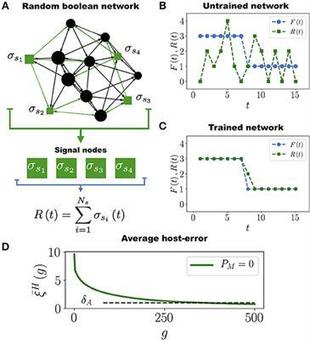
There is undeniable evidence showing that bacteria have strongly influenced the evolution and biological functions of multicellular organisms. It has been hypothesized that many host-microbial interactions have emerged so as to increase the adaptive fitness of the holobiont (the host plus its microbiota). Although this association has been corroborated for many specific cases, general mechanisms explaining the role of the microbiota in the evolution of the host are yet to be understood. Here we present an evolutionary model in which a network representing the host adapts in order to perform a predefined function. During its adaptation, the host network (HN) can interact with other networks representing its microbiota. We show that this interaction greatly accelerates and improves the adaptability of the HN without decreasing the adaptation of the microbial networks. Furthermore, the adaptation of the HN to perform several functions is possible only when it interacts with many different bacterial networks in a specialized way (each bacterial network participating in the adaptation of one function). Disrupting these interactions often leads to non-adaptive states, reminiscent of dysbiosis, where none of the networks the holobiont consists of can perform their respective functions. By considering the holobiont as a unit of selection and focusing on the adaptation of the host to predefined but arbitrary functions, our model predicts the need for specialized diversity in the microbiota. This structural and dynamical complexity in the holobiont facilitates its adaptation, whereas a homogeneous (non-specialized) microbiota is inconsequential or even detrimental to the holobiont’s evolution. To our knowledge, this is the first model in which symbiotic interactions, diversity, specialization and dysbiosis in an ecosystem emerge as a result of coevolution. It also helps us understand the emergence of complex organisms, as they adapt more easily to perform multiple tasks than non-complex ones.


Modeling the Role of the Microbiome in Evolution

Saúl Huitzil, Santiago Sandoval-Motta, Alejandro Frank and Maximino Aldana

Front. Physiol., 20 December 2018 | https://doi.org/10.3389/fphys.2018.01836 

Source: www.frontiersin.org

Complex Networks: Theory, Methods, and Applications – Lake Como School of Advanced Studies – May 13-17, 2019

Many real systems can be modeled as networks, where the elements of the system are nodes and interactions between elements are edges. An even larger set of systems can be modeled using dynamical processes on networks, which are in turn affected by the dynamics. Networks thus represent the backbone of many complex systems, and their theoretical and computational analysis makes it possible to gain insights into numerous applications. Networks permeate almost every conceivable discipline—including sociology, transportation, economics and finance, biology, and myriad others—and the study of "network science" has thus become a crucial component of modern scientific education.

The school "Complex Networks: Theory, Methods, and Applications" offers a succinct education in network science. It is open to all aspiring scholars in any area of science or engineering who wish to study networks of any kind (whether theoretical or applied), and it is especially addressed to doctoral students and young postdoctoral scholars. The aim of the school is to deepen into both theoretical developments and applications in targeted fields.

LECTURERS
— IAIN COUZIN, Max Planck Institute for Ornithology, and University of Konstanz
— TINA ELIASSI-RAD, Northeastern University
— SONIA KEFI, CNRS-Université de Montpellier
— VITO LATORA, Queen Mary University of London
— GIOVANNI PETRI, ISI Foundation, Turin

Source: ntme.lakecomoschool.org

Cohesion, order and information flow in the collective motion of mixed-species shoals

Despite the frequency with which mixed-species groups are observed in nature, studies of collective behaviour typically focus on single-species groups. Here, we quantify and compare the patterns of interactions between three fish species, threespine sticklebacks (Gasterosteus aculeatus), ninespine sticklebacks (Pungitius pungitius) and roach (Rutilus rutilus) in both single- and mixed-species shoals in the laboratory. Pilot data confirmed that the three species form both single- and mixed-species shoals in the wild. In our laboratory study, we found that single-species groups were more polarized than mixed-species groups, while single-species groups of threespine sticklebacks and roach were more cohesive than mixed shoals of these species. Furthermore, while there was no difference between the inter-individual distances between threespine and ninespine sticklebacks within mixed-species groups, there was some evidence of segregation by species in mixed groups of threespine sticklebacks and roach. There were differences between treatments in mean pairwise transfer entropy, and in particular we identify species-differences in information use within the mixed-species groups, and, similarly, differences in responses to conspecifics and heterospecifics in mixed-species groups. We speculate that differences in the patterns of interactions between species in mixed-species groups may determine patterns of fission and fusion in such groups.


Cohesion, order and information flow in the collective motion of mixed-species shoals
Ashley J. W. Ward , T. M. Schaerf , A. L. J. Burns , J. T. Lizier , E. Crosato , M. Prokopenko and M. M. Webster

Royal Society Open Science

Source: royalsocietypublishing.org

Connecting empirical phenomena and theoretical models of biological coordination across scales

Coordination is ubiquitous in living systems. Existing theoretical models of coordination — from bacteria to brains — focus on either gross statistics in large-scale systems (N→∞) or detailed dynamics in small-scale systems (mostly N=2). Both approaches have proceeded largely independent of each other. The present work bridges this gap with a theoretical model of biological coordination that captures key experimental observations of mid-scale social coordination at multiple levels of description. It also reconciles in a single formulation two well-studied models of large- and small-scale biological coordination (Kuramoto and extended Haken-Kelso-Bunz). The model adds second-order coupling (from extended Haken-Kelso-Bunz) to the Kuramoto model. We show that second-order coupling is indispensable for reproducing empirically observed phenomena and gives rise to a phase transition from mono- to multi-stable coordination across scales. This mono-to-multistable transition connects the emergence and growth of behavioral complexity in small and large systems.


Connecting empirical phenomena and theoretical models of biological coordination across scales
Mengsen Zhang, Christopher Beetle, J. A. Scott Kelso, Emmanuelle Tognoli

Source: arxiv.org

Antifragility of Random Boolean Networks

Antifragility is a property that enhances the capability of a system in response to external perturbations. Although the concept has been applied in many areas, a practical measure of antifragility has not been developed yet. Here we propose a simply calculable measure of antifragility, based on the change of "satisfaction" before and after adding perturbations, and apply it to random Boolean networks (RBNs). Using the measure, we found that ordered RBNs are the most antifragile. Also, we demonstrate that seven biological systems are antifragile. Our measure and results can be used in various applications of Boolean networks (BNs) including creating antifragile engineering systems, identifying the genetic mechanism of antifragile biological systems, and developing new treatment strategies for various diseases.


Antifragility of Random Boolean Networks
Omar K. Pineda, Hyobin Kim, Carlos Gershenson

Source: arxiv.org