
Author: cxdig

The universal decay of collective memory and attention

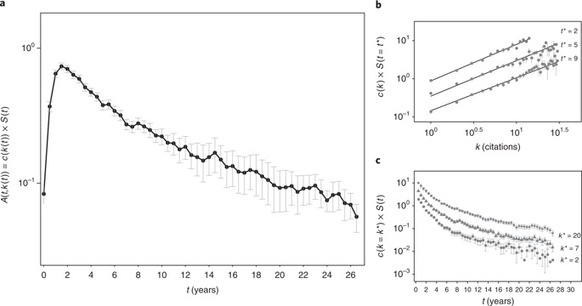
Collective memory and attention are sustained by two channels: oral communication (communicative memory) and the physical recording of information (cultural memory). Here, we use data on the citation of academic articles and patents, and on the online attention received by songs, movies and biographies, to describe the temporal decay of the attention received by cultural products. We show that, once we isolate the temporal dimension of the decay, the attention received by cultural products decays following a universal biexponential function. We explain this universality by proposing a mathematical model based on communicative and cultural memory, which fits the data better than previously proposed log-normal and exponential models. Our results reveal that biographies remain in our communicative memory the longest (20–30 years) and music the shortest (about 5.6 years). These findings show that the average attention received by cultural products decays following a universal biexponential function.


The universal decay of collective memory and attention
Cristian Candia, C. Jara-Figueroa, Carlos Rodriguez-Sickert, Albert-László Barabási & César A. Hidalgo 
Nature Human Behaviour (2018)

Source: www.nature.com

The chaperone effect in scientific publishing

Experience plays a critical role in crafting high-impact scientific work. This is particularly evident in top multidisciplinary journals, where a scientist is unlikely to appear as senior author if he or she has not previously published within the same journal. Here, we develop a quantitative understanding of author order by quantifying this “chaperone effect,” capturing how scientists transition into senior status within a particular publication venue. We illustrate that the chaperone effect has a different magnitude for journals in different branches of science, being more pronounced in medical and biological sciences and weaker in natural sciences. Finally, we show that in the case of high-impact venues, the chaperone effect has significant implications, specifically resulting in a higher average impact relative to papers authored by new principal investigators (PIs). Our findings shed light on the role played by experience in publishing within specific scientific journals, on the paths toward acquiring the necessary experience and expertise, and on the skills required to publish in prestigious venues.


The chaperone effect in scientific publishing
Vedran Sekara, Pierre Deville, Sebastian E. Ahnert, Albert-László Barabási, Roberta Sinatra, and Sune Lehmann
PNAS December 11, 2018 115 (50) 12603-12607

https://doi.org/10.1073/pnas.1800471115

Source: www.pnas.org

Infinite Powers: How Calculus Reveals the Secrets of the Universe: Steven Strogatz

From preeminent math personality and author of The Joy of x, a brilliant and endlessly appealing explanation of calculus – how it works and why it makes our lives immeasurably better.

Without calculus, we wouldn’t have cell phones, TV, GPS, or ultrasound. We wouldn’t have tamed AIDS or discovered Neptune or figured out how to put 5,000 songs in your pocket.

Though many of us were scared away from this essential, engrossing subject in high school and college, Steven Strogatz’s brilliantly creative, down‑to‑earth history shows that calculus is not about complexity; it’s about simplicity. It harnesses an unreal number—infinity—to tackle real‑world problems, breaking them down into easier ones and then reassembling the answers into solutions that feel miraculous.

Infinite Powers recounts how calculus tantalized and thrilled its inventors, starting with its first glimmers in ancient Greece and bringing us right up to the discovery of gravitational waves (a phenomenon predicted by calculus). Strogatz reveals how this form of math rose to the challenges of each age: how to determine the area of a circle with only sand and a stick; how to explain why Mars goes “backwards” sometimes; how to make electricity with magnets; how to ensure your rocket doesn’t miss the moon; how to cure infectious diseases.

As Strogatz proves, calculus is truly the language of the universe. By unveiling the principles of that language, Infinite Powers makes us marvel at the world anew.

Source: www.amazon.com

Macroscopic dynamics and the collapse of urban traffic

Stories of mega-jams that last tens of hours or even days appear not only in fiction but also in reality. In this context, it is important to characterize the collapse of the network, defined as the transition from a characteristic travel time to orders of magnitude longer for the same distance traveled. In this multicity study, we unravel this complex phenomenon under various conditions of demand and translate it to the travel time of the individual drivers. First, we start with the current conditions, showing that there is a characteristic time τ that takes a representative group of commuters to arrive at their destinations once their maximum density has been reached. While this time differs from city to city, it can be explained by Γ, defined as the ratio of the vehicle miles traveled to the total vehicle distance the road network can support per hour. Modifying Γ can improve τ and directly inform planning and infrastructure interventions. In this study we focus on measuring the vulnerability of the system by increasing the volume of cars in the network, keeping the road capacity and the empirical spatial dynamics from origins to destinations unchanged. We identify three states of urban traffic, separated by two distinctive transitions. The first one describes the appearance of the first bottlenecks and the second one the collapse of the system. This collapse is marked by a given number of commuters in each city and it is formally characterized by a nonequilibrium phase transition.

Macroscopic dynamics and the collapse of urban traffic
Luis E. Olmos, Serdar Çolak, Sajjad Shafiei, Meead Saberi, and Marta C. González
PNAS December 11, 2018 115 (50) 12654-12661

https://doi.org/10.1073/pnas.1800474115

Source: www.pnas.org

Cancer: a complex disease

The study of complex systems and their related phenomena has become a major research venue in the recent years and it is commonly regarded as an important part of the scientific revolution developing through the 21st century. The science of complexity is concerned with the laws of operation and evolution of systems formed by many locally interacting elements that produce collective order at spatiotemporal scales larger than that of the single constitutive elements. This new thinking, that explores formally the emergence of spontaneous higher order and feedback hierarchies, has been particularly successful in the biological sciences. One particular life-threatening disease in humans, overwhelmingly common in the modern world is cancer. It is regarded as a collection of phenomena involving anomalous cell growth caused by an underlying genetic instability with the potential to spread to other parts of the human body.

In the present book, a group of well recognised specialists discuss new ideas about the disease. These authors coming from solid backgrounds in physics, mathematics, medicine, molecular and cell biology, genetics and anthropology have dedicated their time to write an authoritative free-available text published under the open access philosophy that hopefully would be in the front-line struggle against cancer, a complex disease.


Cancer: a complex disease
by Elena R. Alvarez-Buylla • Juan Carlos Balandran • Jose Luis Caldu-Primo • Jose Davila-Velderrain • Jennifer Enciso • Enrique Hernandez-Lemus • Lucia S. Lopez Castillo • Juan Carlos Martinez-Garcia • Nancy R. Mejia-Dominguez • Leticia R. Paiva • Rosana Pelayo • Osbaldo Resendis-Antonio • Octavio Valadez-Blanco

Source: scifunam.fisica.unam.mx