
Author: cxdig

A structural transition in physical networks

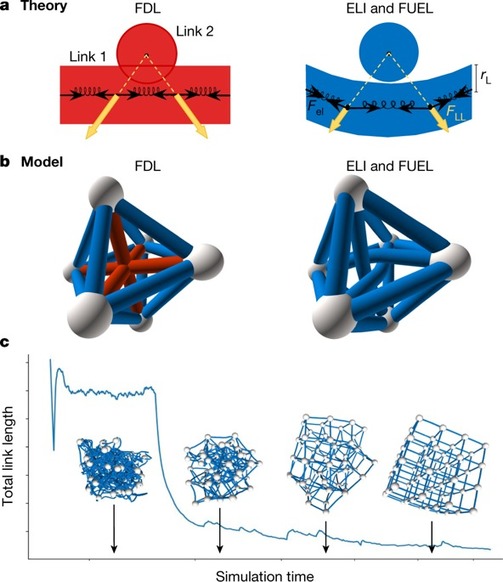
In many physical networks, including neurons in the brain1,2, three-dimensional integrated circuits3 and underground hyphal networks4, the nodes and links are physical objects that cannot intersect or overlap with each other. To take this into account, non-crossing conditions can be imposed to constrain the geometry of networks, which consequently affects how they form, evolve and function. However, these constraints are not included in the theoretical frameworks that are currently used to characterize real networks5,6,7. Most tools for laying out networks are variants of the force-directed layout algorithm8,9—which assumes dimensionless nodes and links—and are therefore unable to reveal the geometry of densely packed physical networks. Here we develop a modelling framework that accounts for the physical sizes of nodes and links, allowing us to explore how non-crossing conditions affect the geometry of a network. For small link thicknesses, we observe a weakly interacting regime in which link crossings are avoided via local link rearrangements, without altering the overall geometry of the layout compared to the force-directed layout. Once the link thickness exceeds a threshold, a strongly interacting regime emerges in which multiple geometric quantities, such as the total link length and the link curvature, scale with the link thickness. We show that the crossover between the two regimes is driven by the non-crossing condition, which allows us to derive the transition point analytically and show that networks with large numbers of nodes will ultimately exist in the strongly interacting regime. We also find that networks in the weakly interacting regime display a solid-like response to stress, whereas in the strongly interacting regime they behave in a gel-like fashion. Networks in the weakly interacting regime are amenable to 3D printing and so can be used to visualize network geometry, and the strongly interacting regime provides insights into the scaling of the sizes of densely packed mammalian brains.


A structural transition in physical networks
Nima Dehmamy, Soodabeh Milanlouei & Albert-László Barabási 
Nature volume 563, pages 676–680 (2018)

Source: www.nature.com

The Impact of Potential Crowd Behaviours on Emergency Evacuation

Crowd dynamics have important applications in evacuation management systems relevant to organizing safer large scale gatherings. For crowd safety, it is very important to study the evolution of potential crowd behaviours by simulating the crowd evacuation process. Planning crowd control tasks via studying the impact of crowd behavioural evolution towards evacuation simulation could mitigate the possibility of crowd disasters that may happen. During a typical emergency evacuation scenario, conflict among agents occurs when agents intend to move to the same location as a result of the interaction of agents within their nearest neighbours. The effect of the agent response towards their neighbourhood is vital in order to understand the effect of variation of crowd behaviours towards the whole environment. In this work, we model crowd motion subject to exit congestion under uncertainty conditions in a continuous space via computer simulations. We model best-response, risk-seeking, risk-averse and risk-neutral behaviours of agents via certain game theory notions. We perform computer simulations with heterogeneous populations in order to study the effect of the evolution of agent behaviours towards egress flow under threat conditions. Our simulation results show the relation between the local crowd pressure and the number of injured agents. We observe that when the proportion of agents in a population of risk-seeking agents is increased, the average crowd pressure, average local density and the number of injured agents get increased. Besides that, based on our simulation results, we can infer that crowd disaster could be prevented if the agent population are full of risk-averse and risk-neutral agents despite circumstances that lead to threat consequences.


The Impact of Potential Crowd Behaviours on Emergency Evacuation: An Evolutionary Game Theoretic Approach
Azhar Mohd Ibrahim , Ibrahim Venkat and De Wilde Philippe
Journal of Artificial Societies and Social Simulation 22 (1) 3
<http://jasss.soc.surrey.ac.uk/22/1/3.html>
DOI: 10.18564/jasss.3837

Source: jasss.soc.surrey.ac.uk

AI for the Common Good?! Pitfalls, challenges, and Ethics Pen-Testing

Recently, many AI researchers and practitioners have embarked on research visions that involve doing AI for "Good". This is part of a general drive towards infusing AI research and practice with ethical thinking. One frequent theme in current ethical guidelines is the requirement that AI be good for all, or: contribute to the Common Good. But what is the Common Good, and is it enough to want to be good? Via four lead questions, I will illustrate challenges and pitfalls when determining, from an AI point of view, what the Common Good is and how it can be enhanced by AI. The questions are: What is the problem / What is a problem?, Who defines the problem?, What is the role of knowledge?, and What are important side effects and dynamics? The illustration will use an example from the domain of "AI for Social Good", more specifically "Data Science for Social Good". Even if the importance of these questions may be known at an abstract level, they do not get asked sufficiently in practice, as shown by an exploratory study of 99 contributions to recent conferences in the field. Turning these challenges and pitfalls into a positive recommendation, as a conclusion I will draw on another characteristic of computer-science thinking and practice to make these impediments visible and attenuate them: "attacks" as a method for improving design. This results in the proposal of ethics pen-testing as a method for helping AI designs to better contribute to the Common Good.

AI for the Common Good?! Pitfalls, challenges, and Ethics Pen-Testing
Bettina Berendt

Source: arxiv.org

Quantifying the sensing power of crowd-sourced vehicle fleets

Sensors can measure air quality, traffic congestion, and other aspects of urban environments. The fine-grained diagnostic information they provide could help urban managers to monitor a city’s health. Recently, a `drive-by’ paradigm has been proposed in which sensors are deployed on third-party vehicles, enabling wide coverage at low cost} Research on drive-by sensing has mostly focused on sensor engineering, but a key question remains unexplored: How many vehicles would be required to adequately scan a city? Here, we address this question by analyzing the sensing power of a taxi fleet. Taxis, being numerous in cities and typically equipped with some sensing technology (e.g. GPS), are natural hosts for the sensors. Our strategy is to view drive-by sensing as a spreading process, in which the area of sensed terrain expands as sensor-equipped taxis diffuse through a city’s streets. In tandem with a simple model for the movements of the taxis, this analogy lets us analytically determine the fraction of a city’s street network sensed by a fleet of taxis during a day. Our results agree with taxi data obtained from nine major cities, and reveal that a remarkably small number of taxis can scan a large number of streets. This finding appears to be universal, indicating its applicability to cities beyond those analyzed here. Moreover, because taxi motions combine randomness and regularity (passengers’ destinations being random, but the routes to them being deterministic), the spreading properties of taxi fleets are unusual; in stark contrast to random walks, the stationary densities of our taxi model obey Zipf’s law, consistent with the empirical taxi data. Our results have direct utility for town councilors, smart-city designers, and other urban decision makers.


Quantifying the sensing power of crowd-sourced vehicle fleets
Kevin P. O’Keeffe, Amin Anjomshoaa, Steven H. Strogatz, Paolo Santi, Carlo Ratti

Source: arxiv.org

Statistical physics of liquid brains

Liquid neural networks (or ”liquid brains”) are a widespread class of cognitive living networks characterised by a common feature: the agents (ants or immune cells, for example) move in space. Thus, no fixed, long-term agent-agent connections are maintained, in contrast with standard neural systems. How is this class of systems capable of displaying cognitive abilities, from learning to decision-making? In this paper, the collective dynamics, memory and learning properties of liquid brains is explored under the perspective of statistical physics. Using a comparative approach, we review the generic properties of three large classes of systems, namely: standard neural networks (”solid brains”), ant colonies and the immune system. It is shown that, despite their intrinsic physical differences, these systems share key properties with standard neural systems in terms of formal descriptions, but strongly depart in other ways. On one hand, the attractors found in liquid brains are not always based on connection weights but instead on population abundances. However, some liquid systems use fluctuations in ways similar to those found in cortical networks, suggesting a relevant role of criticality as a way of rapidly reacting to external signals.


Statistical physics of liquid brains
Jordi Pinero, Ricard Sole

Source: www.biorxiv.org