Author: cxdig

The Crisis of Reproducibility, the Denominator Problem and the Scientific Role of Multi-scale Modeling

The “Crisis of Reproducibility” has received considerable attention both within the scientific community and without. While factors associated with scientific culture and practical practice are most often invoked, I propose that the Crisis of Reproducibility is ultimately a failure of generalization with a fundamental scientific basis in the methods used for biomedical research. The Denominator Problem describes how limitations intrinsic to the two primary approaches of biomedical research, clinical studies and preclinical experimental biology, lead to an inability to effectively characterize the full extent of biological heterogeneity, which compromises the task of generalizing acquired knowledge. Drawing on the example of the unifying role of theory in the physical sciences, I propose that multi-scale mathematical and dynamic computational models, when mapped to the modular structure of biological systems, can serve a unifying role as formal representations of what is conserved and similar from one biological context to another. This ability to explicitly describe the generation of heterogeneity from similarity addresses the Denominator Problem and provides a scientific response to the Crisis of Reproducibility.


The Crisis of Reproducibility, the Denominator Problem and the Scientific Role of Multi-scale Modeling

Gary An

Bulletin of Mathematical Biology
December 2018, Volume 80, Issue 12, pp 3071–3080

Source: link.springer.com

Optimal Sequence Memory in Driven Random Networks

Autonomous, randomly coupled, neural networks display a transition to chaos at a critical coupling strength. Here, we investigate the effect of a time-varying input on the onset of chaos and the resulting consequences for information processing. Dynamic mean-field theory yields the statistics of the activity, the maximum Lyapunov exponent, and the memory capacity of the network. We find an exact condition that determines the transition from stable to chaotic dynamics and the sequential memory capacity in closed form. The input suppresses chaos by a dynamic mechanism, shifting the transition to significantly larger coupling strengths than predicted by local stability analysis. Beyond linear stability, a regime of coexistent locally expansive but nonchaotic dynamics emerges that optimizes the capacity of the network to store sequential input.


Optimal Sequence Memory in Driven Random Networks

Jannis Schuecker, Sven Goedeke, and Moritz Helias
Phys. Rev. X 8, 041029

Source: journals.aps.org

Quantifying Biases in Online Information Exposure

Our consumption of online information is mediated by filtering, ranking, and recommendation algorithms that introduce unintentional biases as they attempt to deliver relevant and engaging content. It has been suggested that our reliance on online technologies such as search engines and social media may limit exposure to diverse points of view and make us vulnerable to manipulation by disinformation. In this article, we mine a massive data set of web traffic to quantify two kinds of bias: (i) homogeneity bias, which is the tendency to consume content from a narrow set of information sources, and (ii) popularity bias, which is the selective exposure to content from top sites. Our analysis reveals different bias levels across several widely used web platforms. Search exposes users to a diverse set of sources, while social media traffic tends to exhibit high popularity and homogeneity bias. When we focus our analysis on traffic to news sites, we find higher levels of popularity bias, with smaller differences across applications. Overall, our results quantify the extent to which our choices of online systems confine us inside “social bubbles.”


Nikolov, D.; Lalmas, M.; Flammini, A.; and Menczer, F. Journal of the Association for Information Science and Technology. doi:10.1002/asi.24121 – https://rdcu.be/bbRXl

Source: onlinelibrary.wiley.com

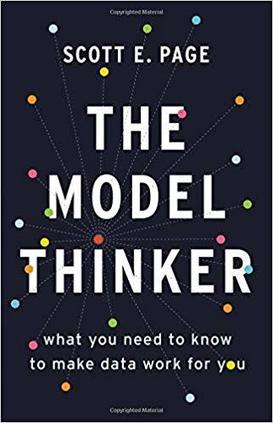
The Model Thinker: What You Need to Know to Make Data Work for You: Scott E. Page

From the stock market to genomics laboratories, census figures to marketing email blasts, we are awash with data. But as anyone who has ever opened up a spreadsheet packed with seemingly infinite lines of data knows, numbers aren’t enough: we need to know how to make those numbers talk. In The Model Thinker, social scientist Scott E. Page shows us the mathematical, statistical, and computational models–from linear regression to random walks and far beyond–that can turn anyone into a genius. At the core of the book is Page’s "many-model paradigm," which shows the reader how to apply multiple models to organize the data, leading to wiser choices, more accurate predictions, and more robust designs. The Model Thinker provides a toolkit for business people, students, scientists, pollsters, and bloggers to make them better, clearer thinkers, able to leverage data and information to their advantage.

Source: www.amazon.com

Alife 2019: The 2019 Conference on Artificial Life

How Can Artificial Life Help Solve Societal Challenges?

Artificial Life has historically been regarded by its adversaries as an academic “hobby” with little relation to real life. We feel that these days are past, as in fact, our interdisciplinary and constantly self-innovating discipline brings together a set of skills and perspectives with a unique potential to tackle some of the most pressing societal challenges of our times. The theme “How can Artificial Life help to solve Societal Challenges” will run through the conference in the shape of keynote presentations and satellite events that apply Artificial Life principles to research on sustainable technologies, bioremediation, urban development and environmental planning, alternative societies a.s.o.But more than merely theming presentations, ALIFE2019 in Newcastle plans to revisit the very way academic conferences are run: a balanced amount of remote talks as well as broadcasting of presentations in order to reduce CO2 emissions, carbon-offset bursaries that allow participants to diminish their ecological footprint, locally sourced catering – these are just a few of the ideas that the organizers will explore, so that us academics can realize some of the change we are advocating for.


July 29-August 2

Newcastle upon Tyne, UK

Source: 2019.alife.org