Author: cxdig

Linguistic Bodies

A novel theoretical framework for an embodied, non-representational approach to language that extends and deepens enactive theory, bridging the gap between sensorimotor skills and language.

Linguistic Bodies offers a fully embodied and fully social treatment of human language without positing mental representations. The authors present the first coherent, overarching theory that connects dynamical explanations of action and perception with language. Arguing from the assumption of a deep continuity between life and mind, they show that this continuity extends to language. Expanding and deepening enactive theory, they offer a constitutive account of language and the co-emergent phenomena of personhood, reflexivity, social normativity, and ideality. Language, they argue, is not something we add to a range of existing cognitive capacities but a new way of being embodied. Each of us is a linguistic body in a community of other linguistic bodies. The book describes three distinct yet entangled kinds of human embodiment, organic, sensorimotor, and intersubjective; it traces the emergence of linguistic sensitivities and introduces the novel concept of linguistic bodies; and it explores the implications of living as linguistic bodies in perpetual becoming, applying the concept of linguistic bodies to questions of language acquisition, parenting, autism, grammar, symbol, narrative, and gesture, and to such ethical concerns as microaggression, institutional speech, and pedagogy.


Linguistic Bodies
The Continuity between Life and Language
By Ezequiel A. Di Paolo, Elena Clare Cuffari and Hanne De Jaegher

Source: mitpress.mit.edu

Semantic information, agency, & physics

Shannon information theory provides various measures of so-called syntactic information, which reflect the amount of statistical correlation between systems. By contrast, the concept of ‘semantic information’ refers to those correlations which carry significance or ‘meaning’ for a given system. Semantic information plays an important role in many fields, including biology, cognitive science and philosophy, and there has been a long-standing interest in formulating a broadly applicable and formal theory of semantic information. In this paper, we introduce such a theory. We define semantic information as the syntactic information that a physical system has about its environment which is causally necessary for the system to maintain its own existence. ‘Causal necessity’ is defined in terms of counter-factual interventions which scramble correlations between the system and its environment, while ‘maintaining existence’ is defined in terms of the system’s ability to keep itself in a low entropy state. We also use recent results in non-equilibrium statistical physics to analyse semantic information from a thermodynamic point of view. Our framework is grounded in the intrinsic dynamics of a system coupled to an environment, and is applicable to any physical system, living or otherwise. It leads to formal definitions of several concepts that have been intuitively understood to be related to semantic information, including ‘value of information’, ‘semantic content’ and ‘agency’.


Semantic information, autonomous agency and non-equilibrium statistical physics
Artemy Kolchinsky, David H. Wolpert

Interface Focus
Published 19 October 2018.DOI: 10.1098/rsfs.2018.0041

Source: rsfs.royalsocietypublishing.org

An Information-Theoretic Approach to Self-Organisation: Emergence of Complex Interdependencies in Coupled Dynamical Systems

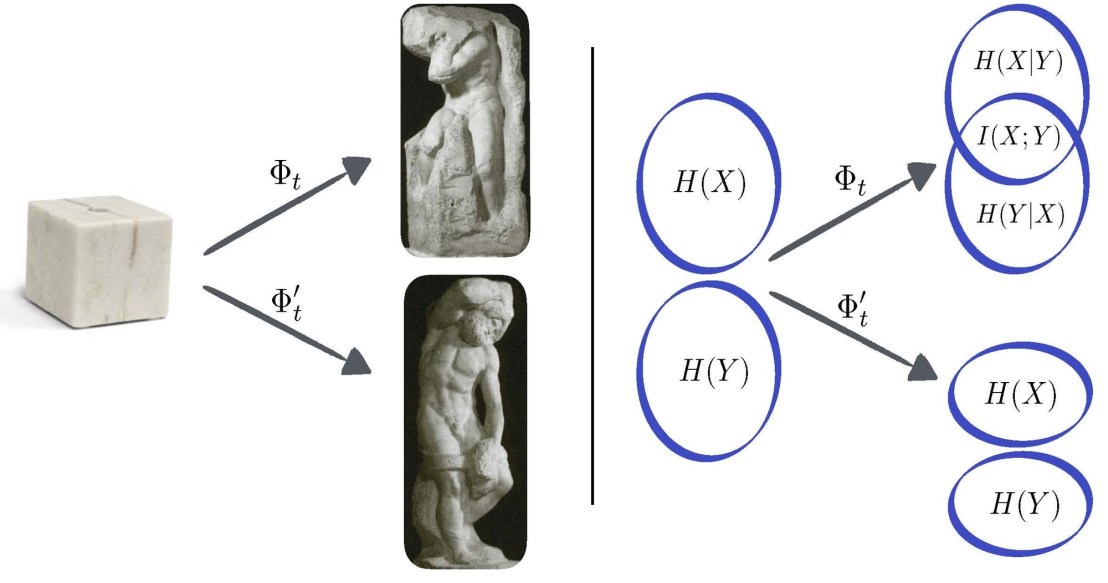
Self-organisation lies at the core of fundamental but still unresolved scientific questions, and holds the promise of de-centralised paradigms crucial for future technological developments. While self-organising processes have been traditionally explained by the tendency of dynamical systems to evolve towards specific configurations, or attractors, we see self-organisation as a consequence of the interdependencies that those attractors induce. Building on this intuition, in this work we develop a theoretical framework for understanding and quantifying self-organisation based on coupled dynamical systems and multivariate information theory. We propose a metric of global structural strength that identifies when self-organisation appears, and a multi-layered decomposition that explains the emergent structure in terms of redundant and synergistic interdependencies. We illustrate our framework on elementary cellular automata, showing how it can detect and characterise the emergence of complex structures.


An Information-Theoretic Approach to Self-Organisation: Emergence of Complex Interdependencies in Coupled Dynamical Systems
Fernando Rosas, Pedro A.M. Mediano, Martín Ugarte and Henrik J. Jensen

Entropy 2018, 20(10), 793; https://doi.org/10.3390/e20100793

Source: www.mdpi.com

Thermodynamics of urban transformations

Urban transformations within large and growing metropolitan areas often generate critical dynamics affecting social interactions, transport connectivity and income flow distribution. We develop a statistical–mechanical model of urban transformations, exemplified for Greater Sydney, and derive a thermodynamic description highlighting critical regimes. We consider urban dynamics at two time scales: fast dynamics for the distribution of population and income, modelled via the maximum entropy principle, and slower dynamics evolving the urban structure under spatially distributed competition. We identify phase transitions between dispersed and polycentric phases, induced by varying the social disposition—a factor balancing the suburbs’ attractiveness—in contrast with the travel impedance. Using the Fisher information, we identify critical thresholds and quantify the thermodynamic cost of urban transformation, as the minimal work required to vary the underlying parameter. Finally, we introduce the notion of thermodynamic efficiency of urban transformation, as the ratio of the order gained during a change to the amount of required work, showing that this measure is maximized at criticality.


On critical dynamics and thermodynamic efficiency of urban transformations
Emanuele Crosato, Ramil Nigmatullin, Mikhail Prokopenko

Open Society

Published 17 October 2018.DOI: 10.1098/rsos.180863

Source: rsos.royalsocietypublishing.org