
Author: cxdig

Modeling Collective Rule at Ancient Teotihuacan as a Complex Adaptive System: Communal Ritual Makes Social Hierarchy More Effective

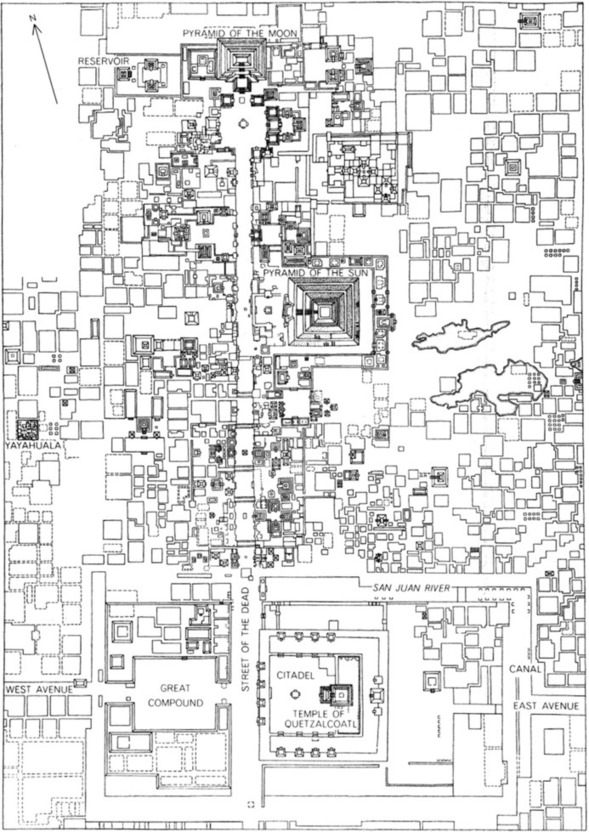
Experts remain divided about the nature of the sociopolitical system of ancient Teotihuacan, which was one of the earliest and largest urban civilizations of the Americas. Excavations hoping to find compelling evidence of powerful rulers, such as a royal tomb, keep coming away empty-handed. But the alternative possibility of collective rule still remains poorly understood as well. Previously we used a computational model of this city’s hypothetical sociopolitical network to show that in principle collective rule based on communal ritual could be an effective strategy of ensuring widespread social coordination, as long as we assume that the network’s structure could be transformed via social learning and local leaders were not strongly subdivided. Here we extended this model to investigate whether increased social hierarchy could mitigate the negative effects of such strong divisions. We found a special synergy between social hierarchy and communal ritual: only their combination improved the extent of social coordination, whereas the introduction of centralization and top-down influence by themselves had no effect. This finding is consistent with portrayals of the Teotihuacan elite as religious specialists serving the public good, in particular by synchronizing the city’s ritual calendar with the rhythms of the stars.


Modeling Collective Rule at Ancient Teotihuacan as a Complex Adaptive System: Communal Ritual Makes Social Hierarchy More Effective
Tom Froese & Linda R. Manzanilla

Cognitive Systems Research

Source: www.sciencedirect.com

The 2018 Nobel Prize in Physics

Arthur Ashkin invented optical tweezers that grab particles, atoms, viruses and other living cells with their laser beam fingers. This new tool allowed Ashkin to realise an old dream of science fiction – using the radiation pressure of light to move physical objects. He succeeded in getting laser light to push small particles towards the centre of the beam and to hold them there. Optical tweezers had been invented.

A major breakthrough came in 1987, when Ashkin used the tweezers to capture living bacteria without harming them. He immediately began studying biological systems and optical tweezers are now widely used to investigate the machinery of life.

Gérard Mourou and Donna Strickland paved the way towards the shortest and most intense laser pulses ever created by mankind. Their revolutionary article was published in 1985 and was the foundation of Strickland’s doctoral thesis.

Using an ingenious approach, they succeeded in creating ultrashort high-intensity laser pulses without destroying the amplifying material. First they stretched the laser pulses in time to reduce their peak power, then amplified them, and finally compressed them. If a pulse is compressed in time and becomes shorter, then more light is packed together in the same tiny space – the intensity of the pulse increases dramatically.

Strickland and Mourou’s newly invented technique, called chirped pulse amplification, CPA, soon became standard for subsequent high-intensity lasers. Its uses include the millions of corrective eye surgeries that are conducted every year using the sharpest of laser beams.

The innumerable areas of application have not yet been completely explored. However, even now these celebrated inventions allow us to rummage around in the microworld in the best spirit of Alfred Nobel – for the greatest benefit to humankind.

Source: www.nobelprize.org

The 2018 Nobel Prize in Physiology or Medicine

Cancer kills millions of people every year and is one of humanity’s greatest health challenges. By stimulating the inherent ability of our immune system to attack tumor cells this year’s Nobel Laureates have established an entirely new principle for cancer therapy.

James P. Allison studied a known protein that functions as a brake on the immune system. He realized the potential of releasing the brake and thereby unleashing our immune cells to attack tumors. He then developed this concept into a brand new approach for treating patients.

In parallel, Tasuku Honjo discovered a protein on immune cells and, after careful exploration of its function, eventually revealed that it also operates as a brake, but with a different mechanism of action. Therapies based on his discovery proved to be strikingly effective in the fight against cancer.

Allison and Honjo showed how different strategies for inhibiting the brakes on the immune system can be used in the treatment of cancer. The seminal discoveries by the two Laureates constitute a landmark in our fight against cancer.

Source: www.nobelprize.org

25th International Workshop on Cellular Automata and Discrete Complex Systems

The 25th International Workshop on Cellular Automata and Discrete Complex Systems AUTOMATA 2019 will take place on June 26-28 in Guadalajara, Mexico.   Proceedings Accepted full papers will appear in the proceedings published by Springer in the Lecture Notes in Computer Science series. About the Conference AUTOMATA 2019 is the twenty-fifth workshop in a series of events established in 1995. These workshops aim:

  • To establish and maintain a permanent, international, multidisciplinary forum for the collaboration of researchers in the field of Cellular Automata (CA) and Discrete Complex Systems (DCS).
  • To provide a platform for presenting and discussing new ideas and results.
  • To support the development of theory and applications of CA and DCS (e.g. parallel computing, physics, biology, social sciences, and others) as long as fundamental aspects and their relations are concerned.
  • To identify and study within an inter- and multidisciplinary context, the important fundamental aspects, concepts, notions and problems concerning CA and DCS.


Source: automata2019.wordpress.com

Large-scale investigation of the reasons why potentially important genes are ignored

Biomedical research is one of the largest areas of present-day science and embeds the hope and potential to improve the lives of the general public. In order to understand how individual scientists choose individual research questions, we study why certain genes are well studied but others are not. While it has been previously observed that most research on human genes only concentrates on approximately 2,000 of the 19,000 genes of the human genome, the reasons for this ignorance are largely unknown. We systematically test explanations for this observation by compiling an extensive resource that characterizes biomedical research, including but not limited to hundreds of chemical and biological properties of gene-encoded proteins, and the published scientific literature on individual genes. Using machine learning methods, we can predict the number of publications on individual genes, the year of the first publication about them, the extent of funding by the National Institutes of Health, and the existence of related medical drugs. We find that biomedical research is primarily guided by a handful of generic chemical and biological characteristics of genes, which facilitated experimentation during the 1980s and 1990s, rather than the physiological importance of individual genes or their relevance to human disease.


Stoeger T, Gerlach M, Morimoto RI, Nunes Amaral LA (2018) Large-scale investigation of the reasons why potentially important genes are ignored. PLoS Biol 16(9): e2006643. https://doi.org/10.1371/journal.pbio.2006643

Source: journals.plos.org