
Author: cxdig

What an Entangled Web We Weave: An Information-centric Approach to Time-evolving Socio-technical Systems

A new layer of complexity, constituted of networks of information token recurrence, has been identified in socio-technical systems such as the Wikipedia online community and the Zooniverse citizen science platform. The identification of this complexity reveals that our current understanding of the actual structure of those systems, and consequently the structure of the entire World Wide Web, is incomplete, which raises novel questions for data science research but also from the perspective of social epistemology. Here we establish the principled foundations and practical advantages of analyzing information diffusion within and across Web systems with Transcendental Information Cascades, and outline resulting directions for future study in the area of socio-technical systems. We also suggest that Transcendental Information Cascades may be applicable to any kind of time-evolving system that can be observed using digital technologies, and that the structures found in such systems comprise properties common to all naturally occurring complex systems.


Luczak-Roesch, M., O’Hara, K., Dinneen, J.D. et al. Minds & Machines (2018). https://doi.org/10.1007/s11023-018-9478-1

Source: link.springer.com
Decentralized Collective Learning for Self-managed Sharing Economies

The Internet of Things equips citizens with phenomenal new means for online participation in sharing economies. When agents self-determine options from which they choose, for instance their resource consump- tion and production, while these choices have a collective system-wide impact, optimal decision-making turns into a combinatorial optimization problem known as NP-hard. In such challenging computational problems, centrally managed (deep) learning systems often require personal data with implications on privacy and citizens’ autonomy. This paper envisions an alternative unsupervised and decentralized collective learning approach that preserves privacy, autonomy and participation of multi-agent systems self-organized into a hierarchical tree structure. Remote interactions orchestrate a highly efficient process for decentralized collective learning. This disruptive concept is realized by I-EPOS, the Iterative Economic Planning and Optimized Selections, accompanied by a paradigmatic software artifact. Strikingly, I-EPOS outperforms related algorithms that in- volve non-local brute-force operations or exchange full information. This paper contributes new experimental findings about the influence of network topology and planning on learning efficiency as well as findings on techno-socio-economic trade-offs and global optimality. Experimental evaluation with real-world data from energy and bike sharing pilots demonstrates the grand potential of collective learning to design ethically and socially responsible participatory sharing economies.


Decentralized Collective Learning for Self-managed Sharing Economies
EVANGELOS POURNARAS, PETER PILGERSTORFER, and THOMAS ASIKIS,

Source: evangelospournaras.com

Good Things for Those Who Wait: Predictive Modeling Highlights Importance of Delay Discounting for Income Attainment

Income is a primary determinant of social mobility, career progression, and personal happiness. It has been shown to vary with demographic variables like age and education, with more oblique variables such as height, and with behaviors such as delay discounting, i.e., the propensity to devalue future rewards. However, the relative contribution of each these salary-linked variables to income is not known. Further, much of past research has often been underpowered, drawn from populations of convenience, and produced findings that have not always been replicated. Here we tested a large (n = 2,564), heterogeneous sample, and employed a novel analytic approach: using three machine learning algorithms to model the relationship between income and age, gender, height, race, zip code, education, occupation, and discounting. We found that delay discounting is more predictive of income than age, ethnicity, or height. We then used a holdout data set to test the robustness of our findings. We discuss the benefits of our methodological approach, as well as possible explanations and implications for the prominent relationship between delay discounting and income.


Good Things for Those Who Wait: Predictive Modeling Highlights Importance of Delay Discounting for Income Attainment
William H. Hampton, Nima Asadi, and Ingrid R. Olson

Front. Psychol., 03 September 2018 | https://doi.org/10.3389/fpsyg.2018.01545

Source: www.frontiersin.org

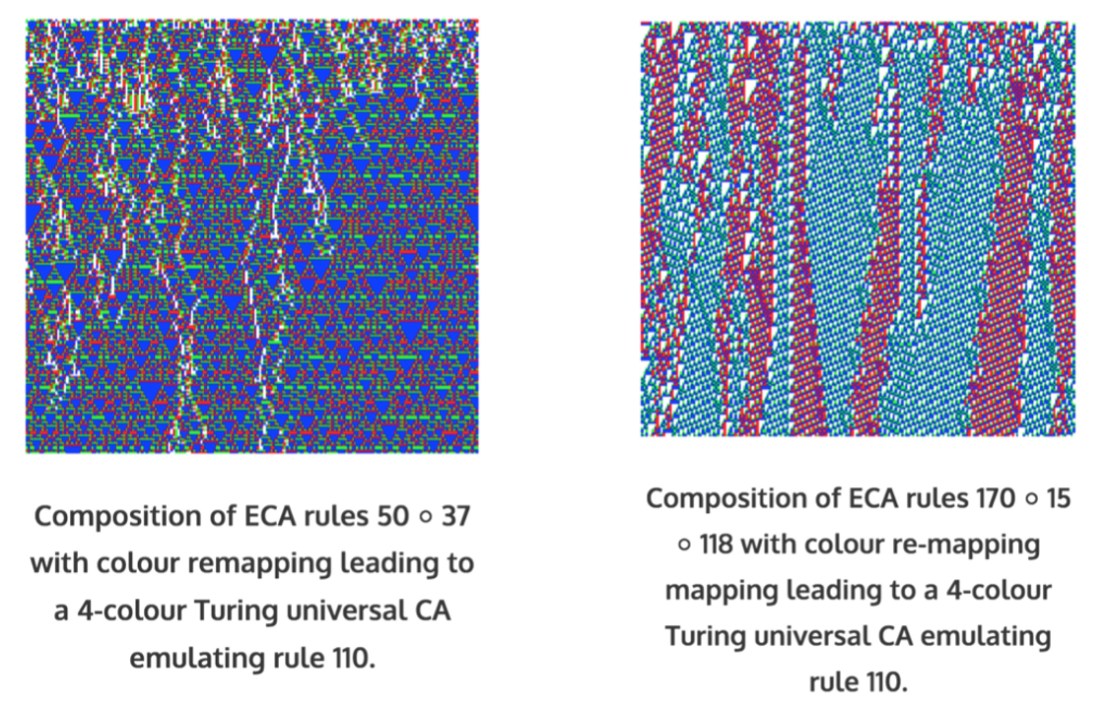
Rule Primality, Minimal Generating Sets and Turing-Universality in the Causal Decomposition of Elementary Cellular Automata

New Turing-universality results in Elementary Cellular Automata in recent published paper: "Rule Primality, Minimal Generating Sets and Turing-Universality in the Causal Decomposition of Elementary Cellular Automata" by Jürgen Riedel and Hector Zenil


New paper discovers and proves new universality results in ECA, namely, that the Boolean composition of ECA rules 51 and 118, and 170, 15 and 118 can emulate ECA rule 110 and are thus Turing-universal coupled systems. It is introduced a 4-colour Turing-universal cellular automaton that carries the Boolean composition of 2 and 3 ECA rules emulating ECA rule 110 under multi-scale coarse-graining. They find that rules generating the ECA rulespace by Boolean composition are of low complexity and comprise prime rules implementing basic operations that when composed enable complex behaviour. They also found a candidate minimal set with only 38 ECA prime rules — and several other small sets — capable of generating all other (non-trivially symmetric) 88 ECA rules under Boolean composition.

Source: www.oldcitypublishing.com

The Silent Cooperator: An Epigenetic Model for Emergence of Altruistic Traits in Biological Systems

Spatial evolutionary game theory explains how cooperative traits can survive the intense competition in biological systems. If the spatial distribution allows cooperators to interact with each other frequently, the benefits of cooperation will outweigh the losses due to exploitation by selfish organisms. However, for a cooperative behavior to get established in a system, it needs to be found initially in a sufficiently large cluster to allow a high frequency of intracooperator interactions. Since mutations are rare events, this poses the question of how cooperation can arise in a biological system in the first place. We present a simple model which captures two concepts from genetics that can explain how evolution overcomes the emergence problem. The first concept is, often in nature, a gene may not express its phenotype except under specific environmental conditions, rendering it to be a “silent” gene. The second key idea is that a neutral gene, one that does not harm or improve an organism’s survival chances, can still spread through a population if it is physically near to another gene that is positively selected. Through these two ideas, our model offers a possible solution to the fundamental problem of emergence of cooperation in biological systems.


The Silent Cooperator: An Epigenetic Model for Emergence of Altruistic Traits in Biological Systems
I. Hashem, D. Telen, P. Nimmegeers, and J. Van Impe

Complexity
Volume 2018, Article ID 2082037, 16 pages
https://doi.org/10.1155/2018/2082037

Source: www.hindawi.com