Author: cxdig

Train Global, Test Local: Privacy-preserving Learning of Cost-effectiveness in Decentralized Systems

The mandate of citizens for more socially responsible information systems that respect privacy and autonomy calls for a computational and storage decentral- ization. Crowd-sourced sensor networks monitor energy consumption and traffic jams. Distributed ledgers systems provide unprecedented opportunities to perform secure peer-to-peer transactions using blockchain. However, decentralized systems often show performance bottlenecks that undermine their broader adoption: prop- agating information in a network is costly and time-consuming. Optimization of cost-effectiveness with supervised machine learning is challenging. Training usu- ally requires privacy-sensitive local data, for instance, adjusting the communication rate based on citizens’ mobility. This paper studies the following research question: How feasible is to train with privacy-preserving aggregate data and test on local data to improve cost-effectiveness of a decentralized system? Centralized machine learning optimization strategies are applied to DIAS, the Dynamic Intelligent Aggre- gation Service and they are compared to decentralized self-adaptive strategies that use local data instead. Experimental evaluation with a testing set of 2184 decentral- ized networks of 3000 nodes aggregating real-world Smart Grid data confirms the feasibility of a linear regression strategy to improve both estimation accuracy and communication cost, while the other optimization strategies show trade-offs.


Train Global, Test Local: Privacy-preserving Learning of Cost-effectiveness in Decentralized Systems
Jovan Nikolic ́, Marcel Schöengens and Evangelos Pournaras

Source: evangelospournaras.com
“The Science of Success” Special Issue | Advances in Complex Systems

The increasing availability of digital data on human activities has led to the emergence of computational social science, a research field at the interface of computer science, mathematical modeling and social sciences. Among the concepts that have attracted much attention, we find "success". The premise of a science of success rests on observing that a difference exists between performance and success: Performance, representing the totality of objectively measurable achievements in a certain domain of activity, like the publication record of a scientist or the winning record of an athlete or a team, captures the actions of an individual entity. In contrast, success, captured by fame, celebrity, popularity, impact or visibility, is a collective measure, representing a community’s reaction to and acceptance of an individual entity’s performance. The link between these two measures, while is often taken for granted, is actually far from being understood and often controversial.


EDITORIAL
Roberta Sinatra and Renaud Lambiotte

Advances in Complex Systems Vol. 21, No. 03n04, 1802001 (2018) https://doi.org/10.1142/S0219525918020010

Source: www.worldscientific.com

Hot streaks in artistic, cultural, and scientific careers

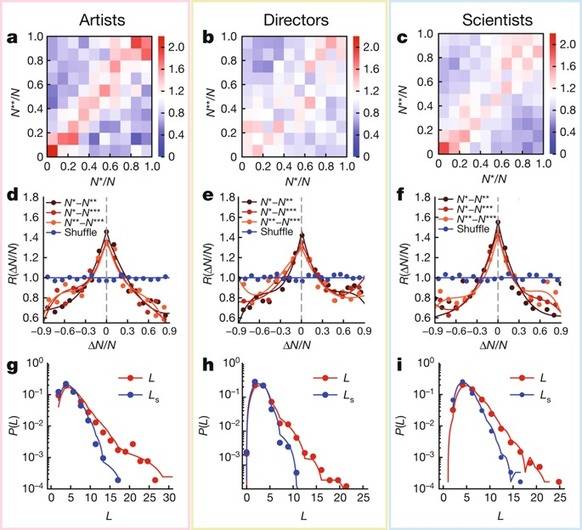
The hot streak—loosely defined as ‘winning begets more winnings’—highlights a specific period during which an individual’s performance is substantially better than his or her typical performance. Although hot streaks have been widely debated in sports, gambling and financial markets over the past several decades, little is known about whether they apply to individual careers. Here, building on rich literature on the lifecycle of creativity, we collected large-scale career histories of individual artists, film directors and scientists, tracing the artworks, films and scientific publications they produced. We find that, across all three domains, hit works within a career show a high degree of temporal regularity, with each career being characterized by bursts of high-impact works occurring in sequence. We demonstrate that these observations can be explained by a simple hot-streak model, allowing us to probe quantitatively the hot streak phenomenon governing individual careers. We find this phenomemon to be remarkably universal across diverse domains: hot streaks are ubiquitous yet usually unique across different careers. The hot streak emerges randomly within an individual’s sequence of works, is temporally localized, and is not associated with any detectable change in productivity. We show that, because works produced during hot streaks garner substantially more impact, the uncovered hot streaks fundamentally drive the collective impact of an individual, and ignoring this leads us to systematically overestimate or underestimate the future impact of a career. These results not only deepen our quantitative understanding of patterns that govern individual ingenuity and success, but also may have implications for identifying and nurturing individuals whose work will have lasting impact.


Hot streaks in artistic, cultural, and scientific careers
Lu Liu, Yang Wang, Roberta Sinatra, C. Lee Giles, Chaoming Song & Dashun Wang 
Nature volume 559, pages 396–399 (2018)

Source: www.nature.com

The future of hyperdiverse tropical ecosystems

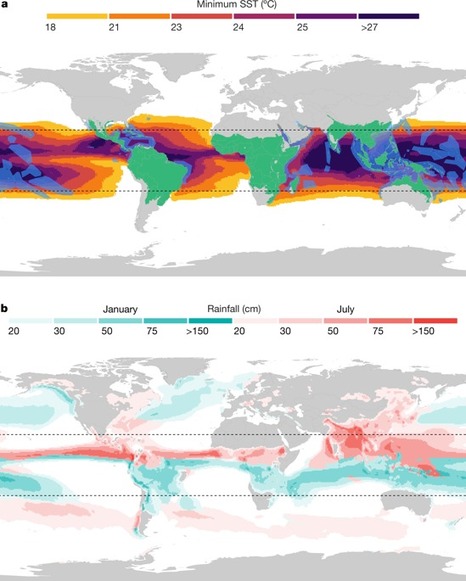
The tropics contain the overwhelming majority of Earth’s biodiversity: their terrestrial, freshwater and marine ecosystems hold more than three-quarters of all species, including almost all shallow-water corals and over 90% of terrestrial birds. However, tropical ecosystems are also subject to pervasive and interacting stressors, such as deforestation, overfishing and climate change, and they are set within a socio-economic context that includes growing pressure from an increasingly globalized world, larger and more affluent tropical populations, and weak governance and response capacities. Concerted local, national and international actions are urgently required to prevent a collapse of tropical biodiversity.


The future of hyperdiverse tropical ecosystems
Jos Barlow, et al.
Nature volume 559, pages 517–526 (2018)

Source: www.nature.com