Author: cxdig

Key Features of Turing Systems are Determined Purely by Network Topology

Turing’s theory of pattern formation is a universal model for self-organization, applicable to many systems in physics, chemistry, and biology. Essential properties of a Turing system, such as the conditions for the existence of patterns and the mechanisms of pattern selection, are well understood in small networks. However, a general set of rules explaining how network topology determines fundamental system properties and constraints has not been found. Here we provide a first general theory of Turing network topology, which proves why three key features of a Turing system are directly determined by the topology: the type of restrictions that apply to the diffusion rates, the robustness of the system, and the phase relations of the molecular species.


Key Features of Turing Systems are Determined Purely by Network Topology

Xavier Diego, Luciano Marcon, Patrick Müller, and James Sharpe
Phys. Rev. X 8, 021071

Source: journals.aps.org

Complexity Explorables | I herd you!

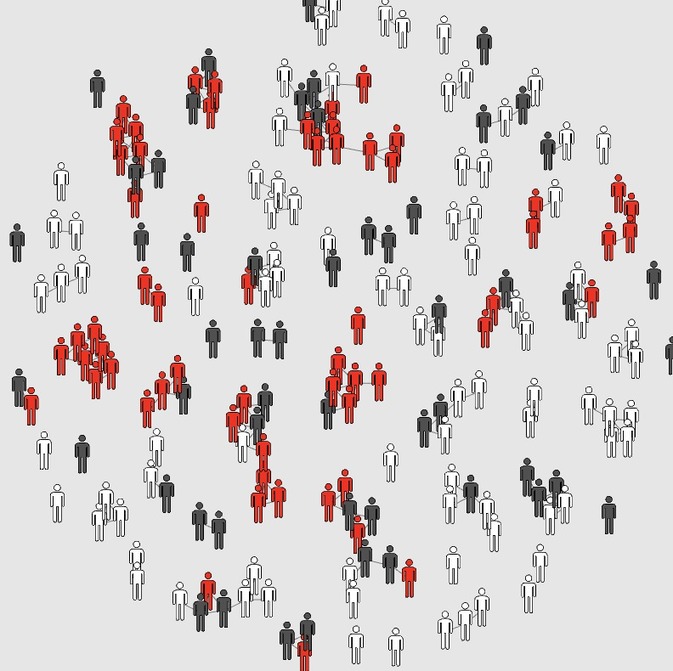
This explorable illustrates the mechanism of herd immunity. When an infectious disease spreads in a population, an individual can be protected by a vaccine that delivers immunity. But there’s a greater good. Immunization not only projects the individual directly. The immunized person will also never transmit the disease to others, effectively reducing the likelihood that the disease can proliferate in the population. Because of this, a disease can be eradicated even if not the entire population is immunized. This population wide effect is known as herd immunity.

Source: www.complexity-explorables.org

Optimized flocking of autonomous drones in confined environments

We address a fundamental issue of collective motion of aerial robots: how to ensure that large flocks of autonomous drones seamlessly navigate in confined spaces. The numerous existing flocking models are rarely tested on actual hardware because they typically neglect some crucial aspects of multirobot systems. Constrained motion and communication capabilities, delays, perturbations, or the presence of barriers should be modeled and treated explicitly because they have large effects on collective behavior during the cooperation of real agents. Handling these issues properly results in additional model complexity and a natural increase in the number of tunable parameters, which calls for appropriate optimization methods to be coupled tightly to model development. In this paper, we propose such a flocking model for real drones incorporating an evolutionary optimization framework with carefully chosen order parameters and fitness functions. We numerically demonstrated that the induced swarm behavior remained stable under realistic conditions for large flock sizes and notably for large velocities. We showed that coherent and realistic collective motion patterns persisted even around perturbing obstacles. Furthermore, we validated our model on real hardware, carrying out field experiments with a self-organized swarm of 30 drones. This is the largest of such aerial outdoor systems without central control reported to date exhibiting flocking with collective collision and object avoidance. The results confirmed the adequacy of our approach. Successfully controlling dozens of quadcopters will enable substantially more efficient task management in various contexts involving drones.


Optimized flocking of autonomous drones in confined environments
Gábor Vásárhelyi, Csaba Virágh, Gergő Somorjai, Tamás Nepusz, Agoston E. Eiben and Tamás Vicsek
Science Robotics  18 Jul 2018:
Vol. 3, Issue 20, eaat3536
DOI: 10.1126/scirobotics.aat3536

Source: robotics.sciencemag.org

General complexity: A philosophical and critical perspective

In this paper we argue that a rigorous understanding of the nature and implications of complexityreveals that the underlying assumptions that inform our understanding of complex phenomena are deeply related to general philosophical issues. We draw on a very specific philosophical interpretation of complexity, as informed by the work of Paul Cilliers and Edgar Morin. This interpretation of complexity, we argue, resonates with specific themes in post-structural philosophy in general, and deconstruction in particular. We argue that post-structural terms such as différance carry critical insights into furthering our understanding of complexity. The defining feature that distinguishes the account of complexity offered here to other contemporary theories of complexity is the notion of critique. The critical imperative that can be located in a philosophical interpretation of complexity exposes the limitations of totalising theories and subsequently calls for examining the normativity inherent in the knowledge claims that we make. The conjunction of complexity and post-structuralism inscribes a critical-emancipatory impetus into the complexity approach that is missing from othertheories of complexity. We therefore argue for the importance of critical complexity against reductionist or restricted understandings of complexity.


General complexity: A philosophical and critical perspective. Emergence: Complexity and Organization.
June 2018
DOI: 10.emerg/10.17357.c9734094d98458109d25b79d546318af.
Rika Preiser, Minka  Woermann, Oliver Human


Source: www.researchgate.net