
Author: cxdig

Evidence for a conserved quantity in human mobility

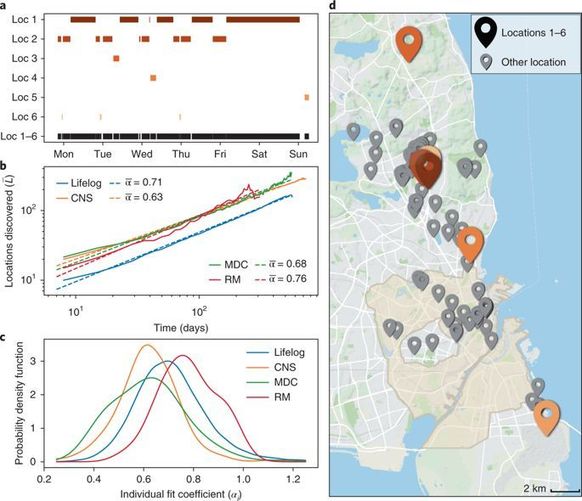
Recent seminal works on human mobility have shown that individuals constantly exploit a small set of repeatedly visited locations1,2,3. A concurrent study has emphasized the explorative nature of human behaviour, showing that the number of visited places grows steadily over time4,5,6,7. How to reconcile these seemingly contradicting facts remains an open question. Here, we analyse high-resolution multi-year traces of ~40,000 individuals from 4 datasets and show that this tension vanishes when the long-term evolution of mobility patterns is considered. We reveal that mobility patterns evolve significantly yet smoothly, and that the number of familiar locations an individual visits at any point is a conserved quantity with a typical size of ~25. We use this finding to improve state-of-the-art modelling of human mobility4,8. Furthermore, shifting the attention from aggregated quantities to individual behaviour, we show that the size of an individual’s set of preferred locations correlates with their number of social interactions. This result suggests a connection between the conserved quantity we identify, which as we show cannot be understood purely on the basis of time constraints, and the ‘Dunbar number’9,10 describing a cognitive upper limit to an individual’s number of social relations. We anticipate that our work will spark further research linking the study of human mobility and the cognitive and behavioural sciences.


Evidence for a conserved quantity in human mobility
Laura Alessandretti, Piotr Sapiezynski, Vedran Sekara, Sune Lehmann & Andrea Baronchelli 
Nature Human Behaviour volume 2, pages 485–491 (2018)

Source: www.nature.com
Breaking free: freedom, peace and prosperity | Dirk Helbing | TEDxVarese

Source: www.youtube.com

See Also:

https://www.youtube.com/watch?v=u-TCsFNnj54 

https://www.youtube.com/watch?v=rxfwNTwzyCw 

https://www.youtube.com/watch?v=uLWoeCwZHGk 

https://www.youtube.com/watch?v=MuTRpKmbAgk 

https://www.youtube.com/watch?v=M6lLfeLOlbA 

https://www.youtube.com/watch?v=Hdb1wMTxIxc 

A dynamical systems approach to gross domestic product forecasting

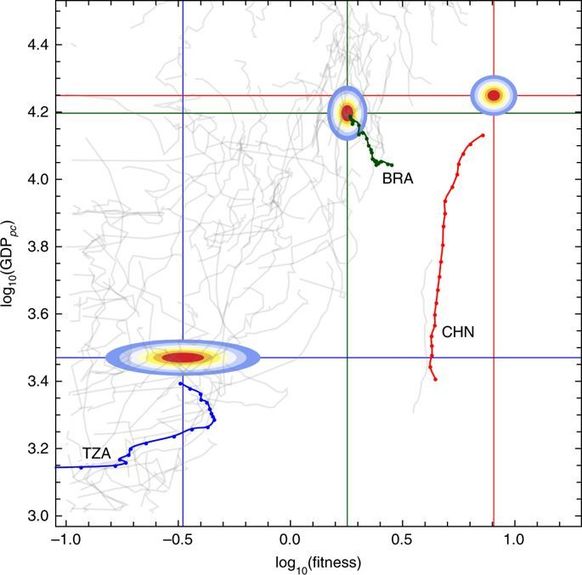
Models developed for gross domestic product (GDP) growth forecasting tend to be extremely complex, relying on a large number of variables and parameters. Such complexity is not always to the benefit of the accuracy of the forecast. Economic complexity constitutes a framework that builds on methods developed for the study of complex systems to construct approaches that are less demanding than standard macroeconomic ones in terms of data requirements, but whose accuracy remains to be systematically benchmarked. Here we develop a forecasting scheme that is shown to outperform the accuracy of the five-year forecast issued by the International Monetary Fund (IMF) by more than 25% on the available data. The model is based on effectively representing economic growth as a two-dimensional dynamical system, defined by GDP per capita and ‘fitness’, a variable computed using only publicly available product-level export data. We show that forecasting errors produced by the method are generally predictable and are also uncorrelated to IMF errors, suggesting that our method is extracting information that is complementary to standard approaches. We believe that our findings are of a very general nature and we plan to extend our validations on larger datasets in future works.


A dynamical systems approach to gross domestic product forecasting
A. Tacchella, D. Mazzilli & L. Pietronero
Nature Physicsvolume 14, pages 861–865 (2018)

Source: www.nature.com

Does putting your emotions into words make you feel better? Measuring the minute-scale dynamics of emotions from online data

Studies of affect labeling, i.e. putting your feelings into words, indicate that it can attenuate positive and negative emotions. Here we track the evolution of individual emotions for tens of thousands of Twitter users by analyzing the emotional content of their tweets before and after they explicitly report having a strong emotion. Our results reveal how emotions and their expression evolve at the temporal resolution of one minute. While the expression of positive emotions is preceded by a short but steep increase in positive valence and followed by short decay to normal levels, negative emotions build up more slowly, followed by a sharp reversal to previous levels, matching earlier findings of the attenuating effects of affect labeling. We estimate that positive and negative emotions last approximately 1.25 and 1.5 hours from onset to evanescence. A separate analysis for male and female subjects is suggestive of possible gender-specific differences in emotional dynamics.


Does putting your emotions into words make you feel better? Measuring the minute-scale dynamics of emotions from online data

Rui Fan, Ali Varamesh, Onur Varol, Alexander Barron, Ingrid van de Leemput, Marten Scheffer, Johan Bollen

Source: arxiv.org

Rule Primality, Minimal Generating Sets and Turing-Universality in the Causal Decomposition of Elementary Cellular Automata

New Universality results in Elementary Cellular Automata by emulation of Rule 110 just published by the Journal of Cellular Automata: https://goo.gl/vWQsCk . Also available at: https://arxiv.org/abs/1802.08769  includes a minimal set of only 38 ECAs generating all others under composition and 2 new Turing universal 4-colour cellular automata.


"We introduce several concepts such as prime and composite rule, tools and methods for causal composition and decomposition. We discover and prove new universality results in ECA, namely, that the Boolean composition of ECA rules 51 and 118, and 170, 15 and 118 can emulate ECA rule 110 and are thus Turing-universal coupled systems. We construct two 4-colour Turing-universal cellular automata that carries the Boolean composition of the 2 and 3 ECA rules emulating ECA rule 110 under multi-scale coarse-graining. We find that rules generating the ECA rulespace by Boolean composition are of low complexity and comprise prime rules implementing basic operations that when composed enable complex behaviour. We also found a candidate minimal set with only 38 ECA prime rules — and several other small sets — capable of generating all other (non-trivially symmetric) 88 ECA rules under Boolean composition."

Source: www.oldcitypublishing.com