Author: cxdig

Robot Collection and Transport of Objects: A Biomimetic Process

Animals as diverse as ants and humans are faced with the tasks of collecting, transporting or herding objects. Sheepdogs do this daily when they collect, herd, and maneuver flocks of sheep. Here, we adapt a shepherding algorithm inspired by sheepdogs to collect and transport objects using a robot. Our approach produces an effective robot collection process that autonomously adapts to changing environmental conditions and is robust to noise from various sources. We suggest that this biomimetic process could be implemented into suitable robots to perform collection and transport tasks that might include – for example – cleaning up objects in the environment, keeping animals away from sensitive areas or collecting and herding animals to a specific location. Furthermore, the feedback controlled interactions between the robot and objects which we study can be used to interrogate and understand the local and global interactions of real animal groups, thus offering a novel methodology of value to researchers studying collective animal behavior.


Robot Collection and Transport of Objects: A Biomimetic Process

Daniel Strömbom and Andrew J. King

Front. Robot. AI, 18 May 2018 | https://doi.org/10.3389/frobt.2018.00048

Source: www.frontiersin.org
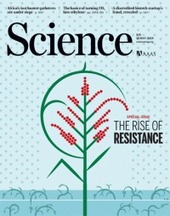
Meeting resistance

Almost as soon as antibiotics were discovered to be valuable in medicine, resistance emerged among bacteria. Whenever mutating or recombining organisms are faced with extirpation, those individuals with variations that avert death will survive and reproduce to take over the population. This can happen rapidly among organisms that reproduce fast and outpace our efforts to combat them. Thus, our use of chemical entities to rid ourselves of clinical, domestic, and agricultural pathogens and pests has selected for resistance.

Today, we find ourselves at the nexus of an alarming acceleration of resistance to antibiotics, insecticides, and herbicides. Through chemical misuse, resistance also brings widespread collateral damage to natural, social, and economic systems. Resistance to antifungal agents poses a particular challenge because a limited suite of chemicals is used in both agricultural and clinical settings.


INTRODUCTION TO SPECIAL ISSUE
Meeting resistance
Caroline Ash

Science  18 May 2018:
Vol. 360, Issue 6390, pp. 726-727
DOI: 10.1126/science.360.6390.726

Source: science.sciencemag.org

5th IEEE International Conference on Data Science and Advanced Analytics

The IEEE International Conference on Data Science and Advanced Analytics (DSAA) aims to be the flagship annual meeting spanning the interdisciplinary field of Data Science. DSAA focuses on the science of data science, as well as the implications of the science for applications to industry, government, and society. From the science side, DSAA spans all of the component fields of data science, including statistics, probabilistic and mathematical modeling, machine learning, data mining and knowledge discovery, complexity science, network science, business analytics, data management, infrastructure and storage, retrieval and search, security, privacy and ethics. From the applications side, DSAA aims both to show researchers important problems and issues that are revealed by real applications, and to show practitioners and users how the science can be applied to realize value. DSAA is intended to reflect the interdisciplinary nature of data science and analytics, as an alternative to the highly specialized disciplinary conferences.


October 1-4, 2018

Torino, Italy

Source: dsaa2018.isi.it

CSS Junior Scientific Awards 2018

The CSS promotes the Junior Scientific Award to recognize the excellence in the scientific career of young CSS members. It will be awarded once a year to a maximum of two young researchers (up to ten years after PhD completion) who have achieved outstanding results in complexity science in any of the areas representative of the CSS.

Source: cssociety.org