Author: cxdig

Surprise finding points to DNA’s role in shaping cells

As a basic unit of life, the cell is one of the most carefully studied components of all living organisms. Yet details on basic processes such as how cells are shaped have remained a mystery. Working at the intersection of biology and physics, scientists at the University of California San Diego have made an unexpected discovery at the root of cell formation.

Source: phys.org

AI and Beyond

A practical guide for decision makers to the transformation of business
Artificial intelligence is changing the fundamentals of business. There are new ways to improve performance and new business opportunities. As AI is adopted the role of human beings will change. Understanding how to chart this transition is increasingly central to entrepreneurs, executives and the organizations they lead. What functions do you fully automate with AI, what functions do you augment with AI, and what functions should rely on human intelligence? Complex systems science reveals the different and complementary strengths of human and artificial intelligence, and how they can be combined for performance advantage in business.


Featured Presenters:
Iyad Rahwan
Stephen Wolfram
Yaneer Bar-Yam
Alfredo J. Morales


February 26 to March 2 in Cambridge, MA

Source: necsi.edu

Evolving Ecosystems: Inheritance and Selection in the Light of the Microbiome

The importance of microorganisms in human biology is undeniable. The amount of research that supports that microbes have a fundamental role in animal and plant physiology is substantial and increasing every year. Even though we are only beginning to comprehend the broadness and complexity of microbial communities, evolutionary theories need to be recast in the light of such discoveries to fully understand and incorporate the role of microbes in our evolution. Fundamental evolutionary concepts such as diversity, heredity, selection, speciation, etc., which constitute the modern synthesis, are now being challenged, or at least expanded, by the emerging notion of the holobiont, which defines the genetic and metabolic networks of the host and its microbes as a single evolutionary unit. Several concepts originally developed to study ecosystems, can be used to understand the physiology and evolution of such complex systems that constitute “individuals.” In this review, we discuss these ecological concepts and also provide examples that range from squids, insects and koalas to other mammals and humans, suggesting that microorganisms have a fundamental role not only in physiology but also in evolution. Current evolutionary theories need to take into account the dynamics and interconnectedness of the host-microbiome network, as animals and plants not only owe their symbiogenetic origin to microbes, but also share a long evolutionary history together.


Evolving Ecosystems: Inheritance and Selection in the Light of the Microbiome

Santiago Sandoval-Motta, Maximino Aldana, Alejandro Frank

Archives of Medical Research

https://doi.org/10.1016/j.arcmed.2018.01.002

Source: www.arcmedres.com

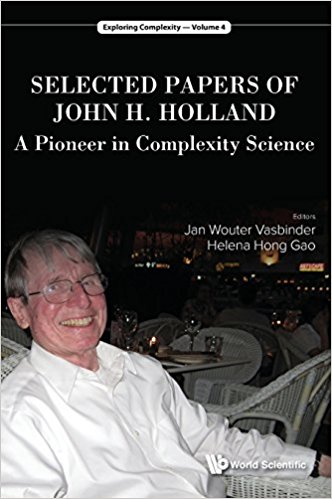
Selected Papers Of John H. Holland: A Pioneer In Complexity Science

With his work on computer logic, John H Holland became one of the most important founders of modern computer science. People who knew John H Holland were all amazed and deeply influenced by his incredibly imaginative and creative mind. He produced many more ideas than he could follow up in his life time. This selection of his papers in the field of computer logic entails many of his explored and unexplored ideas. Revisiting the explored ideas and exploring the unexplored ones should be of great interest to scientists of all ages, and of great value to the current research not only in computer science but in many other fields as well.

Source: www.amazon.com

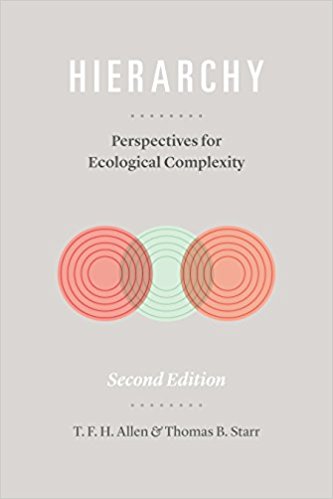
Hierarchy: Perspectives for Ecological Complexity (by T. F. H. Allen & Thomas B. Starr)

Although complexity surrounds us, its inherent uncertainty, ambiguity, and contradiction can at first make complex systems appear inscrutable. Ecosystems, for instance, are nonlinear, self-organizing, seemingly chaotic structures in which individuals interact both with each other and with the myriad biotic and abiotic components of their surroundings across geographies as well as spatial and temporal scales. In the face of such complexity, ecologists have long sought tools to streamline and aggregate information. Among them, in the 1980s, T. F. H. Allen and Thomas B. Starr implemented a burgeoning concept from business administration: hierarchy theory. Cutting-edge when Hierarchy was first published, their approach to unraveling complexity is now integrated into mainstream ecological thought.

This thoroughly revised and expanded second edition of Hierarchy reflects the assimilation of hierarchy theory into ecological research, its successful application to the understanding of complex systems, and the many developments in thought since. Because hierarchies and levels are habitual parts of human thinking, hierarchy theory has proven to be the most intuitive and tractable vehicle for addressing complexity. By allowing researchers to look explicitly at only the entities and interconnections that are relevant to a specific research question, hierarchically informed data analysis has enabled a revolution in ecological understanding. With this new edition of Hierarchy, that revolution continues.

Source: www.amazon.com