Author: cxdig

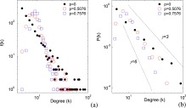
Generating clustered scale-free networks using Poisson based localization of edges

  • We introduce a variety of methods for generating clustered scale-free networks.
  • The Watts-Strogatz model is verified by reverse way.
  • Connections to spatially closer neighbors are promoted by Poisson based rewiring.
  • Barabasi-Albert model is rewired to have more local connections.
  • Growing clustered scale-free models with simple but efficient approaches are introduced.


Generating clustered scale-free networks using Poisson based localization of edges
İlker Türker

Physica A: Statistical Mechanics and its Applications

Source: www.sciencedirect.com

Tenure-track Research Professor in Data Science at UNAM Mérida

The Computer Science Department of the Instituto de Investigaciones en Matemáticas Aplicadas y en Sistemas (IIMAS) of the Universidad Nacional Autónoma de México (UNAM) has a open call for a research professor in data science for the new UNAM campus in Mérida, Yucatán. This position, aimed at young researchers, consists of renewable one-year contracts with the possibility of tenure after three years.

Source: complexes.blogspot.mx

Editorial: Metastable Dynamics of Neural Ensembles

A classical view of neural computation is that it can be characterized in terms of convergence to fixed-point-type attractor states (representing for instance memory patterns in Hopfield, 1982) or limit-cycle-like sequential transitions among states (mapping e.g., motor or syntactical sequences in Elman, 1990). After over three decades, is this still a valid model of how brain dynamics implements cognition? The idea that neuro-computational dynamics is mainly deterministically driven by convergence to emergent stable states in a synaptic/network noisy background has been lively debated, and recently challenged both empirically and by computational work. This question touches on the very basics of our understanding of neural computation; and hence it is one of the most exciting topics currently in systems and computational neuroscience.

This e-book comprises a comprehensive collection of recent theoretical and experimental contributions addressing the question of stable versus transient neural population dynamics, and its implications for the observed variability in neural activity, from diverse, complementary angles.


Editorial: Metastable Dynamics of Neural Ensembles
Emili Balaguer-Ballester, Ruben Moreno-Bote, Gustavo Deco, and Daniel Durstewitz

Front. Syst. Neurosci., 26 January 2018 | https://doi.org/10.3389/fnsys.2017.00099

Source: www.frontiersin.org

Social Mixing and Home–Work Carpooling

Shared mobility is widely recognized for its contribution in reducing carbon footprint, traffic congestion, parking needs and transportation-related costs in urban and suburban areas. In this context, the use of carpooling in home-work commute is particularly appealing for its potential of lessening the number of cars and kilometers traveled, consequently reducing major causes of traffic in cities. Accordingly, most of the carpooling algorithms are optimized for reducing total travel time, cost, and other transportation-related metrics. In this paper, the authors analyze the benefits of carpooling from a new angle, posing it as a possible means for favoring social integration in the city by matching carpoolers taking into account some of their social characteristics. Building upon a recently introduced network-based approach to model ride-sharing opportunities, the authors define two social-related carpooling problems: how to maximize the number of rides shared between people belonging to different social groups, and how to maximize the amount of time people spend together along the ride. For each of the problems, the authors provide corresponding optimal and computationally efficient solutions. The authors then demonstrate their approach on two data sets collected in the city of Pisa, Italy, and Cambridge, US, and quantify the potential social benefits of carpooling, and how they can be traded off with traditional transportation-related metrics. When collectively considered, the models, algorithms, and results presented in this paper broaden the perspective from which carpooling problems are typically analyzed to encompass multiple disciplines including urban planning, public policy, and social sciences.

Source: trid.trb.org

Dynamic Structure of Competition Networks in Affordable Care Act Insurance Market


“Stimulating competition is one of the main topics in most health care reform debates, and it has been a central issue in the Affordable Care Act in the United States since 2009. The goal of this paper is to use complex network methods to study dynamic and structure of competition under Affordable Care Act (ACA) and its evolution over time since its beginning until 2017. Using publicly available data, we construct a bipartite network of counties and insurance providers, create associated weighted single-mode networks, and analyze the evolution of network parameters that are related to competition and potential collusion in complex networks. These parameters have been previously tied to dynamics of collaboration and competition in earlier theoretical works. We argue that three parameters, namely network modularity, and eigenvector centrality mean and skewness are appropriate indicators of the overall competition in the insurance market. Based on these parameters, we show that the level of systemic competition among insurers as a function of time is an inverse U-shape trend, and that competition has returned back to what it was at the very beginning of ACA, indicating an undesirable resilience in the national health care system.”


Dynamic Structure of Competition Networks in Affordable Care Act Insurance Market

David A Gianetto;  Mohsen Mosleh;  Babak Heydari

IEEE Access

DOI: 10.1109/ACCESS.2018.2800659

Source: ieeexplore.ieee.org