
Author: cxdig

The shape of collaborations

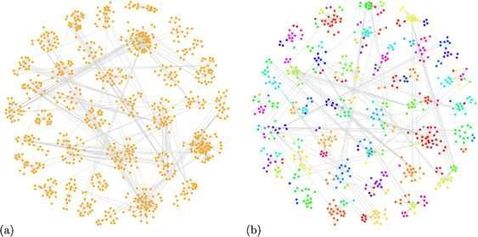
The structure of scientific collaborations has been the object of intense study both for its importance for innovation and scientific advancement, and as a model system for social group coordination and formation thanks to the availability of authorship data. Over the last years, complex networks approach to this problem have yielded important insights and shaped our understanding of scientific communities. In this paper we propose to complement the picture provided by network tools with that coming from using simplicial descriptions of publications and the corresponding topological methods. We show that it is natural to extend the concept of triadic closure to simplicial complexes and show the presence of strong simplicial closure. Focusing on the differences between scientific fields, we find that, while categories are characterized by different collaboration size distributions, the distributions of how many collaborations to which an author is able to participate is conserved across fields pointing to underlying attentional and temporal constraints. We then show that homological cycles, that can intuitively be thought as hole in the network fabric, are an important part of the underlying community linking structure.


The shape of collaborations
Alice PataniaEmail authorView ORCID ID profile, Giovanni Petri and Francesco Vaccarino
EPJ Data Science20176:18
https://doi.org/10.1140/epjds/s13688-017-0114-8

Source: epjdatascience.springeropen.com
Data-driven modeling of collaboration networks: a cross-domain analysis

We analyze large-scale data sets about collaborations from two different domains: economics, specifically 22,000 R&D alliances between 14,500 firms, and science, specifically 300,000 co-authorship relations between 95,000 scientists. Considering the different domains of the data sets, we address two questions: (a) to what extent do the collaboration networks reconstructed from the data share common structural features, and (b) can their structure be reproduced by the same agent-based model. In our data-driven modeling approach we use aggregated network data to calibrate the probabilities at which agents establish collaborations with either newcomers or established agents. The model is then validated by its ability to reproduce network features not used for calibration, including distributions of degrees, path lengths, local clustering coefficients and sizes of disconnected components. Emphasis is put on comparing domains, but also sub-domains (economic sectors, scientific specializations). Interpreting the link probabilities as strategies for link formation, we find that in R&D collaborations newcomers prefer links with established agents, while in co-authorship relations newcomers prefer links with other newcomers. Our results shed new light on the long-standing question about the role of endogenous and exogenous factors (i.e., different information available to the initiator of a collaboration) in network formation.


Data-driven modeling of collaboration networks: a cross-domain analysis
Mario V Tomasello, Giacomo VaccarioEmail authorView ORCID ID profile and Frank Schweitzer
EPJ Data Science20176:22
https://doi.org/10.1140/epjds/s13688-017-0117-5

Source: epjdatascience.springeropen.com
Estimating local commuting patterns from geolocated Twitter data

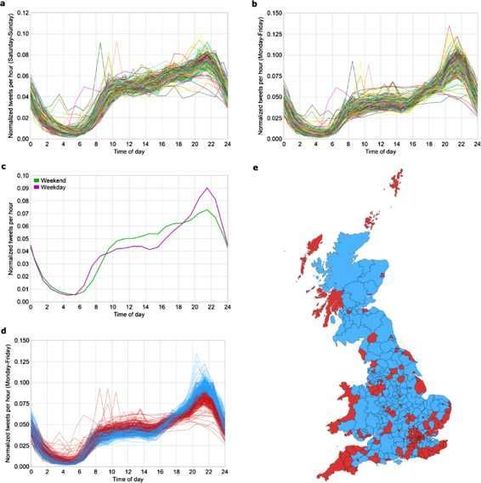
The emergence of large stores of transactional data generated by increasing use of digital devices presents a huge opportunity for policymakers to improve their knowledge of the local environment and thus make more informed and better decisions. A research frontier is hence emerging which involves exploring the type of measures that can be drawn from data stores such as mobile phone logs, Internet searches and contributions to social media platforms and the extent to which these measures are accurate reflections of the wider population. This paper contributes to this research frontier, by exploring the extent to which local commuting patterns can be estimated from data drawn from Twitter. It makes three contributions in particular. First, it shows that heuristics applied to geolocated Twitter data offer a good proxy for local commuting patterns; one which outperforms the current best method for estimating these patterns (the radiation model). This finding is of particular significance because we make use of relatively coarse geolocation data (at the city level) and use simple heuristics based on frequency counts. Second, it investigates sources of error in the proxy measure, showing that the model performs better on short trips with higher volumes of commuters; it also looks at demographic biases but finds that, surprisingly, measurements are not significantly affected by the fact that the demographic makeup of Twitter users differs significantly from the population as a whole. Finally, it looks at potential ways of going beyond simple frequency heuristics by incorporating temporal information into models.


Estimating local commuting patterns from geolocated Twitter data
Graham McNeill, Jonathan Bright, and Scott A Hale

EPJ Data Science 2017 6:24

https://doi.org/10.1140/epjds/s13688-017-0120-x

Source: epjdatascience.springeropen.com
Rapid rise and decay in petition signing

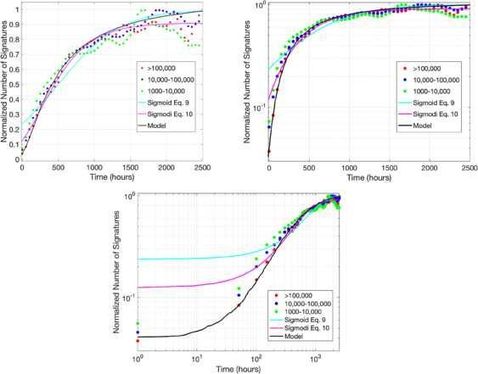
Contemporary collective action, much of which involves social media and other Internet-based platforms, leaves a digital imprint which may be harvested to better understand the dynamics of mobilization. Petition signing is an example of collective action which has gained in popularity with rising use of social media and provides such data for the whole population of petition signatories for a given platform. This paper tracks the growth curves of all 20,000 petitions to the UK government petitions website (http://epetitions.direct.gov.uk) and 1,800 petitions to the US White House site (https://petitions.whitehouse.gov), analyzing the rate of growth and outreach mechanism. Previous research has suggested the importance of the first day to the ultimate success of a petition, but has not examined early growth within that day, made possible here through hourly resolution in the data. The analysis shows that the vast majority of petitions do not achieve any measure of success; over 99 percent fail to get the 10,000 signatures required for an official response and only 0.1 percent attain the 100,000 required for a parliamentary debate (0.7 percent in the US). We analyze the data through a multiplicative process model framework to explain the heterogeneous growth of signatures at the population level. We define and measure an average outreach factor for petitions and show that it decays very fast (reducing to 0.1% after 10 hours in the UK and 30 hours in the US). After a day or two, a petition’s fate is virtually set. The findings challenge conventional analyses of collective action from economics and political science, where the production function has been assumed to follow an S-shaped curve.


Rapid rise and decay in petition signing
Taha YasseriEmail author, Scott A Hale and Helen Z Margetts
EPJ Data Science20176:20
https://doi.org/10.1140/epjds/s13688-017-0116-6

Source: epjdatascience.springeropen.com
The 2017 Nobel Prize in Chemistry

We may soon have detailed images of life’s complex machineries in atomic resolution. The Nobel Prize in Chemistry 2017 is awarded to Jacques Dubochet, Joachim Frank and Richard Henderson for the development of cryo-electron microscopy, which both simplifies and improves the imaging of biomolecules. This method has moved biochemistry into a new era.

A picture is a key to understanding. Scientific breakthroughs often build upon the successful visualisation of objects invisible to the human eye. However, biochemical maps have long been filled with blank spaces because the available technology has had difficulty generating images of much of life’s molecular machinery. Cryo-electron microscopy changes all of this. Researchers can now freeze biomolecules mid-movement and visualise processes they have never previously seen, which is decisive for both the basic understanding of life’s chemistry and for the development of pharmaceuticals.

Electron microscopes were long believed to only be suitable for imaging dead matter, because the powerful electron beam destroys biological material. But in 1990, Richard Henderson succeeded in using an electron microscope to generate a three-dimensional image of a protein at atomic resolution. This breakthrough proved the technology’s potential.

Joachim Frank made the technology generally applicable. Between 1975 and 1986 he developed an image processing method in which the electron microscope’s fuzzy twodimensional images are analysed and merged to reveal a sharp three-dimensional structure.

Jacques Dubochet added water to electron microscopy. Liquid water evaporates in the electron microscope’s vacuum, which makes the biomolecules collapse. In the early 1980s, Dubochet succeeded in vitrifying water – he cooled water so rapidly that it solidified in its liquid form around a biological sample, allowing the biomolecules to retain their natural shape even in a vacuum.

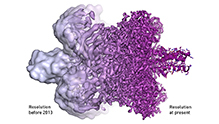
Following these discoveries, the electron microscope’s every nut and bolt have been optimised. The desired atomic resolution was reached in 2013, and researchers can now routinely produce three-dimensional structures of biomolecules. In the past few years, scientific literature has been filled with images of everything from proteins that cause antibiotic resistance, to the surface of the Zika virus. Biochemistry is now facing an explosive development and is all set for an exciting future.

Source: www.nobelprize.org