Author: cxdig

The origins of intelligent life

In his ambitious book Life Through Time and Space, Wallace Arthur tack­les an extraordinarily difficult set of topics. What is the origin and fate of the universe? How did life, and eventually intelligent life, come into existence on Earth? How does a fertilized human egg trans­form into a complex person with only DNA to guide development?


The origins of intelligent life
Marcos Huerta
Life Through Time and Space Wallace Arthur Harvard University Press, 2017. 289 pp.
Science  11 Aug 2017:
Vol. 357, Issue 6351, pp. 556
DOI: 10.1126/science.aao0931

Source: science.sciencemag.org

Complexity of evolutionary equilibria in static fitness landscapes

Experiments show that fitness landscapes can have a rich combinatorial structure due to epistasis and yet theory assumes that local peaks can be reached quickly. I introduce a distinction between easy landscapes where local fitness peaks can be found in a moderate number of steps and hard landscapes where finding evolutionary equilibria requires an infeasible amount of time. Hard examples exist even among landscapes with no reciprocal sign epistasis; on these, strong selection weak mutation dynamics cannot find the unique peak in polynomial time. On hard rugged fitness landscapes, no evolutionary dynamics — even ones that do not follow adaptive paths — can find a local fitness peak quickly; and the fitness advantage of nearby mutants cannot drop off exponentially fast but has to follow a power-law that long term evolution experiments have associated with unbounded growth in fitness. I present candidates for hard landscapes at scales from singles genes, to microbes, to complex organisms with costly learning (Baldwin effect). Even though hard landscapes are static and finite, local evolutionary equilibrium cannot be assumed.

Source: www.biorxiv.org

Reliable uncertainties in indirect measurements

In this article we present very intuitive, easy to follow, yet mathematically rigorous, approach to the so called data fitting process. Rather than minimizing the distance between measured and simulated data points, we prefer to find such an area in searched parameters’ space that generates simulated curve crossing as many acquired experimental points as possible, but at least half of them. Such a task is pretty easy to attack with interval calculations. The problem is, however, that interval calculations operate on guaranteed intervals, that is on pairs of numbers determining minimal and maximal values of measured quantity while in vast majority of cases our measured quantities are expressed rather as a pair of two other numbers: the average value and its standard deviation. Here we propose the combination of interval calculus with basic notions from probability and statistics. This approach makes possible to obtain the results in familiar form as reliable values of searched parameters, their standard deviations, and their correlations as well. There are no assumptions concerning the probability density distributions of experimental values besides the obvious one that their variances are finite. Neither the symmetry of uncertainties of experimental distributions is required (assumed) nor those uncertainties have to be `small.’ As a side effect, outliers are quietly and safely ignored, even if numerous.


Reliable uncertainties in indirect measurements
Marek W. Gutowski

Source: arxiv.org

The 2017 Nobel Prize in Physics

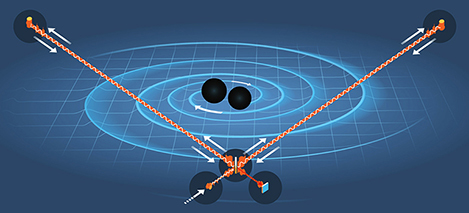
On 14 September 2015, the universe’s gravitational waves were observed for the very first time. The waves, which were predicted by Albert Einstein a hundred years ago, came from a collision between two black holes. It took 1.3 billion years for the waves to arrive at the LIGO detector in the USA.

The signal was extremely weak when it reached Earth, but is already promising a revolution in astrophysics. Gravitational waves are an entirely new way of observing the most violent events in space and testing the limits of our knowledge.

LIGO, the Laser Interferometer Gravitational-Wave Observatory, is a collaborative project with over one thousand researchers from more than twenty countries. Together, they have realised a vision that is almost fifty years old. The 2017 Nobel Laureates have, with their enthusiasm and determination, each been invaluable to the success of LIGO. Pioneers Rainer Weiss and Kip S. Thorne, together with Barry C. Barish, the scientist and leader who brought the project to completion, ensured that four decades of effort led to gravitational waves finally being observed.

In the mid-1970s, Rainer Weiss had already analysed possible sources of background noise that would disturb measurements, and had also designed a detector, a laser-based interferometer, which would overcome this noise. Early on, both Kip Thorne and Rainer Weiss were firmly convinced that gravitational waves could be detected and bring about a revolution in our knowledge of the universe.

Gravitational waves spread at the speed of light, filling the universe, as Albert Einstein described in his general theory of relativity. They are always created when a mass accelerates, like when an ice-skater pirouettes or a pair of black holes rotate around each other. Einstein was convinced it would never be possible to measure them. The LIGO project’s achievement was using a pair of gigantic laser interferometers to measure a change thousands of times smaller than an atomic nucleus, as the gravitational wave passed the Earth.

So far all sorts of electromagnetic radiation and particles, such as cosmic rays or neutrinos, have been used to explore the universe. However, gravitational waves are direct testimony to disruptions in spacetime itself. This is something completely new and different, opening up unseen worlds. A wealth of discoveries awaits those who succeed in capturing the waves and interpreting their message.

Source: www.nobelprize.org

Algorithmically probable mutations reproduce aspects of evolution such as convergence rate, genetic memory, modularity, diversity explosions, and mass extinction

We show that if evolution is algorithmic in any form and can thus be considered a program in software space, the emergence of a natural algorithmic probability distribution has the potential to become an accelerating mechanism. We simulate the application of algorithmic mutations to binary matrices based on numerical approximations to algorithmic probability, comparing the evolutionary speed to the alternative hypothesis of uniformly distributed mutations for a series of matrices of varying complexity. When the algorithmic mutation produces unfit organisms—because mutations may lead to, for example, syntactically useless evolutionary programs—massive extinctions may occur. We show that modularity provides an evolutionary advantage also evolving a genetic memory. We demonstrate that such regular structures are preserved and carried on when they first occur and can also lead to an accelerated production of diversity and extinction, possibly explaining natural phenomena such as periods of accelerated growth of the number of species (e.g. the Cambrian explosion) and the occurrence of massive extinctions (e.g. the End Triassic) whose causes are a matter of considerable debate. The approach introduced here appears to be a better approximation to actual biological evolution than models based upon the application of mutation from uniform probability distributions, and because evolution by algorithmic probability converges faster to regular structures (both artificial and natural, as tested on a small biological network), it also approaches a formal version of open-ended evolution based on previous results. The results validate the motivations and results of Chaitin’s Metabiology programme. We also show that the procedure has the potential to significantly accelerate solving optimization problems in the context of artificial evolutionary algorithms.


Algorithmically probable mutations reproduce aspects of evolution such as convergence rate, genetic memory, modularity, diversity explosions, and mass extinction

Santiago Hernández-Orozco, Hector Zenil, Narsis A. Kiani

Click here to edit the content

Source: arxiv.org