
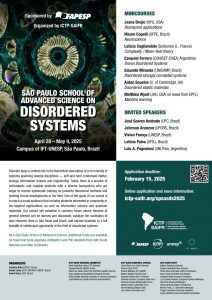
Category: Conferences

International Conference on Complex Systems Modeling, Analysis & Applications [IC2SMA2 2025]

IC2SMA2 2025 aims to create a new international venue that can unite scholars, practitioners and students from diverse fields to address various real-world challenges and opportunities using methodologies of complex systems modeling and analysis. The conference will showcase cutting-edge modeling/analysis methods, interdisciplinary applications, and innovative solutions, fostering collaboration and sparking new ideas. Its inaugural 2025 edition will have a particular focus on the applications to education and society. By integrating insights from systems science, mathematics, computer science, engineering, economics, social sciences, psychology, healthcare, education, and many others, we seek to advance understanding and application in these crucial areas. Join us to explore how multidisciplinary approaches can drive improvements in our society!

Organized in Hybrid Mode by CHRIST University, Pune Lavasa, India & Binghamton University, State University of New York, USA

More at: ic2sma2-2025.christuniversity.in

Winter Workshop on Complex Systems 2025

The Winter Workshop on Complex Systems is a one-week workshop where young researchers worldwide come together to work on interdisciplinary projects around complex systems.

The primary focus of the workshop is for participants to engage into novel research projects.

This is the 10th edition of the WWCS and it will be held in Rifugio Madonna delle Nevi (Lombardy, Italy) from the 26th to the 31st of January 2025.

More at: wwcs2025.github.io

Complex thinking and artificial intelligence, October 28, 2024, Online

Workshop | October 28, 2024, 13h00-19h30 (GMT+1), Online

Large Language Models (LLMs) such as ChatGPT have also opened new possibilities for Human-AI interaction towards systems of co and augmented intelligence. On the other hand, developments regarding the practice of complex thinking, as a mode of coupling with the world that is organisationally coherent with the properties that organise complex natural and social systems, has been proposed as potentially leading to more effective ecosystemically positive and sustainable possibilities for action. It is hypothesised that more complex modes of thinking may lead to creative and abductive leaps capable of guiding effective interventions and the process of managing change in “real-world” complex systems, in conditions of uncertainty and risk.  The CT & AI project will explore possibilities and limits of the interaction of a framework for the practice and promotion of Complex Thinking (CT) with AI tools based on LLMs (e.g. Chat GPT, Gemini). It aimed at developing and evaluating preliminary protocols to guide the integration of methods and tools for promoting CT with the use of AI tools towards generating complex understandings for practice and research. Finally, it aimed at exploring stakeholders (policy-makers, practitioners, scientists/academics) stances regarding the use of AI in relation to CT.

More at: ces.uc.pt

ICTP – SAIFR » Minicourse on Bayesian Machine Learning for Scientific Research

October 28 – November 1, 2024

São Paulo, Brazil

ICTP-SAIFR/IFT-UNESP

We will present five 3-hour lectures that will introduce participants to the world of Bayesian Machine Learning for scientific purposes. The minicourse is tailored to suit both senior and junior researchers, catering to their respective levels of experience and interest.

In the first block of each lecture, we aim to transmit the big picture of the lecture’s topic with a focus on the details from a supervising point of view. The fine points and subtleties will be addressed here, but without strict demonstrations or supplied code. This block is intended for both seniors and juniors: for seniors as a summary that shows how to apply these tools to scientific research; and for juniors as an entrance to the second block in which we put our hands in the dough. We conclude the block with an extended coffee break where we expect that the proposed ideas trigger discussions around each participant’s field of study and how to apply it in their data.

The second block is very hands-on and is intended for juniors, but seniors interested in getting actively involved in the calculations are welcome as well. We present, discuss and write code. Participants are engaged in coding exercises and discussing practical applications. This block emphasizes practical skills and real-world problem-solving. We use different libraries, and we deploy statistical software especially designed to tackle the presented problems

The minicourse is generally designed for any scientific career. We use mostly physics examples, but the material will be useful and insightful for any other field with hard scientific research. We will try to adapt and discuss the problems within the participants’ fields of research.

Participants are expected to have taken courses in algebra and analysis, be familiar with multi-dimensional vectors and expressions, have some knowledge of probability and statistics, and be prepared for non-trivial abstract reasoning and thinking. Juniors, in addition, are expected to have some knowledge of Python.

There is no registration fee and limited funds are available for local expenses.

Lecturer:

Ezequiel Alvarez (ICAS-UNSAM, Argentina)
Organizer:

Rogério Rosenfeld (IFT-UNESP/ICTP-SAIFR, Brazil)

Apply  at: www.ictp-saifr.org

School on Biological Physics across Scales: Pattern Formation. November 11 – 22, 2024,  São Paulo, Brazil

Systems as different as the cellular cytoskeleton, microbial communities in soil, and savanna landscapes have in common the emergence of patterns: random yet organized spatial structures that form in an otherwise translationally invariant space. These structures emerge due to the local, individual-level interactions of agents – proteins, cells, trees – that, on a larger scale, result in nonlinear dynamics for the density field. Crucial phenomena hinge on the formation of these patterns: mitosis, embryo development, bacterial population survival, ecosystem’s robustness to aridification.

While broadly different in scale, these systems can be theoretically described by similar statistical physics frameworks, an approach pioneered by Alan Turing in 1952 and still the focus of very active development. The goal of this school is to bring together experts on these different systems using mathematical modeling, experimental approaches and modern data-driven techniques to engage in an interdisciplinary dialogue about pattern formation in living systems.

There is no registration fee and limited funds are available for travel and local expenses.

More at: www.ictp-saifr.org

See Also: 3rd ICTP-SAIFR Symposium on Current Topics in Molecular Biophysics (CTMB3): October 7 – 9, 2024