
Category: Papers

Assembly theory explains and quantifies selection and evolution

Abhishek Sharma, Dániel Czégel, Michael Lachmann, Christopher P. Kempes, Sara I. Walker & Leroy Cronin 

Nature (2023)

Scientists have grappled with reconciling biological evolution1,2 with the immutable laws of the Universe defined by physics. These laws underpin life’s origin, evolution and the development of human culture and technology, yet they do not predict the emergence of these phenomena. Evolutionary theory explains why some things exist and others do not through the lens of selection. To comprehend how diverse, open-ended forms can emerge from physics without an inherent design blueprint, a new approach to understanding and quantifying selection is necessary3,4,5. We present assembly theory (AT) as a framework that does not alter the laws of physics, but redefines the concept of an ‘object’ on which these laws act. AT conceptualizes objects not as point particles, but as entities defined by their possible formation histories. This allows objects to show evidence of selection, within well-defined boundaries of individuals or selected units. We introduce a measure called assembly (A), capturing the degree of causation required to produce a given ensemble of objects. This approach enables us to incorporate novelty generation and selection into the physics of complex objects. It explains how these objects can be characterized through a forward dynamical process considering their assembly. By reimagining the concept of matter within assembly spaces, AT provides a powerful interface between physics and biology. It discloses a new aspect of physics emerging at the chemical scale, whereby history and causal contingency influence what exists.

Read the full article at: www.nature.com
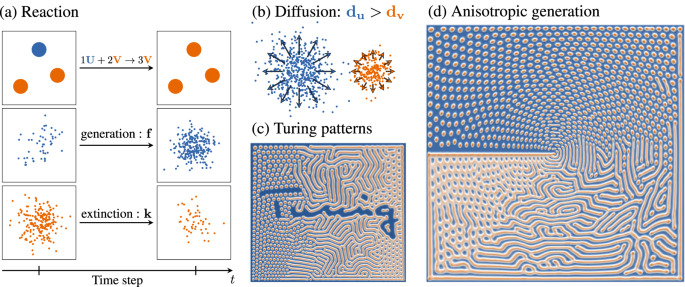
Morphogenetic metasurfaces: unlocking the potential of Turing patterns

Thomas Fromenteze, Okan Yurduseven, Chidinma Uche, Eric Arnaud, David R. Smith & Cyril Decroze 
Nature Communications volume 14, Article number: 6249 (2023)

The reaction-diffusion principle imagined by Alan Turing in an attempt to explain the structuring of living organisms is leveraged in this work for the procedural synthesis of radiating metasurfaces. The adaptation of this morphogenesis technique ensures the growth of anisotropic cellular patterns automatically arranged to satisfy local electromagnetic constraints, facilitating the radiation of waves controlled in frequency, space, and polarization. Experimental validations of this method are presented, designing morphogenetic metasurfaces radiating far-field circularly polarized beams and generating a polarization-multiplexed hologram in the radiative near-field zone. The exploitation of morphogenesis-inspired models proves particularly well suited for solving generative design problems, converting global physical constraints into local interactions of simulated chemical reactants ensuring the emergence of self-organizing meta-atoms.

Read the full article at: www.nature.com

Resilience—Towards an interdisciplinary definition using information theory

Eleni Nisioti, Colby Clark, Kaushik Kunal Das, Ekkehard Ernst, Nicholas A. Friedenberg, Emily Gates, Maryl Lambros, Anita Lazurko, Nataša Puzović, Ilvanna Salas

Front. Complex Syst., 25 September 2023

The term “resilience” has risen in popularity following a series of natural disasters, the impacts of climate change, and the Covid-19 pandemic. However, different disciplines use the term in widely different ways, resulting in confusion regarding how the term is used and difficulties operationalising the underlying concept. Drawing on an overview of eleven disciplines, our paper offers a guiding framework to navigate this ambiguity by suggesting a novel typology of resilience using an information-theoretic approach. Specifically, we define resilience by borrowing an existing definition of individuals as sub-systems within multi-scale systems that exhibit temporal integrity amidst interactions with the environment. We quantify resilience as the ability of individuals to maintain fitness in the face of endogenous and exogenous disturbances. In particular, we distinguish between four different types of resilience: (i) preservation of structure and function, which we call “strong robustness”; (ii) preservation of function but change in structure (“weak robustness”); (iii) change in both structure and function (“strong adaptability”); and (iv) change in function but preservation in structure (“weak adaptability”). Our typology offers an approach for navigating these different types and demonstrates how resilience can be operationalised across disciplines.

Read the full article at: www.frontiersin.org

The boundary problem

Michael Batty

Environment and Planning B: Urban Analytics and City Science Volume 50, Issue 7

A basic canon of the systems approach applicable to any field is the notion that a system is separable and distinct from its wider environment. In short, to formally study such a system, it must have a well-defined boundary beyond which it has no substantial impact on its wider context, while its wider context is usually composed of similar systems which have minimal impact on the system in question. The implication is that the environment defined by its boundary ‘excludes’ any significant actions or interactions essential for the functioning of the system itself. This is, in some respects, equivalent to the notion that we are defining a closed system which we can study in isolation from any extraneous or exogenous factors that might affect its operation. It is the definition used by Karl Popper (1959) to justify the use of the classical scientific method as fashioned in experimental science where the laboratory must be closed from the outside environment for robust theories to be tested and validated. In the case of cities, historically or at least from the middle of the last century, such boundaries are typically defined to minimise the overall interactions between the system and its environment. The implication is that insofar as there are many distinct systems, to minimise the interactions between one another, they are often arranged as a hierarchy. To minimise the exchange of energies between the system and all the systems within its environment, a good working definition of a system is that it contains the most significant interactions within the system itself (Simon, 1969). This question of course turns on what is regarded as ‘significant’.

Read the full article at: journals.sagepub.com

Unifying pairwise interactions in complex dynamics

Oliver M. Cliff, Annie G. Bryant, Joseph T. Lizier, Naotsugu Tsuchiya & Ben D. Fulcher 
Nature Computational Science (2023)

Scientists have developed hundreds of techniques to measure the interactions between pairs of processes in complex systems, but these computational methods—from contemporaneous correlation coefficients to causal inference methods—define and formulate interactions differently, using distinct quantitative theories that remain largely disconnected. Here we introduce a large assembled library of 237 statistics of pairwise interactions, and assess their behavior on 1,053 multivariate time series from a wide range of real-world and model-generated systems. Our analysis highlights commonalities between disparate mathematical formulations of interactions, providing a unified picture of a rich interdisciplinary literature. Using three real-world case studies, we then show that simultaneously leveraging diverse methods can uncover those most suitable for addressing a given problem, facilitating interpretable understanding of the quantitative formulation of pairwise dependencies that drive successful performance. Our results and accompanying software enable comprehensive analysis of time-series interactions by drawing on decades of diverse methodological contributions.

Read the full article at: www.nature.com