
Category: Papers

Multi pathways temporal distance unravels the hidden geometry of network-driven processes

Sebastiano Bontorin & Manlio De Domenico 
Communications Physics volume 6, Article number: 129 (2023)

Network-based interactions allow one to model many technological and natural systems, where understanding information flow between nodes is important to predict their functioning. The complex interplay between network connectivity and dynamics can be captured by scaling laws overcoming the paradigm of information spread being solely dependent on network structure. Here, we capitalize on this paradigm to identify the relevant paths for perturbation propagation. We introduce a multi-pathways temporal distance between nodes that overcomes the limitation of focussing only on the shortest path. This metric predicts the latent geometry induced by the dynamics in which the signal propagation resembles the traveling wave solution of reaction-diffusion systems. We validate the framework on a set of synthetic dynamical models, showing that it outperforms existing approaches in predicting arrival times. On a set of empirical contact-based social systems, we show that it can be reliably used also for models of infectious diseases spread – such as the Susceptible-Infected-Susceptible – with remarkable accuracy in predicting the observed timing of infections. Our framework naturally encodes the concerted behavior of the ensemble of paths connecting two nodes in conveying perturbations, with applications ranging from regulatory dynamics within cells to epidemic spreading in social networks.

Read the full article at: www.nature.com
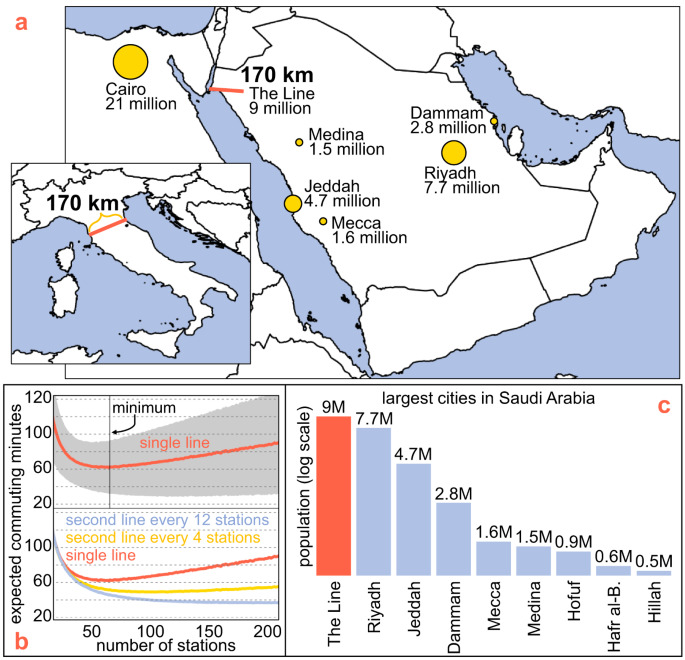
Arguments for building The Circle and not The Line in Saudi Arabia

Rafael Prieto-Curiel & Dániel Kondor 
npj Urban Sustainability volume 3, Article number: 35 (2023)

Saudi Arabia plans to construct a new city, home to 9 million people. The most relevant aspect is its form, a line with a surprising length of 170 km. We analyse whether this is the best plan for a new city and some inconveniences of the prolonged urban form.

Read the full article at: www.nature.com

How biological codes break causal chains to enable autonomy for organisms

Keith Farnsworth

This is an un-reviewed, unpublished pre-print of a paper written for a special issue of BioSystems on Code Biology. It explains why biological codes are essential for life to be autonomous. The first reason is that autonomy requires freedom from exogenous control (cause-effect) and this is achieved by stripping the force from efficient causes using transducers at the organism boundary (e.g. cell receptors) so they become signal-response: contingent influences, rather than controls. All transducers embody a cypher or a code. The second is that evolvable reproduction requires the maintenance of a separate formal information store (from Von Neumann’s replicator theory), which must be causally isolated from the rest of the replicating system. This is achieved by storing the information in a form that does not correlate with the rest of the system, hence it requires code-translation to become causal. These explanations rest on the idea of efficient cause being the result of empowering formal cause with a physical force-field (Farnsworth 2022 – BioSystems). They also provide a new and powerful way of understanding semiotic communications in general.

Read the full article at: www.researchgate.net

Dancer From the Dance

Alva Noë

From The Entanglement, which was published last month by Princeton University Press.

When she dances, a young child already moves her body with a sensitivity to what is expected of her. Perhaps she has seen videos of Billie Eilish or Taylor Swift; she has danced with her mom; she has a bank of personalities and images that supply her with a sense of what feels right. Remarkably, what feels right has everything to do with what would look right to others—with her sensitivity, however unarticulated, to how others would respond to her. What she actualizes is nothing less than the embodiment of choreographic ideas of which she is not the author. This is a distinctively human form of intelligence at work.

The child’s dancing is the location of what I want to call an entanglement between her native impulse to move and an artistic representation of what movement is supposed to be. We come to embody choreographic ideas when we dance. We do so naturally, and we cannot avoid doing so.

Read the full article at: harpers.org