
Category: Papers

Long-Range Social Influence in Phone Communication Networks on Offline Adoption Decisions

Yan Leng , Xiaowen Dong, Esteban Moro, Alex Pentland

Information Systems Research

We use high-resolution mobile phone data with geolocation information and propose a novel technical framework to study how social influence propagates within a phone communication network and affects the offline decision to attend a performance event. Our fine-grained data are based on the universe of phone calls made in a European country between January and July 2016. We isolate social influence from observed and latent homophily by taking advantage of the rich spatial-temporal information and the social interactions available from the longitudinal behavioral data. We find that influence stemming from phone communication is significant and persists up to four degrees of separation in the communication network. Building on this finding, we introduce a new “influence” centrality measure that captures the empirical pattern of influence decay over successive connections. A validation test shows that the average influence centrality of the adopters at the beginning of each observational period can strongly predict the number of eventual adopters and has a stronger predictive power than other prevailing centrality measures such as the eigenvector centrality and state-of-the-art measures such as diffusion centrality. Our centrality measure can be used to improve optimal seeding strategies in contexts with influence over phone calls, such as targeted or viral marketing campaigns. Finally, we quantitatively demonstrate how raising the communication probability over each connection, as well as the number of initial seeds, can significantly amplify the expected adoption in the network and raise net revenue after taking into account the cost of these interventions.

Read the full article at: pubsonline.informs.org
Nonequilibrium thermodynamics of the asymmetric Sherrington-Kirkpatrick model

Miguel Aguilera, Masanao Igarashi & Hideaki Shimazaki
Nature Communications volume 14, Article number: 3685 (2023)

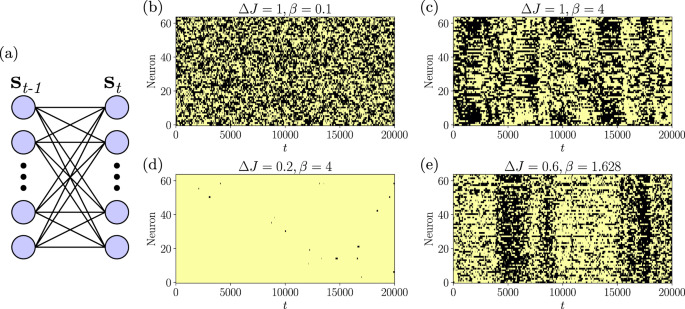
Most natural systems operate far from equilibrium, displaying time-asymmetric, irreversible dynamics characterized by a positive entropy production while exchanging energy and matter with the environment. Although stochastic thermodynamics underpins the irreversible dynamics of small systems, the nonequilibrium thermodynamics of larger, more complex systems remains unexplored. Here, we investigate the asymmetric Sherrington-Kirkpatrick model with synchronous and asynchronous updates as a prototypical example of large-scale nonequilibrium processes. Using a path integral method, we calculate a generating functional over trajectories, obtaining exact solutions of the order parameters, path entropy, and steady-state entropy production of infinitely large networks. Entropy production peaks at critical order-disorder phase transitions, but is significantly larger for quasi-deterministic disordered dynamics. Consequently, entropy production can increase under distinct scenarios, requiring multiple thermodynamic quantities to describe the system accurately. These results contribute to developing an exact analytical theory of the nonequilibrium thermodynamics of large-scale physical and biological systems and their phase transitions. The Sherrington-Kirkpatrick model is a paradigmatic model in the field of complex disordered systems such as spin glasses and neural networks. Here the authors study the stochastic thermodynamics of an asymmetric version of the model by using a path integral method and provide exact solutions for the entropy production.

Read the full article at: www.nature.com

Classical spin Hamiltonians are context-sensitive languages

Sebastian Stengele, David Drexel and Gemma De las Cuevas

Classical spin Hamiltonians are a powerful tool to model complex systems, characterized by a local structure given by the local Hamiltonians. One of the best understood local structures is the grammar of formal languages, which are central in computer science and linguistics, and have a natural complexity measure given by the Chomsky hierarchy. If we see classical spin Hamiltonians as languages, what grammar do the local Hamiltonians correspond to? Here, we cast classical spin Hamiltonians as formal languages, and classify them in the Chomsky hierarchy. We prove that the language of (effectively) zero-dimensional spin Hamiltonians is regular, one-dimensional spin Hamiltonians is deterministic context-free, and higher-dimensional and all-to-all spin Hamiltonians is context-sensitive. This provides a new complexity measure for classical spin Hamiltonians, which captures the hardness of recognizing spin configurations and their energies. We compare it with the computational complexity of the ground state energy problem, and find a different easy-to-hard threshold for the Ising model. We also investigate the dependence on the language of the spin Hamiltonian. Finally, we define the language of the time evolution of a spin Hamiltonian and classify it in the Chomsky hierarchy. Our work suggests that universal spin models are weaker than universal Turing machines.

Read the full article at: royalsocietypublishing.org

Efficient automatic design of robots

David Matthews, Andrew Spielberg, Daniela Rus, Sam Kriegman, Josh Bongard

Robots are notoriously difficult to design because of complex interdependencies between their physical structure, sensory and motor layouts, and behavior. Despite this, almost every detail of every robot built to date has been manually determined by a human designer after several months or years of iterative ideation, prototyping, and testing. Inspired by evolutionary design in nature, the automated design of robots using evolutionary algorithms has been attempted for two decades, but it too remains inefficient: days of supercomputing are required to design robots in simulation that, when manufactured, exhibit desired behavior. Here we show for the first time de-novo optimization of a robot’s structure to exhibit a desired behavior, within seconds on a single consumer-grade computer, and the manufactured robot’s retention of that behavior. Unlike other gradient-based robot design methods, this algorithm does not presuppose any particular anatomical form; starting instead from a randomly-generated apodous body plan, it consistently discovers legged locomotion, the most efficient known form of terrestrial movement. If combined with automated fabrication and scaled up to more challenging tasks, this advance promises near instantaneous design, manufacture, and deployment of unique and useful machines for medical, environmental, vehicular, and space-based tasks.

Read the full article at: arxiv.org