
Category: Papers

Self-Organizing Railway Traffic Management

Federico Naldini, Fabio Oddi, Leo D’Amato, Grégory Marlière, Vito Trianni, Paola Pellegrini
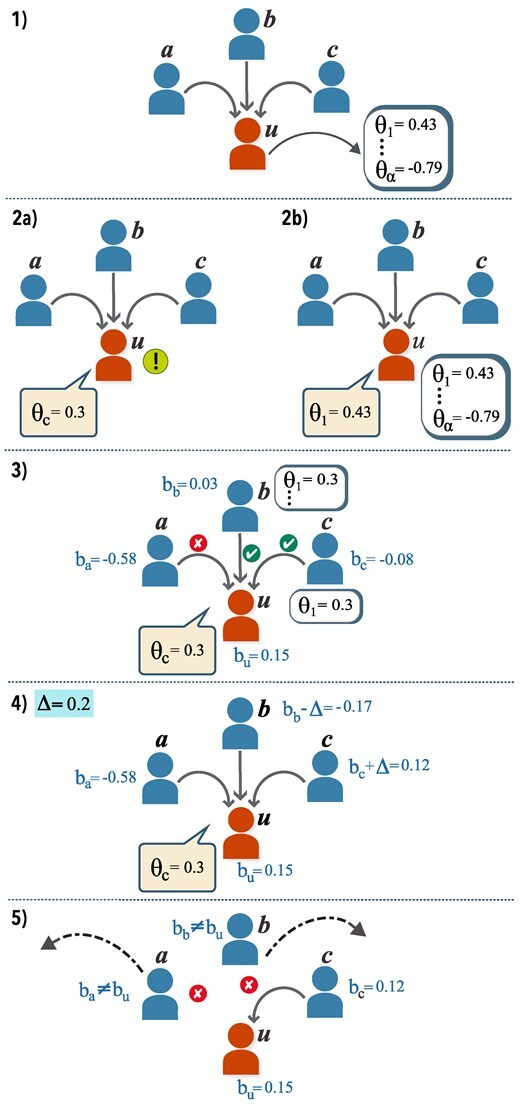
Improving traffic management in case of perturbation is one of the main challenges in today’s railway research. The great majority of the existing literature proposes approaches to make centralized decisions to minimize delay propagation. In this paper, we propose a new paradigm to the same aim: we design and implement a modular process to allow trains to self-organize. This process consists in having trains identifying their neighbors, formulating traffic management hypotheses, checking their compatibility and selecting the best ones through a consensus mechanism. Finally, these hypotheses are merged into a directly applicable traffic plan. In a thorough experimental analysis on a portion of the Italian network, we compare the results of self-organization with those of a state-of-the-art centralized approach. In particular, we make this comparison mimicking a realistic deployment thanks to a closed-loop framework including a microscopic railway simulator. The results indicate that self-organization achieves better results than the centralized algorithm, specifically thanks to the definition and exploitation of the instance decomposition allowed by the proposed approach.

Read the full article at: arxiv.org
The meaning of life in a universe whose ultimate origins are unknown

John E. Stewart

BioSystems Volume 262, April 2026, 105733

Our universe appears to be fine-tuned for life. But once life emerges, it does not evolve randomly. Evolution has a trajectory. Both evolvability and cooperative integration increase as evolution proceeds. Until now, this trajectory has largely been driven blindly by gene-based natural selection. But humans are developing cognitive capacities that are far superior than natural selection at adapting and evolving humanity. These capacities will enable humanity to use an understanding of evolution’s future trajectory to guide its own evolution, avoiding the destructive selection that will otherwise reinforce the trajectory. Humans who help realize this potential will be fulfilling vital evolutionary roles that are meaningful and purposeful in a much larger scheme of things. The paper considers whether these roles remain meaningful when considered in the wider context of possible origins of the universe. But this analysis is faced with a potentially infinite number of origin hypotheses (including innumerable ‘God hypotheses’), which are not falsified by current knowledge. The paper addresses this challenge using methods that enable rational decision-making despite radical uncertainty. Broadly, this approach reinforces the conclusions reached by consideration of the evolutionary trajectory within the universe, and opens some new possibilities. Finally, the paper demonstrates that extending this analysis also largely overcomes Hume’s critique of induction, placing scientific methodologies on a firmer footing. It achieves this by recognising that a universe which exhibits a trajectory towards increasing evolvability must contain discoverable regularities that provide adaptive advantages for evolvability.

Read the full article at: www.sciencedirect.com

Mechanistic interplay between information spreading and opinion polarization

Kleber Andrade Oliveira , Henrique Ferraz de Arruda , Yamir Moreno 

PNAS Nexus, Volume 5, Issue 1, January 2026, pgaf402

We investigate how information-spreading mechanisms affect opinion dynamics and vice versa via an agent-based simulation on adaptive social networks. First, we characterize the impact of reposting on user behavior with limited memory, a feature that introduces novel system states. Then, we build an experiment mimicking information-limiting environments seen on social media platforms and study how the model parameters can determine the configuration of opinions. In this scenario, different posting behaviors may sustain polarization or reverse it. We further show the adaptability of the model by calibrating it to reproduce the statistical organization of information cascades as seen empirically in a microblogging social media platform. Our model combines mechanisms for platform content recommendation, connection rewiring, and limited-attention user behavior, paving the way for a robust understanding of echo chambers as a specialized phenomenon of opinion polarization.

Read the full article at: academic.oup.com

Bootstrapping Life-Inspired Machine Intelligence: The Biological Route from Chemistry to Cognition and Creativity

Giovanni Pezzulo, Michael Levin
Achieving advanced machine intelligence remains a central challenge in AI research, often approached through scaling neural architectures and generative models. However, biological systems offer a broader repertoire of strategies for adaptive, goal-directed behavior – strategies that emerged long before nervous systems evolved. This paper advocates a genuinely life-inspired approach to machine intelligence, drawing on principles from biology that enable robustness, autonomy, and open-ended problem-solving across scales. We frame intelligence as flexible problem-solving, following William James, and develop the concept of “cognitive light cones” to characterize the continuum of intelligence in living systems and machines. We argue that biological evolution has discovered a scalable recipe for intelligence – and the progressive expansion of organisms’ “cognitive light cone”, predictive and control capacities. To explain how this is possible, we distill five design principles – multiscale autonomy, growth through self-assemblage of active components, continuous reconstruction of capabilities, exploitation of physical and embodied constraints, and pervasive signaling enabling self-organization and top-down control from goals – that underpin life’s ability to navigate creatively diverse problem spaces. We discuss how these principles contrast with current AI paradigms and outline pathways for integrating them into future autonomous, embodied, and resilient artificial systems.

Read the full article at: arxiv.org

Graphs are maximally expressive for higher-order interactions

Tiago P. Peixoto, Leto Peel, Thilo Gross, Manlio De Domenico
We demonstrate that graph-based models are fully capable of representing higher-order interactions, and have a long history of being used for precisely this purpose. This stands in contrast to a common claim in the recent literature on “higher-order networks” that graph-based representations are fundamentally limited to “pairwise” interactions, requiring hypergraph formulations to capture richer dependencies. We clarify this issue by emphasizing two frequently overlooked facts. First, graph-based models are not restricted to pairwise interactions, as they naturally accommodate interactions that depend simultaneously on multiple adjacent nodes. Second, hypergraph formulations are strict special cases of more general graph-based representations, as they impose additional constraints on the allowable interactions between adjacent elements rather than expanding the space of possibilities. We show that key phenomenology commonly attributed to hypergraphs — such as abrupt transitions — can, in general, be recovered exactly using graph models, even locally tree-like ones, and thus do not constitute a class of phenomena that is inherently contingent on hypergraphs models. Finally, we argue that the broad relevance of hypergraphs for applications that is sometimes claimed in the literature is not supported by evidence. Instead it is likely grounded in misconceptions that network models cannot accommodate multibody interactions or that certain phenomena can only be captured with hypergraphs. We argue that clearly distinguishing between multivariate interactions, parametrized by graphs, and the functions that define them enables a more unified and flexible foundation for modeling interacting systems.

Read the full article at: arxiv.org