Category: Papers

Fifty years of ‘More is different’

Steven Strogatz, Sara Walker, Julia M. Yeomans, Corina Tarnita, Elsa Arcaute, Manlio De Domenico, Oriol Artime & Kwang-Il Goh 
Nature Reviews Physics (2022)

August 1972 saw the publication of Philip Anderson’s essay ‘More is different’. In it, he crystallized the idea of emergence, arguing that “at each level of complexity entirely new properties appear” — that is, although, for example, chemistry is subject to the laws of physics, we cannot infer the field of chemistry from our knowledge of physics. Fifty years on from this landmark publication, eight scientists describe the most interesting phenomena that emerge in their fields.

Read the full article at: www.nature.com

Biological Robots: Perspectives on an Emerging Interdisciplinary Field

Biological Robots: Perspectives on an Emerging Interdisciplinary Field
D. Blackiston, S. Kriegman, J. Bongard, M. Levin
Advances in science and engineering often reveal the limitations of classical approaches initially used to understand, predict, and control phenomena. With progress, conceptual categories must often be re-evaluated to better track recently discovered invariants across disciplines. It is essential to refine frameworks and resolve conflicting boundaries between disciplines such that they better facilitate, not restrict, experimental approaches and capabilities. In this essay, we discuss issues at the intersection of developmental biology, computer science, and robotics. In the context of biological robots, we explore changes across concepts and previously distinct fields that are driven by recent advances in materials, information, and life sciences. Herein, each author provides their own perspective on the subject, framed by their own disciplinary training. We argue that as with computation, certain aspects of developmental biology and robotics are not tied to specific materials; rather, the consilience of these fields can help to shed light on issues of multi-scale control, self-assembly, and relationships between form and function. We hope new fields can emerge as boundaries arising from technological limitations are overcome, furthering practical applications from regenerative medicine to useful synthetic living machines.

Read the full article at: arxiv.org
A Novel Approach to the Partial Information Decomposition

Artemy Kolchinsky

Entropy 2022, 24(3), 403

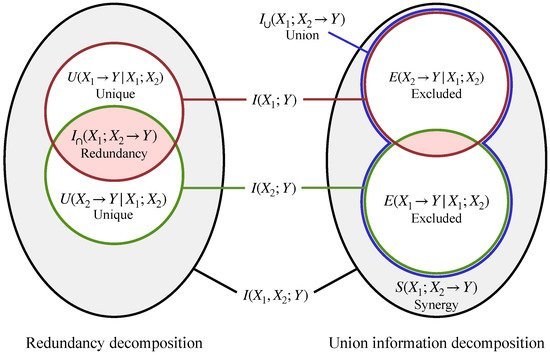
We consider the “partial information decomposition” (PID) problem, which aims to decompose the information that a set of source random variables provide about a target random variable into separate redundant, synergistic, union, and unique components. In the first part of this paper, we propose a general framework for constructing a multivariate PID. Our framework is defined in terms of a formal analogy with intersection and union from set theory, along with an ordering relation which specifies when one information source is more informative than another. Our definitions are algebraically and axiomatically motivated, and can be generalized to domains beyond Shannon information theory (such as algorithmic information theory and quantum information theory). In the second part of this paper, we use our general framework to define a PID in terms of the well-known Blackwell order, which has a fundamental operational interpretation. We demonstrate our approach on numerous examples and show that it overcomes many drawbacks associated with previous proposals

Read the full article at: www.mdpi.com

The role of self-maintaining resilient reaction networks in the origin and evolution of life 

Biosystems
Volume 219, September 2022, 104720

Francis Heylighen, Shima Beigi, Evo Busseniers

We characterize living systems as resilient “chemical organizations”, i.e. self-maintaining networks of reactions that are able to resist a wide range of perturbations. Dissipative structures, such as flames or convection cells, are also self-maintaining, but much less resilient. We try to understand how life could have originated from such self-organized structures, and evolved further, by acquiring various mechanisms to increase resilience. General mechanisms include negative feedback, buffering of resources, and degeneracy (producing the same resources via different pathways). Specific mechanisms use catalysts, such as enzymes, to enable reactions that deal with specific perturbations. This activity can be regulated by “memory” molecules, such as DNA, which selectively produce catalysts when needed. We suggest that major evolutionary transitions take place when living cells of different types or species form a higher-order organization by specializing in different functions and thus minimizing interference between their reactions.

Read the full article at: www.sciencedirect.com

Curiosity as filling, compressing, and reconfiguring knowledge networks

Curiosity as filling, compressing, and reconfiguring knowledge networks
Shubhankar P. Patankar, Dale Zhou, Christopher W. Lynn, Jason Z. Kim, Mathieu Ouellet, Harang Ju, Perry Zurn, David M. Lydon-Staley, Dani S. Bassett
Due to the significant role that curiosity plays in our lives, several theoretical constructs, such as the information gap theory and compression progress theory, have sought to explain how we engage in its practice. According to the former, curiosity is the drive to acquire information that is missing from our understanding of the world. According to the latter, curiosity is the drive to construct an increasingly parsimonious mental model of the world. To complement the densification processes inherent to these theories, we propose the conformational change theory, wherein we posit that curiosity results in mental models with marked conceptual flexibility. We formalize curiosity as the process of building a growing knowledge network to quantitatively investigate information gap theory, compression progress theory, and the conformational change theory of curiosity. In knowledge networks, gaps can be identified as topological cavities, compression progress can be quantified using network compressibility, and flexibility can be measured as the number of conformational degrees of freedom. We leverage data acquired from the online encyclopedia Wikipedia to determine the degree to which each theory explains the growth of knowledge networks built by individuals and by collectives. Our findings lend support to a pluralistic view of curiosity, wherein intrinsically motivated information acquisition fills knowledge gaps and simultaneously leads to increasingly compressible and flexible knowledge networks. Across individuals and collectives, we determine the contexts in which each theoretical account may be explanatory, thereby clarifying their complementary and distinct explanations of curiosity. Our findings offer a novel network theoretical perspective on intrinsically motivated information acquisition that may harmonize with or compel an expansion of the traditional taxonomy of curiosity.

Read the full article at: arxiv.org