
Category: Papers

Language statistics at different spatial, temporal, and grammatical scales

Language statistics at different spatial, temporal, and grammatical scales
Fernanda Sánchez-Puig, Rogelio Lozano-Aranda, Dante Pérez-Méndez, Ewan Colman, Alfredo J. Morales-Guzmán, Carlos Pineda, Carlos Gershenson
Statistical linguistics has advanced considerably in recent decades as data has become available. This has allowed researchers to study how statistical properties of languages change over time. In this work, we use data from Twitter to explore English and Spanish considering the rank diversity at different scales: temporal (from 3 to 96 hour intervals), spatial (from 3km to 3000+km radii), and grammatical (from monograms to pentagrams). We find that all three scales are relevant. However, the greatest changes come from variations in the grammatical scale. At the lowest grammatical scale (monograms), the rank diversity curves are most similar, independently on the values of other scales, languages, and countries. As the grammatical scale grows, the rank diversity curves vary more depending on the temporal and spatial scales, as well as on the language and country. We also study the statistics of Twitter-specific tokens: emojis, hashtags, and user mentions. These particular type of tokens show a sigmoid kind of behaviour as a rank diversity function. Our results are helpful to quantify aspects of language statistics that seem universal and what may lead to variations.

Read the full article at: arxiv.org
Understanding the coevolution of mask wearing and epidemics: A network perspective

Zirou Qiu, et al.

PNAS 119 (26) e2123355119

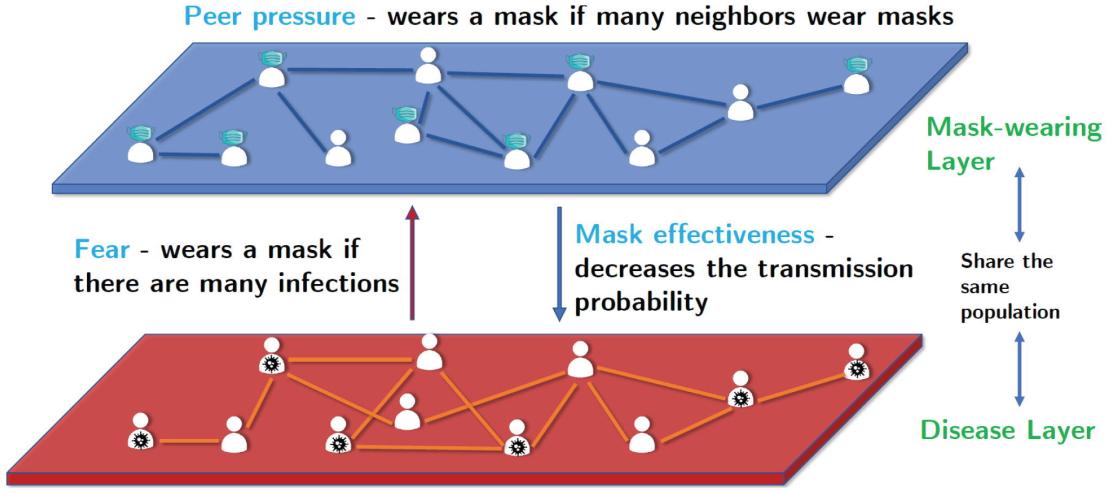
Nonpharmaceutical interventions such as mask wearing play a critical role in reducing disease prevalence. Under the dueling dynamics of mask wearing and disease, we observe a robust nonmonotonic relationship between the attack rate (i.e., the fraction of the ever-infected population) and the transmission probability of the disease. Specifically, the attack rate exhibits an abrupt reduction as the transmission probability increases to a critical threshold. Furthermore, we characterize regimes of the transmission probability where multiple waves of infection and mask adoption are expected. Our results highlight the necessity of continued public mask-wearing mandates to suppress the epidemic and effectively prevent its revival.

Read the full article at: www.pnas.org

Belief propagation for permutations, rankings, and partial orders

George T. Cantwell and Cristopher Moore

Phys. Rev. E 105, L052303

Many datasets give partial information about an ordering or ranking by indicating which team won a game, which item a user prefers, or who infected whom. We define a continuous spin system whose Gibbs distribution is the posterior distribution on permutations, given a probabilistic model of these interactions. Using the cavity method, we derive a belief propagation algorithm that computes the marginal distribution of each node’s position. In addition, the Bethe free energy lets us approximate the number of linear extensions of a partial order and perform model selection between competing probabilistic models, such as the Bradley-Terry-Luce model of noisy comparisons and its cousins.

Read the full article at: link.aps.org

Mapping Philanthropic Support of Science

Louis M. Shekhtman, Alexander J. Gates, Albert-László Barabási
While philanthropic support plays an increasing role in supporting research, there is limited quantitative knowledge about the patterns that characterize the distribution of philanthropic support. Here, we map philanthropic funding to universities and research institutions based on IRS tax forms from 685,397 non-profit organizations. We identify nearly one million grants supporting institutions involved in science, finding that in volume and scope, philanthropic funding is comparable to federal research funding. However, whereas federal funding relies on a few large organizations to distribute grants, the philanthropic ecosystem’s support is fragmented among a large number of funders with diverse focus that support research institutions at varying levels. Furthermore, we find that distinct from government support, philanthropic funders tend to focus locally, indicating that other criteria, beyond research excellence, play a role in their funding decisions. We also show evidence of persistence, i.e., once a grant-giving relationship begins, it tends to continue in time. Finally, we discuss the policy implications of our findings for philanthropic funders, individual researchers, the science of science, and for quantitative studies of philanthropy in general.

Read the full article at: arxiv.org

Critical drift in a neuro-inspired adaptive network

Silja Sormunen, Thilo Gross, Jari Saramäki
It has been postulated that the brain operates in a self-organized critical state that brings multiple benefits, such as optimal sensitivity to input. Thus far, self-organized criticality has typically been depicted as a one-dimensional process, where one parameter is tuned to a critical value. However, the number of adjustable parameters in the brain is vast, and hence critical states can be expected to occupy a high-dimensional manifold inside a high-dimensional parameter space. Here, we show that adaptation rules inspired by homeostatic plasticity drive a neuro-inspired network to drift on a critical manifold, where the system is poised between inactivity and persistent activity. During the drift, global network parameters continue to change while the system remains at criticality.

Read the full article at: arxiv.org