Category: Papers

Instability of networks: effects of sampling frequency and extreme fluctuations in financial data

Jalshayin Bhachech, Arnab Chakrabarti, Taisei Kaizoji & Anindya S. Chakrabarti 

The European Physical Journal B volume 95, Article number: 71 (2022)

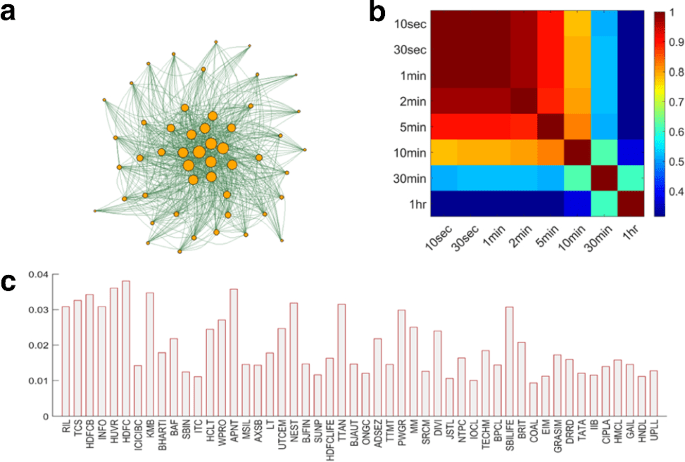
What determines the stability of networks inferred from dynamical behavior of a system? Internal and external shocks in a system can destabilize the topological properties of comovement networks. In real-world data, this creates a trade-off between identification of turbulent periods and the problem of high dimensionality. Longer time-series reduces the problem of high dimensionality, but suffers from mixing turbulent and non-turbulent periods. Shorter time-series can identify periods of turbulence more accurately, but introduces the problem of high dimensionality, so that the underlying linkages cannot be estimated precisely. In this paper, we exploit high-frequency multivariate financial data to analyze the origin of instability in the inferred networks during periods free from external disturbances. We show that the topological properties captured via centrality ordering is highly unstable even during such non-turbulent periods. Simulation results with multivariate Gaussian and fat-tailed stochastic process calibrated to financial data show that both sampling frequencies and the presence of outliers cause instability in the inferred network. We conclude that instability of network properties do not necessarily indicate systemic instability.

Read the full article at: link.springer.com

Online misinformation is linked to early COVID-19 vaccination hesitancy and refusal

Francesco Pierri, Brea L. Perry, Matthew R. DeVerna, Kai-Cheng Yang, Alessandro Flammini, Filippo Menczer & John Bryden
Scientific Reports volume 12, Article number: 5966 (2022)

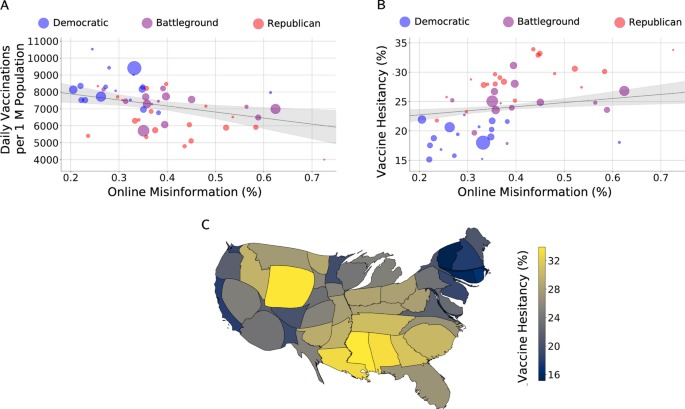
Widespread uptake of vaccines is necessary to achieve herd immunity. However, uptake rates have varied across U.S. states during the first six months of the COVID-19 vaccination program. Misbeliefs may play an important role in vaccine hesitancy, and there is a need to understand relationships between misinformation, beliefs, behaviors, and health outcomes. Here we investigate the extent to which COVID-19 vaccination rates and vaccine hesitancy are associated with levels of online misinformation about vaccines. We also look for evidence of directionality from online misinformation to vaccine hesitancy. We find a negative relationship between misinformation and vaccination uptake rates. Online misinformation is also correlated with vaccine hesitancy rates taken from survey data. Associations between vaccine outcomes and misinformation remain significant when accounting for political as well as demographic and socioeconomic factors. While vaccine hesitancy is strongly associated with Republican vote share, we observe that the effect of online misinformation on hesitancy is strongest across Democratic rather than Republican counties. Granger causality analysis shows evidence for a directional relationship from online misinformation to vaccine hesitancy. Our results support a need for interventions that address misbeliefs, allowing individuals to make better-informed health decisions.

Read the full article at: www.nature.com

Evolution of metamemory based on self-reference to own memory in artificial neural network with neuromodulation

Yusuke Yamato, Reiji Suzuki & Takaya Arita
Scientific Reports volume 12, Article number: 6233 (2022)

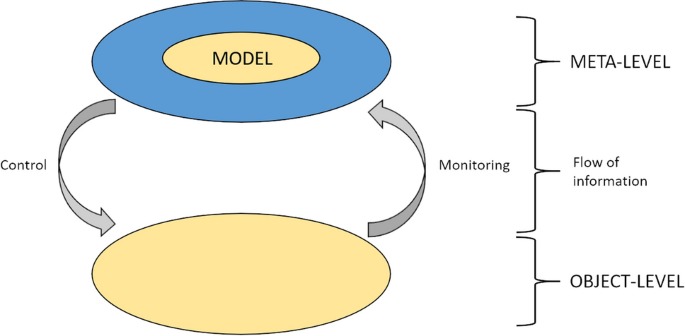
The ability of humans to self-monitor and control their memory processes is called metamemory and has been widely studied as a component of metacognition in cognitive psychology. Metamemory in non-human animals has also been investigated in recent years, although it had been regarded as a truly unique characteristic of human memory. We attempt to evolve artificial neural networks with neuromodulation, which have a metamemory function. Our constructive approach is expected to contribute, by introducing a novel dimension of evolutionary plausibility, to the discussion of animal experiments to detect metamemory. In this study, we demonstrate the evolution of neural networks that have a metamemory function based on the self-reference of memory, including the analysis of the evolved mechanism of metamemory. In addition, we discuss the similarity between the structure of the evolved neural network and the metamemory model defined by Nelson and Narens.

Read the full article at: www.nature.com

The probabilistic pool punishment proportional to the difference of payoff outperforms previous pool and peer punishment

Tetsushi Ohdaira 
Scientific Reports volume 12, Article number: 6604 (2022

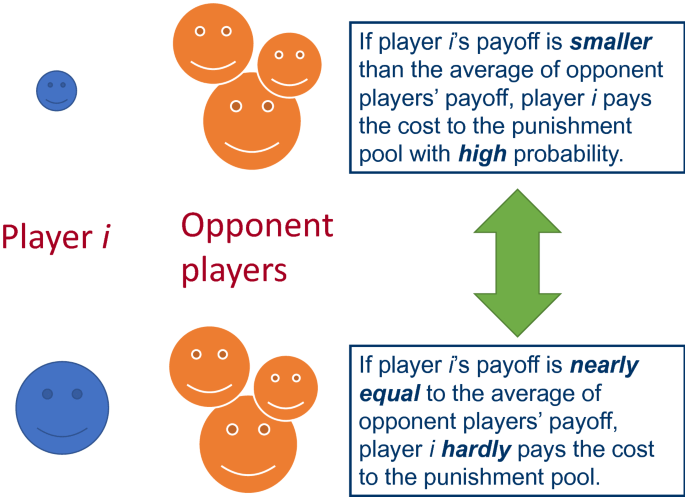
The public goods game is a multiplayer version of the prisoner’s dilemma game. In the public goods game, punishment on defectors is necessary to encourage cooperation. There are two types of punishment: peer punishment and pool punishment. Comparing pool punishment with peer punishment, pool punishment is disadvantageous in comparison with peer punishment because pool punishment incurs fixed costs especially if second-order free riders (those who invest in public goods but do not punish defectors) are not punished. In order to eliminate such a flaw of pool punishment, this study proposes the probabilistic pool punishment proportional to the difference of payoff. In the proposed pool punishment, each punisher pays the cost to the punishment pool with the probability proportional to the difference of payoff between his/her payoff and the average payoff of his/her opponents. Comparing the proposed pool punishment with previous pool and peer punishment, in pool punishment of previous studies, cooperators who do not punish defectors become dominant instead of pool punishers with fixed costs. However, in the proposed pool punishment, more punishers and less cooperators coexist, and such state is more robust against the invasion of defectors due to mutation than those of previous pool and peer punishment. The average payoff is also comparable to peer punishment of previous studies.

Read the full article at: www.nature.com