

Results from neural networks support the idea that brains are “prediction machines” — and that they work that way to conserve energy.
Read the full article at: www.quantamagazine.org
Networking the complexity community since 1999
Category: Papers
Results from neural networks support the idea that brains are “prediction machines” — and that they work that way to conserve energy.
Read the full article at: www.quantamagazine.org

Artemy Kolchinsky and David H. Wolpert
Phys. Rev. X 11, 041024
In many real-world situations, there are constraints on the ways in which a physical system can be manipulated. We investigate the entropy production (EP) and extractable work involved in bringing a system from some initial distribution p to some final distribution p′, given that the set of master equations available to the driving protocol obeys some constraints. We first derive general bounds on EP and extractable work, as well as a decomposition of the nonequilibrium free energy into an “accessible free energy” (which can be extracted as work, given a set of constraints) and an “inaccessible free energy” (which must be dissipated as EP). In a similar vein, we consider the thermodynamics of information in the presence of constraints and decompose the information acquired in a measurement into “accessible” and “inaccessible” components. This decomposition allows us to consider the thermodynamic efficiency of different measurements of the same system, given a set of constraints. We use our framework to analyze protocols subject to symmetry, modularity, and coarse-grained constraints and consider various examples including the Szilard box, the 2D Ising model, and a multiparticle flashing ratchet.
Read the full article at: link.aps.org
Yuanzhao Zhang and Steven H. Strogatz
Phys. Rev. Lett. 127, 194101
To explore basin geometry in high-dimensional dynamical systems, we consider a ring of identical Kuramoto oscillators. Many attractors coexist in this system; each is a twisted periodic orbit characterized by a winding number q, with basin size proportional to e^−(kq^2). We uncover the geometry behind this size distribution and find the basins are octopuslike, with nearly all their volume in the tentacles, not the head of the octopus (the ball-like region close to the attractor). We present a simple geometrical reason why basins with tentacles should be common in high-dimensional systems.
Read the full article at: link.aps.org
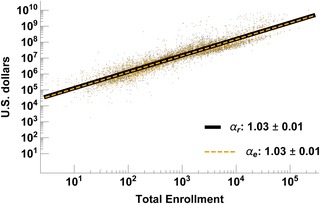
Taylor RC, Liang X, Laubichler MD, West GB, Kempes CP, Dumas M (2021) Systematic shifts in scaling behavior based on organizational strategy in universities. PLoS ONE 16(10): e0254582. https://doi.org/10.1371/journal.pone.0254582
To build better theories of cities, companies, and other social institutions such as universities, requires that we understand the tradeoffs and complementarities that exist between their core functions, and that we understand bounds to their growth. Scaling theory has been a powerful tool for addressing such questions in diverse physical, biological and urban systems, revealing systematic quantitative regularities between size and function. Here we apply scaling theory to the social sciences, taking a synoptic view of an entire class of institutions. The United States higher education system serves as an ideal case study, since it includes over 5,800 institutions with shared broad objectives, but ranges in strategy from vocational training to the production of novel research, contains public, nonprofit and for-profit models, and spans sizes from 10 to roughly 100,000 enrolled students. We show that, like organisms, ecosystems and cities, universities and colleges scale in a surprisingly systematic fashion following simple power-law behavior. Comparing seven commonly accepted sectors of higher education organizations, we find distinct regimes of scaling between a school’s total enrollment and its expenditures, revenues, graduation rates and economic added value. Our results quantify how each sector leverages specific economies of scale to address distinct priorities. Taken together, the scaling of features within a sector along with the shifts in scaling across sectors implies that there are generic mechanisms and constraints shared by all sectors, which lead to tradeoffs between their different societal functions and roles. We highlight the strong complementarity between public and private research universities, and community and state colleges, that all display superlinear returns to scale. In contrast to the scaling of biological systems, our results highlight that much of the observed scaling behavior is modulated by the particular strategies of organizations rather than an immutable set of constraints.
Read the full article at: journals.plos.org
Fabiano L. Ribeiro, Diego Rybski
The quest for a theory of cities that could offer a quantitative and systematic approach to manage cities is at the top priority, given the challenges humanity faces due to the increasing urbanization and densification of cities. If such a theory is feasible, then its formulation must be in a mathematical way. As a contribution to organizing the mathematical ideas that deal with such a systematic way of understanding urban phenomena, we present this material, concentrating on one important aspect of what recently has been called the new science of cities. In this paper, we review the main mathematical models present in the literature that aim at explaining the origin and emergence of urban scaling. We intend to present the models, identify similarities and connections between them, and find situations in which different models lead to the same output. In addition, we report situations in which some ideas initially introduced in a particular model can also be introduced in another model, generating more diversification and increasing the scope of the models. The models treated in this paper explain urban scaling from different premises: from gravity ideas, passing through densification ideas and cites’ geometry, to a hierarchical organization and socio-network properties. We also investigate scenarios in which these different fundamental ideas could be interpreted as similar — where the similarity is likely but not obvious. Furthermore, in what concerns the gravity idea, we propose a general framework that includes all gravity models analyzed as a particular case.
Read the full article at: arxiv.org

