
Category: Papers

Games in Rigged Economies

Luís F. Seoane
Phys. Rev. X 11, 031058 (2021)

Multiple aspects of an economy can be regulated, tampered with, or left to chance. Economic actors can exploit these degrees of freedom, at a cost, to bend the flow of wealth in their favor. If intervention becomes widespread, microeconomic strategies of different actors can build into emergent macroeconomic effects. How viable is a “rigged” economy? How do growing economic complexity and wealth affect it? We study rigged economies with a toy model. In it, economic degrees of freedom progress from minority to coordination games as intervention increases. Growing economic complexity spontaneously defuses cartels. But excessive complexity leads to large-fluctuations regimes, threatening the system’s stability. Simulations suggest that wealth must grow faster than linearly with economic complexity to avoid this regime and keep economies viable in the long run. We discuss a real-case scenario of multiple economic actors coordinated to result in an emergent upset of the stock market.

Read the full article at: link.aps.org
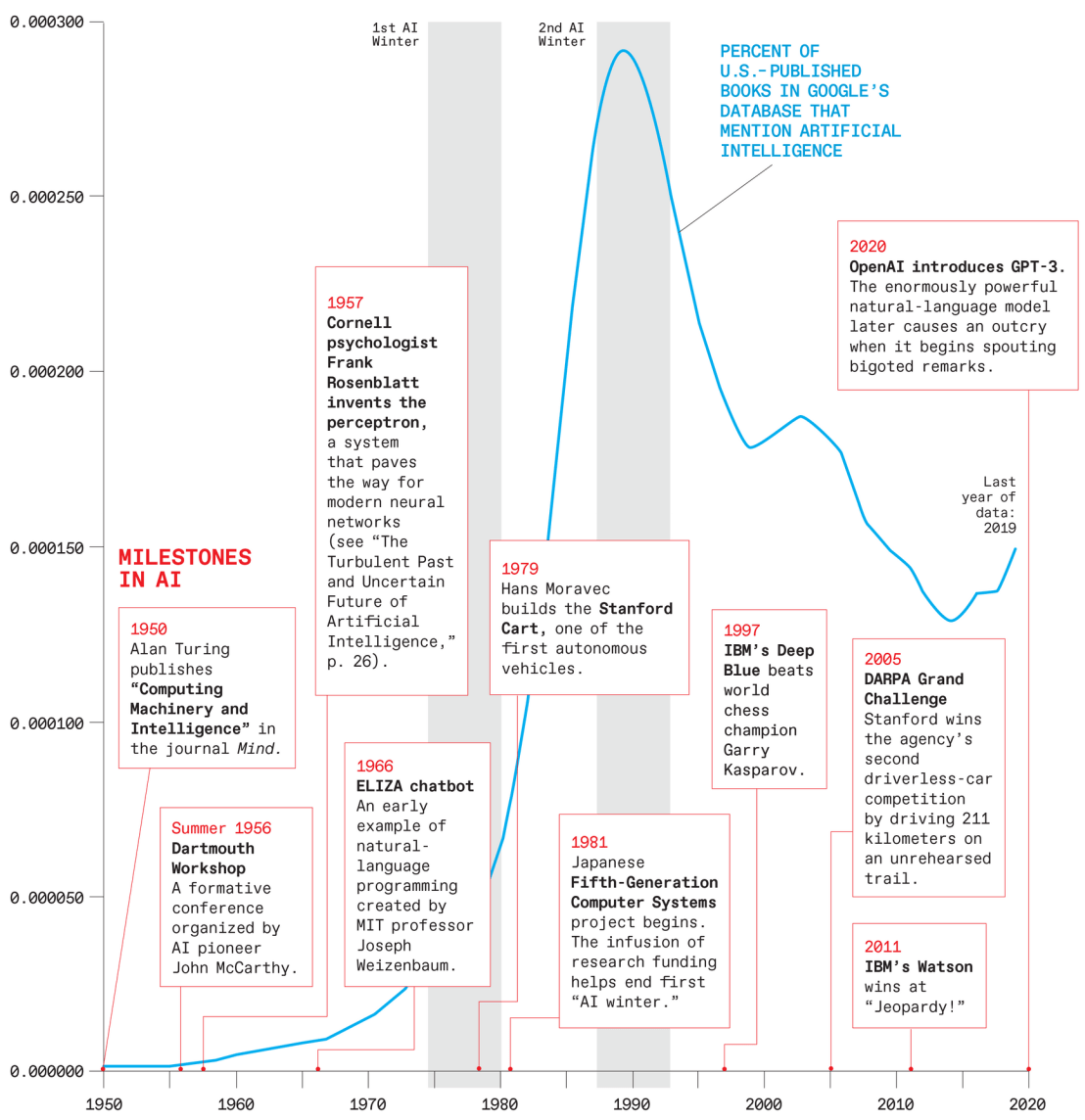
An Inconvenient Truth About AI

Rodney A. Brooks

AI won’t surpass human intelligence anytime soon

Just about every successful deployment of AI has either one of two expedients: It has a person somewhere in the loop, or the cost of failure, should the system blunder, is very low.

Read the full article at: spectrum.ieee.org

Neutral bots probe political bias on social media

Wen Chen, Diogo Pacheco, Kai-Cheng Yang & Filippo Menczer
Nature Communications volume 12, Article number: 5580 (2021)

Social media platforms attempting to curb abuse and misinformation have been accused of political bias. We deploy neutral social bots who start following different news sources on Twitter, and track them to probe distinct biases emerging from platform mechanisms versus user interactions. We find no strong or consistent evidence of political bias in the news feed. Despite this, the news and information to which U.S. Twitter users are exposed depend strongly on the political leaning of their early connections. The interactions of conservative accounts are skewed toward the right, whereas liberal accounts are exposed to moderate content shifting their experience toward the political center. Partisan accounts, especially conservative ones, tend to receive more followers and follow more automated accounts. Conservative accounts also find themselves in denser communities and are exposed to more low-credibility content. 

Read the full article at: www.nature.com