
Category: Papers

A sustainable strategy for Open Streets in (post)pandemic cities

Daniel Rhoads, Albert Solé-Ribalta, Marta C. González & Javier Borge-Holthoefer 
Communications Physics volume 4, Article number: 183 (2021)

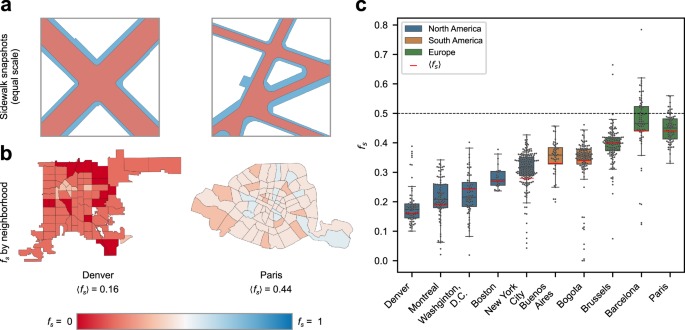
Cities world-wide have taken the opportunity presented by the COVID-19 pandemic to improve and expand pedestrian infrastructure, providing residents with a sense of relief and pursuing long-standing goals to decrease automobile dependence and increase walkability. So far, due to a scarcity of data and methodological shortcomings, these efforts have lacked the system-level view of treating sidewalks as a network. Here, we leverage sidewalk data from ten cities in three continents, to first analyse the distribution of sidewalk and roadbed geometries, and find that cities present an unbalanced distribution of public space, favouring automobiles at the expense of pedestrians. Next, we connect these geometries to build a sidewalk network –adjacent, but irreducible to the road network. Finally, we compare a no-intervention scenario with a shared-effort heuristic, in relation to the performance of sidewalk infrastructures to guarantee physical distancing. The heuristic prevents the sidewalk connectivity breakdown, while preserving the road network’s functionality.

Read the full article at: www.nature.com

Classification of Discrete Dynamical Systems Based on Transients

Barbora Hudcová, Tomáš Mikolov
In order to develop systems capable of artificial evolution, we need to identify which systems can produce complex behavior. We present a novel classification method applicable to any class of deterministic discrete space and time dynamical systems. The method is based on classifying the asymptotic behavior of the average computation time in a given system before entering a loop. We were able to identify a critical region of behavior that corresponds to a phase transition from ordered behavior to chaos across various classes of dynamical systems. To show that our approach can be applied to many different computational systems, we demonstrate the results of classifying cellular automata, Turing machines, and random Boolean networks. Further, we use this method to classify 2D cellular automata to automatically find those with interesting, complex dynamics.
We believe that our work can be used to design systems in which complex structures emerge. Also, it can be used to compare various versions of existing attempts to model open-ended evolution (Ray (1991), Ofria et al. (2004), Channon (2006)).

Read the full article at: arxiv.org

Evidence and theory for lower rates of depression in larger US urban areas

Andrew J. Stier, Kathryn E. Schertz, Nak Won Rim, Carlos Cardenas-Iniguez, Benjamin B. Lahey, Luís M. A. Bettencourt, and Marc G. Berman

PNAS August 3, 2021 118 (31) e2022472118

It is commonly assumed that cities are detrimental to mental health. However, the evidence remains inconsistent and at most, makes the case for differences between rural and urban environments as a whole. Here, we propose a model of depression driven by an individual’s accumulated experience mediated by social networks. The connection between observed systematic variations in socioeconomic networks and built environments with city size provides a link between urbanization and mental health. Surprisingly, this model predicts lower depression rates in larger cities. We confirm this prediction for US cities using four independent datasets. These results are consistent with other behaviors associated with denser socioeconomic networks and suggest that larger cities provide a buffer against depression. This approach introduces a systematic framework for conceptualizing and modeling mental health in complex physical and social networks, producing testable predictions for environmental and social determinants of mental health also applicable to other psychopathologies.

Read the full article at: www.pnas.org

Cooperation dynamics under pandemic risks and heterogeneous economic interdependence

Manuel Chica, Juan M. Hernandez, Francisco C. Santos
The spread of COVID-19 and ensuing containment measures have accentuated the profound interdependence among nations or regions. This has been particularly evident in tourism, one of the sectors most affected by uncoordinated mobility restrictions. The impact of this interdependence on the tendency to adopt less or more restrictive measures is hard to evaluate, more so if diversity in economic exposures to citizens’ mobility are considered. Here, we address this problem by developing an analytical and computational game-theoretical model encompassing the conflicts arising from the need to control the economic effects of global risks, such as in the COVID-19 pandemic. The model includes the individual costs derived from severe restrictions imposed by governments, including the resulting economic interdependence among all the parties involved in the game. By using tourism-based data, the model is enriched with actual heterogeneous income losses, such that every player has a different economic cost when applying restrictions. We show that economic interdependence enhances cooperation because of the decline in the expected payoffs by free-riding parties (i.e., those neglecting the application of mobility restrictions). Furthermore, we show (analytically and through numerical simulations) that these cross-exposures can transform the nature of the cooperation dilemma each region or country faces, modifying the position of the fixed points and the size of the basins of attraction that characterize this class of games. Finally, our results suggest that heterogeneity among regions may be used to leverage the impact of intervention policies by ensuring an agreement among the most relevant initial set of cooperators.

Read the full article at: arxiv.org