
Category: Papers

Messengers: breaking echo chambers in collective opinion dynamics with homophile

Mohsen Raoufi, Heiko Hamann & Pawel Romanczuk
npj Complexity volume 2, Article number: 28 (2025)

Collective estimation is a variant of collective decision-making where agents reach consensus on a continuous quantity through social interactions. Achieving precise consensus is complex due to the co-evolution of opinions and the interaction network. While homophilic networks may facilitate estimation in well-connected systems, disproportionate interactions with like-minded neighbors lead to the emergence of echo chambers and prevent consensus. Our agent-based simulations confirm that, besides limited exposure to attitude-challenging opinions, seeking reaffirming information entrap agents in echo chambers. To overcome this, agents can adopt a stubborn state (Messengers) that carries data and connects clusters by physically transporting their opinion. We propose a generic approach based on a Dichotomous Markov Process, which governs probabilistic switching between behavioral states and generates diverse collective behaviors. We study a continuum between task specialization (no switching), to generalization (slow or rapid switching). Messengers help the collective escape local minima, break echo chambers, and promote consensus.

Read the full article at: www.nature.com
Anticipatory Agents in Causal Bubbles: Reconciling Quantum Bayesianism, Rosen’s Anticipatory Systems, and Pragmatic Constructivism 

Michael Lissack

This paper presents a unified theoretical framework that reconciles four apparently disparate approaches: Quantum Bayesianism (QBism), Robert Rosen’s theory of Anticipatory Systems, the causal bubbles interpretation of quantum mechanics, and pragmatic constructivism through Hans Vaihinger’s philosophy of ‘as if.’ We demonstrate that these frameworks converge on a fundamental insight: reality emerges from a relational causal structure-the pattern of influences that determine what can affect what-rather than from external observation. The QBist agent exemplifies a Rosen Anticipatory System operating within a causal bubble, wherein the quantum wave function serves as a heuristic fiction-an ‘as if’ construct-used for anticipatory modeling within the agent’s architecture rather than for ontological description. This synthesis resolves longstanding quantum paradoxes, provides a naturalized account of final causality, and extends to encompass human cognition and artificial intelligence as distinct instantiations of the same anticipatory pattern. We argue that physical laws function as normative standards for coherent anticipation that acquire constraining force through selective pressure, and that this relational ontology bridges quantum physics, theoretical biology, epistemology, and cognitive science, dissolving apparent conflicts between these domains into perspectives on a shared structure.

Read the full article at: papers.ssrn.com

Copy or collaborate? How networks impact collective problem solving

Gülşah Akçakır, John C. Lang & P. J. Lamberson
npj Complexity volume 2, Article number: 35 (2025)

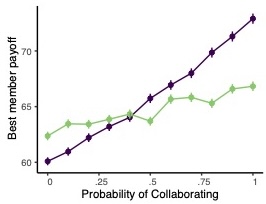
Collaboration enables groups to solve problems beyond the reach of their individual members in contexts ranging from research and development to high-energy physics. While communication networks play a pivotal role in group success, there is a longstanding debate on the optimal network topology for solving complex problems. Prior research reaches contradictory conclusions–some studies suggest networks that slow information transmission help maintain diversity, leading groups to explore more of the problem space and find better solutions in the long run, while others argue that networks that maximize communication efficiency allow groups to exploit known solutions, boosting overall performance. Many existing models assume that individuals use their network connections only to copy better-performing group members, but we show that such groups often perform worse than if individuals worked independently. Instead, our model introduces a crucial distinction: in addition to copying, individuals can actively collaborate, leveraging diverse perspectives to uncover solutions that would otherwise remain inaccessible. Our findings reveal that the optimal network structure depends on the balance between copying and collaboration. When copying dominates, inefficient, exploration-focused networks lead to better outcomes. However, when individuals primarily collaborate, highly connected, efficient networks win out. We also show how groups can reap the benefits of both strategies by employing a collaborate first-copy later heuristic in highly connected networks. The results offer new insights into how organizations should be structured to maximize problem-solving performance across different contexts.

Read the full article at: www.nature.com

The Physics of News, Rumors, and Opinions

Guido Caldarelli, Oriol Artime, Giulia Fischetti, Stefano Guarino, Andrzej Nowak, Fabio Saracco, Petter Holme, Manlio de Domenico
The boundaries between physical and social networks have narrowed with the advent of the Internet and its pervasive platforms. This has given rise to a complex adaptive information ecosystem where individuals and machines compete for attention, leading to emergent collective phenomena. The flow of information in this ecosystem is often non-trivial and involves complex user strategies from the forging or strategic amplification of manipulative content to large-scale coordinated behavior that trigger misinformation cascades, echo-chamber reinforcement, and opinion polarization. We argue that statistical physics provides a suitable and necessary framework for analyzing the unfolding of these complex dynamics on socio-technological systems. This review systematically covers the foundational and applied aspects of this framework. The review is structured to first establish the theoretical foundation for analyzing these complex systems, examining both structural models of complex networks and physical models of social dynamics (e.g., epidemic and spin models). We then ground these concepts by describing the modern media ecosystem where these dynamics currently unfold, including a comparative analysis of platforms and the challenge of information disorders. The central sections proceed to apply this framework to two central phenomena: first, by analyzing the collective dynamics of information spreading, with a dedicated focus on the models, the main empirical insights, and the unique traits characterizing misinformation; and second, by reviewing current models of opinion dynamics, spanning discrete, continuous, and coevolutionary approaches. In summary, we review both empirical findings based on massive data analytics and theoretical advances, highlighting the valuable insights obtained from physics-based efforts to investigate these phenomena of high societal impact.

Read the full article at: arxiv.org

Competition between simple and complex contagion on temporal networks

Elsa Andres, Romualdo Pastor-Satorras, Michele Starnini, and Márton Karsai

Phys. Rev. Research 7, 043088

Behavioral adoptions of individuals are influenced by their peers in different ways. While in some cases an individual may change behavior after a single incoming influence, in other cases multiple cumulated attempts of social influence are necessary for the same outcome. These two mechanisms, known as simple and complex contagion, often occur together in social contagion phenomena, yet their distinguishability based on the observable contagion dynamics is challenging. In this paper we define a social contagion model evolving on temporal networks where individuals can switch between contagion mechanisms. We explore three spreading scenarios: predominated by simple or complex contagion, or where the dominant mechanism changes during the unfolding process. We propose analytical and numerical methods relying on global spreading observables to identify which of these three scenarios characterizes a social spreading outbreak. This work offers insights into social contagion dynamics on temporal networks, without assuming prior knowledge about the contagion mechanism driving the adoptions of individuals.

Read the full article at: link.aps.org