Category: Papers

Data-driven discovery of coordinates and governing equations

Governing equations are essential to the study of physical systems, providing models that can generalize to predict previously unseen behaviors. There are many systems of interest across disciplines where large quantities of data have been collected, but the underlying governing equations remain unknown. This work introduces an approach to discover governing models from data. The proposed method addresses a key limitation of prior approaches by simultaneously discovering coordinates that admit a parsimonious dynamical model. Developing parsimonious and interpretable governing models has the potential to transform our understanding of complex systems, including in neuroscience, biology, and climate science.


Data-driven discovery of coordinates and governing equations
Kathleen Champion, Bethany Lusch, J. Nathan Kutz, and Steven L. Brunton
PNAS November 5, 2019 116 (45) 22445-22451; first published October 21, 2019 https://doi.org/10.1073/pnas.1906995116

Source: www.pnas.org

Quantifying the dynamics of failure across science, startups and security

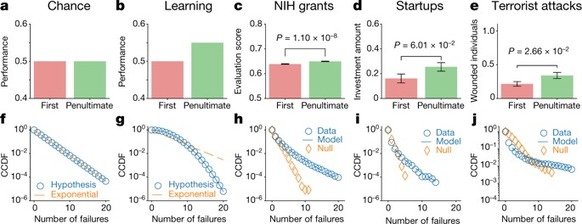
Human achievements are often preceded by repeated attempts that fail, but little is known about the mechanisms that govern the dynamics of failure. Here, building on previous research relating to innovation1,2,3,4,5,6,7, human dynamics8,9,10,11 and learning12,13,14,15,16,17, we develop a simple one-parameter model that mimics how successful future attempts build on past efforts. Solving this model analytically suggests that a phase transition separates the dynamics of failure into regions of progression or stagnation and predicts that, near the critical threshold, agents who share similar characteristics and learning strategies may experience fundamentally different outcomes following failures. Above the critical point, agents exploit incremental refinements to systematically advance towards success, whereas below it, they explore disjoint opportunities without a pattern of improvement. The model makes several empirically testable predictions, demonstrating that those who eventually succeed and those who do not may initially appear similar, but can be characterized by fundamentally distinct failure dynamics in terms of the efficiency and quality associated with each subsequent attempt. We collected large-scale data from three disparate domains and traced repeated attempts by investigators to obtain National Institutes of Health (NIH) grants to fund their research, innovators to successfully exit their startup ventures, and terrorist organizations to claim casualties in violent attacks. We find broadly consistent empirical support across all three domains, which systematically verifies each prediction of our model. Together, our findings unveil detectable yet previously unknown early signals that enable us to identify failure dynamics that will lead to ultimate success or failure. Given the ubiquitous nature of failure and the paucity of quantitative approaches to understand it, these results represent an initial step towards the deeper understanding of the complex dynamics underlying failure.


Quantifying the dynamics of failure across science, startups and security
Yian Yin, Yang Wang, James A. Evans & Dashun Wang 
Nature volume 575, pages190–194(2019)

Source: www.nature.com

Nature’s reach: narrow work has broad impact

How knowledge informs and alters disciplines is itself an enlightening, and vibrant field1. This type of meta research into new findings, insights, conceptual frameworks and techniques is important, among other things, for policymakers who fund research in the hope of tackling society’s most pressing challenges, which inevitably span disciplines.

Since its founding in 1869, Nature has offered a venue for publishing major advances from many fields. To mark its anniversary, we track here how papers cite and are cited across disciplines, using data on tens of millions of scientific articles indexed in Clarivate Analytics’ Web of Science (WoS), a bibliometric database that encompasses many thousands of research journals starting from 1900. We pay particular attention to articles that appeared in Nature. In our view, this snapshot, for all its idiosyncrasies, reveals how scientific work is ever more becoming a mixture of disciplines.


Nature’s reach: narrow work has broad impact
A scientific paper today is inspired by more disciplines than ever before, shows a new analysis marking the journal’s 150th anniversary.
Alexander J. Gates, Qing Ke, Onur Varol & Albert-László Barabási

Source: www.nature.com

Ethics and Complexity: Why standard ethical frameworks cannot cope with socio-technological change

Standard ethical frameworks struggle to deal with transhumanism, ecological issues and the rising technodiversity because they are focused on guiding and evaluating human behavior. Ethics needs its Copernican revolution to be able to deal with all moral agents, including not only humans, but also artificial intelligent agents, robots or organizations of all sizes. We argue that embracing the complexity worldview is the first step towards this revolution, and that standard ethical frameworks are still entrenched in the Newtonian worldview. We first spell out the foundational assumptions of the Newtonian worldview, where all change is reduced to material particles following predetermined trajectories governed by the laws of nature. However, modern physical theories such as relativity, quantum mechanics, chaos theory and thermodynamics have drawn a much more confusing and uncertain picture, and inspired indecisive, subjectivist, relativist, nihilist or postmodern worldviews. Based on cybernetics, systems theory and the new sciences of complexity, we introduce the complexity worldview that sees the world as interactions and their emergent organizations. We use this complexity worldview to show the limitations of standard ethical frameworks such as deontology, theology, consequentialism, virtue ethics, evolutionary ethics and pragmatism. Keywords: Complexity, philosophy, ethics, cybernetics, transhumanism, universal ethics, systems ethics.


Ethics and Complexity: Why standard ethical frameworks cannot cope with socio-technological change
Clément Vidal & Francis Heylighen

Source: philpapers.org

Predicting Urban Innovation from the Workforce Mobility Network in US

While great emphasis has been placed on the role of social interactions as driver of innovation growth, very few empirical studies have explicitly investigated the impact of social network structures on the innovation performance of cities. Past research has mostly explored scaling laws of socio-economic outputs of cities as determined by, for example, the single predictor of population. Here, by drawing on a publicly available dataset of the startup ecosystem, we build the first Workforce Mobility Network among US metropolitan areas. We found that node centrality computed on this network accounts for most of the variability observed in cities’ innovation performance and significantly outperforms other predictors such as population size or density, suggesting that policies and initiatives aiming at sustaining innovation processes might benefit from fostering professional networks alongside other economic or systemic incentives. As opposed to previous approaches powered by census data, our model can be updated in real-time upon open databases, opening up new opportunities both for researchers in a variety of disciplines to study urban economies in new ways, and for practitioners to design tools for monitoring such economies in real-time.


Predicting Urban Innovation from the Workforce Mobility Network in US
Moreno Bonaventura, Luca Maria Aiello, Daniele Quercia, Vito Latora

Source: arxiv.org