Category: Papers

U.S. Social Fragmentation at Multiple Scales

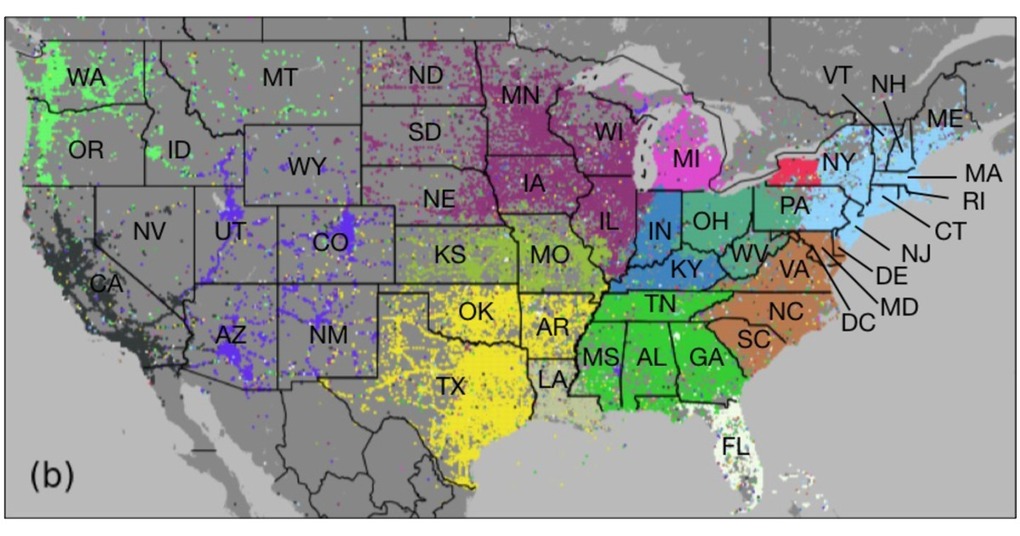
Despite global connectivity, societies seem to be increasingly polarized and fragmented. This phenomenon is rooted in the underlying complex structure and dynamics of social systems. Far from homogeneously mixing or adopting conforming views, individuals self-organize into groups at multiple scales, ranging from families up to cities and cultures. In this paper, we study the fragmented structure of the American society using mobility and communication networks obtained from geo-located social media data. We find self-organized patches with clear geographical borders that are consistent between physical and virtual spaces. The patches have multi-scale structure ranging from parts of a city up to the entire nation. Their significance is reflected in distinct patterns of collective interests and conversations. Finally, we explain the patch emergence by a model of network growth that combines mechanisms of geographical distance gravity, preferential attachment, and spatial growth. Our observations are consistent with the emergence of social groups whose separated association and communication reinforce distinct identities. Rather than eliminating borders, the virtual space reproduces them as people mirror their offline lives online. Understanding the mechanisms driving the emergence of fragmentation in hyper-connected social systems is imperative in the age of the Internet and globalization.


Leila Hedayatifar, Rachel A. Rigg, Yaneer Bar-Yam, and Alfredo J. Morales, U.S. social fragmentation at multiple scales, Journal of the Royal Society Interface (October 8, 2019).

Source: necsi.edu
Anger while driving in Mexico City

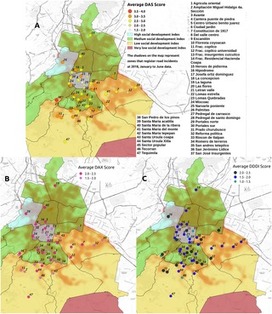
This study aims to analyze the level of anger developed by drivers in Mexico City and also understand the behavior that those drivers use to express that anger, using four different survey methods. The first focuses on personal information, the second Driving Anger Expression Inventory (DAX), the third refers to a shorten version of Driving Anger Scale (DAS) and the fourth being the Dula Dangerous Driving Index (DDDI). These have previously been applied and validated in several different countries. The questionnaires were filled out online by 626 drivers. Using the data collected through the online platform, it was possible to identify the kind of reactions volunteers displayed while driving. Also, it was possible to identify that people in Mexico City developed anger depending on their driving area. Our analyses shows that in the Adaptive/Constructive Expression subscale, males and females show a significant difference in their mean score, with women express their anger in a more constructive way than males.


Hernández-Hernández AM, Siqueiros-García JM, Robles-Belmont E, Gershenson C (2019) Anger while driving in Mexico City. PLoS ONE 14(9): e0223048. https://doi.org/10.1371/journal.pone.0223048

Source: journals.plos.org

Chaos Scientist Finds Hidden Financial Risks That Regulators Miss

Today, in a more bucolic setting—the Institute for New Economic Thinking at the Oxford Martin School—Farmer is drawing on decades of complexity research that began with roulette. After winning acclaim as a pioneer of chaos theory, which helps explain the unpredictability of complex systems such as the weather, he jumped into markets, co-founding one of the early quantitative investment firms in the 1990s. Now, Farmer and a band of central bank researchers are focusing on the tangled web of global finance, using a tool of the natural sciences called agent-based models to find dangers lurking in the system and uncover ways to avoid them.

Source: www.bloomberg.com

Social Network Analysis for Social Neuroscientists

Although social neuroscience is concerned with understanding how the brain interacts with its social environment, prevailing research in the field has primarily considered the human brain in isolation, deprived of its rich social context. Emerging work in social neuroscience that leverages tools from network analysis has begun to pursue this issue, advancing knowledge of how the human brain influences and is influenced by the structures of its social environment. In this paper, we provide an overview of key theory and methods in network analysis (especially for social systems) as an introduction for social neuroscientists who are interested in relating individual cognition to the structures of an individual’s social environments. We also highlight some exciting new work as examples of how to productively use these tools to investigate questions of relevance to social neuroscientists. We include tutorials to help with practical implementation of the concepts that we discuss. We conclude by highlighting the broad range of exciting research opportunities for social neuroscientists who are interested in using network analysis to study social systems.


Baek, Elisa, Mason A. Porter, and Carolyn Parkinson. 2019. “Social Network Analysis for Social Neuroscientists.” PsyArXiv. September 26. doi:10.31234/osf.io/kgc2h.

Source: psyarxiv.com