Category: Papers

How Much Would You Pay to Change a Game before Playing It?

Envelope theorems provide a differential framework for determining how much a rational decision maker (DM) is willing to pay to alter the parameters of a strategic scenario. We generalize this framework to the case of a boundedly rational DM and arbitrary solution concepts. We focus on comparing and contrasting the case where DM’s decision to pay to change the parameters is observed by all other players against the case where DM’s decision is private information. We decompose DM’s willingness to pay a given amount into a sum of three factors: (1) the direct effect a parameter change would have on DM’s payoffs in the future strategic scenario, holding strategies of all players constant; (2) the effect due to DM changing its strategy as they react to a change in the game parameters, with the strategies of the other players in that scenario held constant; and (3) the effect there would be due to other players reacting to a the change in the game parameters (could they observe them), with the strategy of DM held constant. We illustrate these results with the quantal response equilibrium and the matching pennies game and discuss how the willingness to pay captures DM’s anticipation of their future irrationality.


How Much Would You Pay to Change a Game before Playing It?
David Wolpert and Justin Grana

Entropy 2019, 21(7), 686

Source: www.mdpi.com
Connecting empirical phenomena and theoretical models of biological coordination across scales

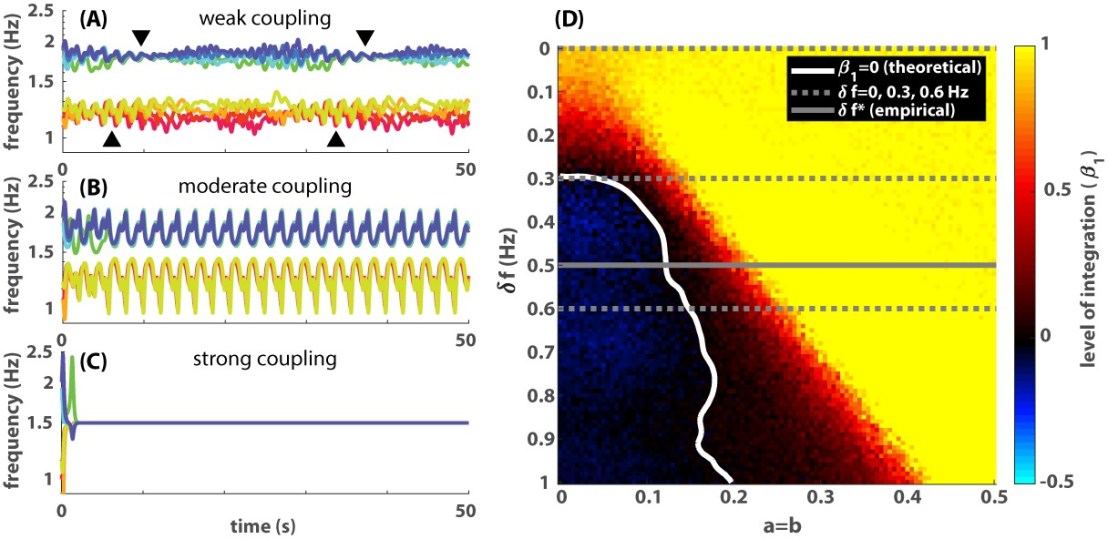
Coordination in living systems—from cells to people—must be understood at multiple levels of description. Analyses and modelling of empirically observed patterns of biological coordination often focus either on ensemble-level statistics in large-scale systems with many components, or on detailed dynamics in small-scale systems with few components. The two approaches have proceeded largely independent of each other. To bridge this gap between levels and scales, we have recently conducted a human experiment of mid-scale social coordination specifically designed to reveal coordination at multiple levels (ensemble, subgroups and dyads) simultaneously. Based on this experiment, the present work shows that, surprisingly, a single system of equations captures key observations at all relevant levels. It also connects empirically validated models of large- and small-scale biological coordination—the Kuramoto and extended Haken–Kelso–Bunz (HKB) models—and the hallmark phenomena that each is known to capture. For example, it exhibits both multistability and metastability observed in small-scale empirical research (via the second-order coupling and symmetry breaking in extended HKB) and the growth of biological complexity as a function of scale (via the scalability of the Kuramoto model). Only by incorporating both of these features simultaneously can we reproduce the essential coordination behaviour observed in our experiment.


Connecting empirical phenomena and theoretical models of biological coordination across scales
Mengsen Zhang , Christopher Beetle , J. A. Scott Kelso and Emmanuelle Tognoli

JRS Interface

Source: royalsocietypublishing.org

Global labor flow network reveals the hierarchical organization and dynamics of geo-industrial clusters

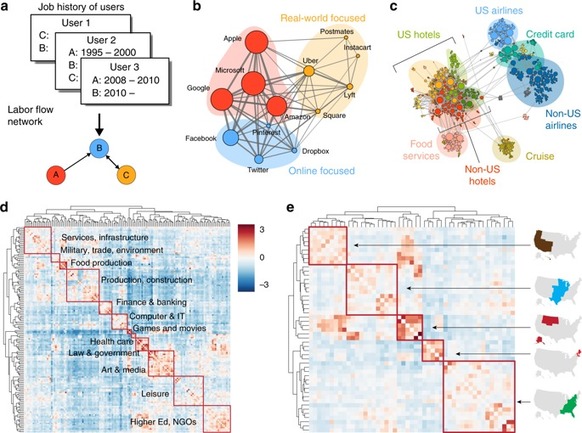
Groups of firms often achieve a competitive advantage through the formation of geo-industrial clusters. Although many exemplary clusters are the subjects of case studies, systematic approaches to identify and analyze the hierarchical structure of geo-industrial clusters at the global scale are scarce. In this work, we use LinkedIn’s employment history data from more than 500 million users over 25 years to construct a labor flow network of over 4 million firms across the world, from which we reveal hierarchical structure by applying network community detection. We show that the resulting geo-industrial clusters exhibit a stronger association between the influx of educated workers and financial performance, compared to traditional aggregation units. Furthermore, our analysis of the skills of educated workers reveals richer insights into the relationship between the labor flow of educated workers and productivity growth. We argue that geo-industrial clusters defined by labor flow provide useful insights into the growth of the economy.


Global labor flow network reveals the hierarchical organization and dynamics of geo-industrial clusters
Jaehyuk Park, Ian B. Wood, Elise Jing, Azadeh Nematzadeh, Souvik Ghosh, Michael D. Conover & Yong-Yeol Ahn
Nature Communications volume 10, Article number: 3449 (2019)

Source: www.nature.com

Fundamental Structures in Dynamic Communication Networks

In this paper I introduce a framework for modeling temporal communication networks and dynamical processes unfolding on such networks. The framework originates from the realization that there is a meaningful division of temporal communication networks into six dynamic classes, where the class of a network is determined by its generating process. In particular, each class is characterized by a fundamental structure: a temporal-topological network motif, which corresponds to the network representation of communication events in that class of network. These fundamental structures constrain network configurations: only certain configurations are possible within a dynamic class. In this way the framework presented here highlights strong constraints on network structures, which simplify analyses and shape network flows. Therefore the fundamental structures hold the potential to impact how we model temporal networks overall. I argue below that networks within the same class can be meaningfully compared, and modeled using similar techniques, but that integrating statistics across networks belonging to separate classes is not meaningful in general. This paper presents a framework for how to analyze networks in general, rather than a particular result of analyzing a particular dataset. I hope, however, that readers interested in modeling temporal networks will find the ideas and discussion useful in spite of the paper’s more conceptual nature.


Fundamental Structures in Dynamic Communication Networks
Sune Lehmann

Source: arxiv.org

Strategies and limitations in app usage and human mobility

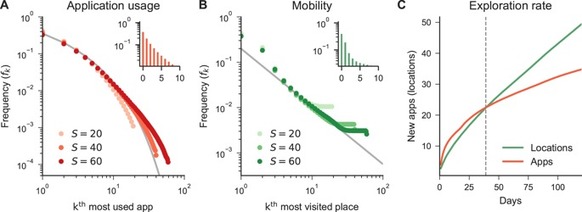
Cognition has been found to constrain several aspects of human behaviour, such as the number of friends and the number of favourite places a person keeps stable over time. This limitation has been empirically defined in the physical and social spaces. But do people exhibit similar constraints in the digital space? We address this question through the analysis of pseudonymised mobility and mobile application (app) usage data of 400,000 individuals in a European country for six months. Despite the enormous heterogeneity of apps usage, we find that individuals exhibit a conserved capacity that limits the number of applications they regularly use. Moreover, we find that this capacity steadily decreases with age, as does the capacity in the physical space but with more complex dynamics. Even though people might have the same capacity, applications get added and removed over time. In this respect, we identify two profiles of individuals: app keepers and explorers, which differ in their stable (keepers) vs exploratory (explorers) behaviour regarding their use of mobile applications. Finally, we show that the capacity of applications predicts mobility capacity and vice-versa. By contrast, the behaviour of keepers and explorers may considerably vary across the two domains. Our empirical findings provide an intriguing picture linking human behaviour in the physical and digital worlds which bridges research studies from Computer Science, Social Physics and Computational Social Sciences.


Strategies and limitations in app usage and human mobility
Marco De Nadai, Angelo Cardoso, Antonio Lima, Bruno Lepri & Nuria Oliver 
Scientific Reportsvolume 9, Article number: 10935 (2019)

Source: www.nature.com