Category: Papers

Bittorio revisited: structural coupling in the Game of Life

The notion of structural coupling plays a central role in Maturana and Varela’s biology of cognition framework and strongly influenced Varela’s subsequent enactive elaboration of this framework. Building upon previous work using a glider in the Game of Life (GoL) cellular automaton as a toy model of a minimal autopoietic system with which to concretely explore these theoretical frameworks, this article presents an analysis of structural coupling between a glider and its environment. Specifically, for sufficiently small GoL universes, we completely characterize the nonautonomous dynamics of both a glider and its environment in terms of interaction graphs, derive the set of possible glider lives determined by the mutual constraints between these interaction graphs, and show how such lives are embedded in the state transition graph of the entire GoL universe.


Bittorio revisited: structural coupling in the Game of Life
Randall D Beer

Adaptive Behavior

Source: journals.sagepub.com
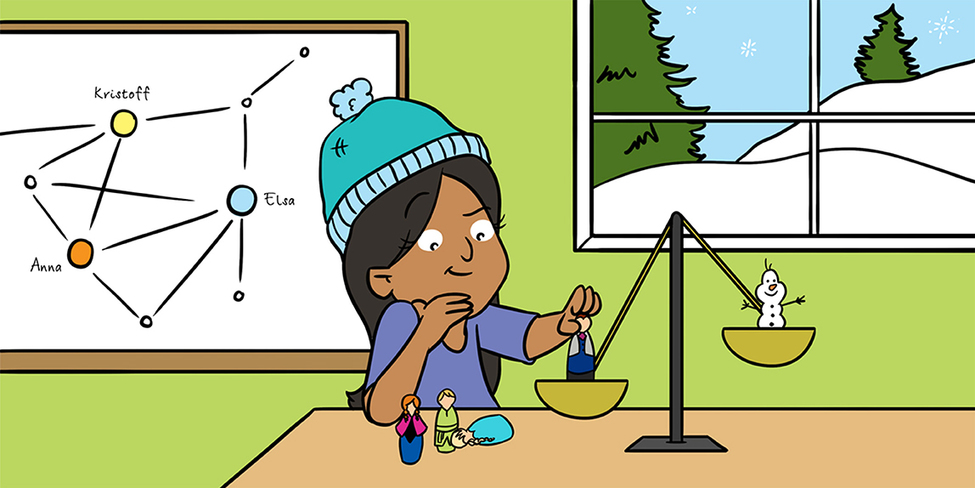
Who Is the Most Important Character in Frozen? What Networks Can Tell Us About the World

How do we determine the important characters in a movie like Frozen? We can watch it, of course, but there are also other ways—using mathematics and computers—to see who is important in the social network of a story. The idea is to compute numbers called centralities, which give ways of measuring who is important in networks. In this paper, we illustrate how different types of centralities measure importance in different ways. We also discuss how centralities are used to study many kinds of networks, not just social ones. In ongoing work, scientists are now developing centrality measures that also consider changes over time and different types of relationships.


Holme P, Porter M and Sayama H (2019) Who Is the Most Important Character in Frozen? What Networks Can Tell Us About the World. Front. Young Minds. 7:99. doi: 10.3389/frym.2019.00099

Source: kids.frontiersin.org

Predicting neighborhoods’ socioeconomic attributes using restaurant data

High-resolution socioeconomic data are crucial for place-based policy design and implementation, but it remains scarce for many developing cities and countries. We show that an easily accessible and timely updated neighborhood attribute, restaurant, when combined with machine-learning models, can be used to effectively predict a range of socioeconomic attributes. This approach allows us to collect training samples from representative neighborhoods and then use our trained model to infer unsampled neighborhoods in the city in a granular, timely, and low-cost manner. The good cross-city transferability performance of our model can also help bridge the “data gap” between cities, by training the model in cities with rich survey data and then applying it to cities where such data are unavailable.


Predicting neighborhoods’ socioeconomic attributes using restaurant data

Lei Dong, Carlo Ratti, and Siqi Zheng
PNAS

Source: www.pnas.org

Estimating the success of re-identifications in incomplete datasets using generative models

While rich medical, behavioral, and socio-demographic data are key to modern data-driven research, their collection and use raise legitimate privacy concerns. Anonymizing datasets through de-identification and sampling before sharing them has been the main tool used to address those concerns. We here propose a generative copula-based method that can accurately estimate the likelihood of a specific person to be correctly re-identified, even in a heavily incomplete dataset. On 210 populations, our method obtains AUC scores for predicting individual uniqueness ranging from 0.84 to 0.97, with low false-discovery rate. Using our model, we find that 99.98% of Americans would be correctly re-identified in any dataset using 15 demographic attributes. Our results suggest that even heavily sampled anonymized datasets are unlikely to satisfy the modern standards for anonymization set forth by GDPR and seriously challenge the technical and legal adequacy of the de-identification release-and-forget model.


Estimating the success of re-identifications in incomplete datasets using generative models
Luc Rocher, Julien M. Hendrickx & Yves-Alexandre de Montjoye
Nature Communicationsvolume 10, Article number: 3069 (2019)

Source: www.nature.com