
Category: Papers

Automatic Off-Line Design of Robot Swarms: A Manifesto

Designing collective behaviors for robot swarms is a difficult endeavor due to their fully distributed, highly redundant, and ever-changing nature. To overcome the challenge, a few approaches have been proposed, which can be classified as manual, semi-automatic, or automatic design. This paper is intended to be the manifesto of the automatic off-line design for robot swarms. We define the off-line design problem and illustrate it via a possible practical realization, highlight the core research questions, raise a number of issues regarding the existing literature that is relevant to the automatic off-line design, and provide guidelines that we deem necessary for a healthy development of the domain and for ensuring its relevance to potential real-world applications.


Automatic Off-Line Design of Robot Swarms: A Manifesto

Mauro Birattari, et al.

Front. Robot. AI, 19 July 2019

Source: www.frontiersin.org
Information Pollution by Social Bots

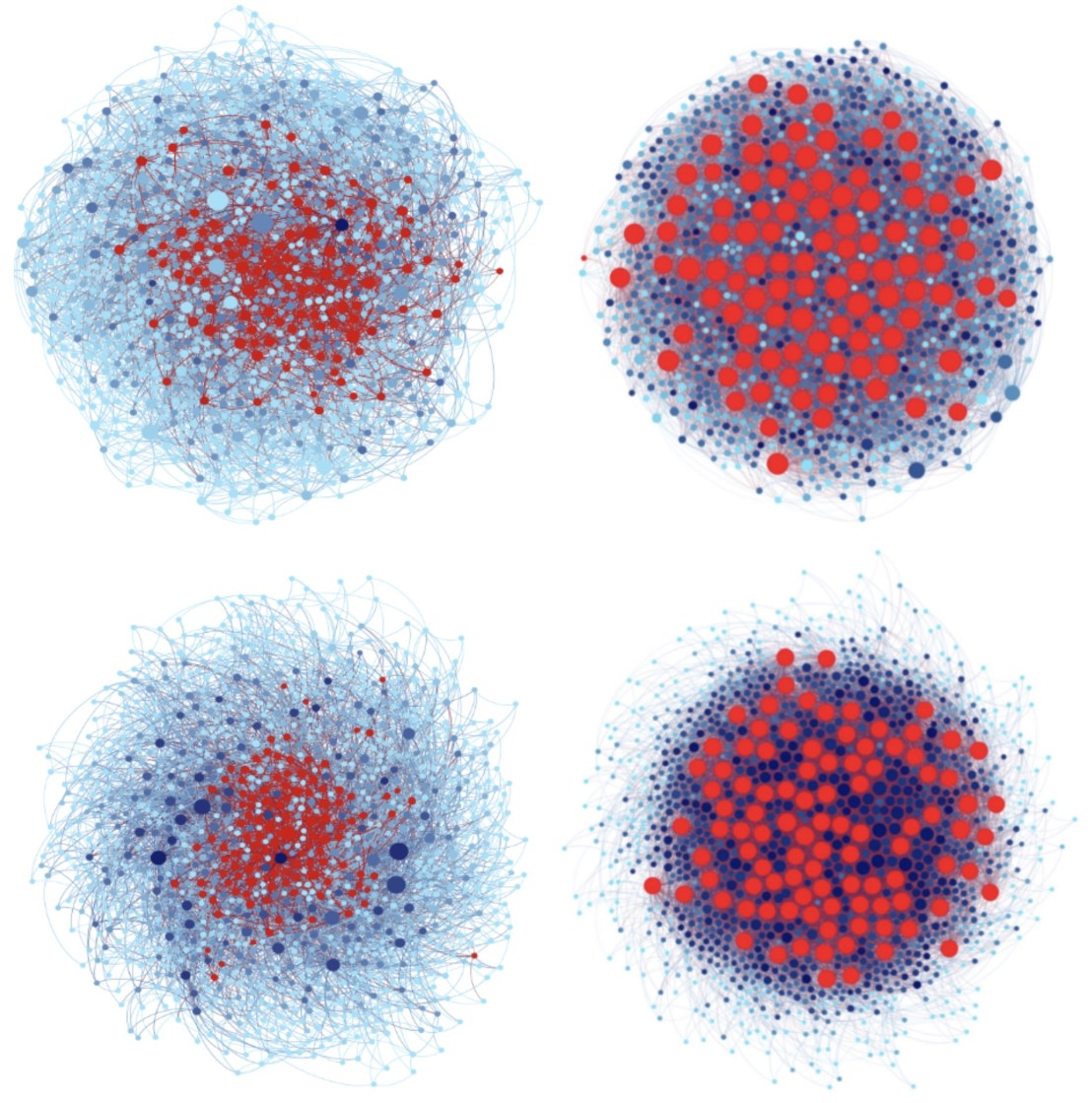
Social media are vulnerable to deceptive social bots, which can impersonate humans to amplify misinformation and manipulate opinions. Little is known about the large-scale consequences of such pollution operations. Here we introduce an agent-based model of information spreading with quality preference and limited individual attention to evaluate the impact of different strategies that bots can exploit to pollute the network and degrade the overall quality of the information ecosystem. We find that penetrating a critical fraction of the network is more important than generating attention-grabbing content and that targeting random users is more damaging than targeting hub nodes. The model is able to reproduce empirical patterns about exposure amplification and virality of low-quality information. We discuss insights provided by our analysis, with a focus on the development of countermeasures to increase the resilience of social media users to manipulation.


Information Pollution by Social Bots

Xiaodan Lou, Alessandro Flammini, Filippo Menczer

Source: arxiv.org

Complexity in Medical Informatics

The topics of the accepted articles include but are not limited to the following: machine and deep learning approaches for health data; data mining and knowledge discovery in healthcare; clinical decision support systems; applications of the genetic algorithm in disease screening, diagnosis, and treatment planning; neurofuzzy system based on genetic algorithm for medical diagnosis and therapy support systems; applications of AI in healthcare; applications of artificial neural networks in medical science; electronic medical record and missing data; network and disease modeling (using administrative data); and health analytics and visualization.


Complexity
Volume 2019, Article ID 8658124, 2 pages
https://doi.org/10.1155/2019/8658124
Editorial
Complexity in Medical Informatics
Panagiotis Vlamos, Ilias Kotsireas, and Dimitrios Vlachakis

Source: www.hindawi.com

Historical comparison of gender inequality in scientific careers across countries and disciplines

There is extensive, yet fragmented, evidence of gender differences in academia suggesting that women are under-represented in most scientific disciplines, publish fewer articles throughout a career, and their work acquires fewer citations. Here, we offer a comprehensive picture of longitudinal gender discrepancies in performance through a bibliometric analysis of academic careers by reconstructing the complete publication history of over 1.5 million gender-identified authors whose publishing career ended between 1955 and 2010, covering 83 countries and 13 disciplines. We find that, paradoxically, the increase of participation of women in science over the past 60 years was accompanied by an increase of gender differences in both productivity and impact. Most surprisingly though, we uncover two gender invariants, finding that men and women publish at a comparable annual rate and have equivalent career-wise impact for the same size body of work. Finally, we demonstrate that differences in dropout rates and career length explain a large portion of the reported career-wise differences in productivity and impact. This comprehensive picture of gender inequality in academia can help rephrase the conversation around the sustainability of women’s careers in academia, with important consequences for institutions and policy makers.


Historical comparison of gender inequality in scientific careers across countries and disciplines

Junming Huang, Alexander J. Gates, Roberta Sinatra, Albert-Laszlo Barabasi

Source: arxiv.org

Embodied robots driven by self-organized environmental feedback

Which kind of complex behavior may arise from self-organizing principles? We investigate this question for the case of snake-like robots composed of passively coupled segments, with every segment containing two wheels actuated separately by a single neuron. The robot is self-organized both on the level of the individual wheels and with respect to inter-wheel coordination, which arises exclusively from the mechanical coupling of the individual wheels and segments. For the individual wheel, the generating principle proposed results in locomotive states that correspond to self-organized limit cycles of the sensorimotor loop. Our robot interacts with the environment by monitoring the state of its actuators, that is, via propriosensation. External sensors are absent. In a structured environment the robot shows complex emergent behavior that includes pushing movable blocks around, reversing direction when hitting a wall, and turning when climbing a slope. On flat grounds the robot wiggles in a snake-like manner, when moving at higher velocities. We also investigate the emergence of motor primitives, namely, the route to locomotion, which is characterized by a series of local and global bifurcations in terms of dynamical system theory.


Embodied robots driven by self-organized environmental feedback
Frederike Kubandt, Michael Nowak, Tim Koglin, Claudius Gros, Bulcsú Sándor

Adaptive Behavior

Source: journals.sagepub.com