
Category: Papers

Element-centric clustering comparison unifies overlaps and hierarchy

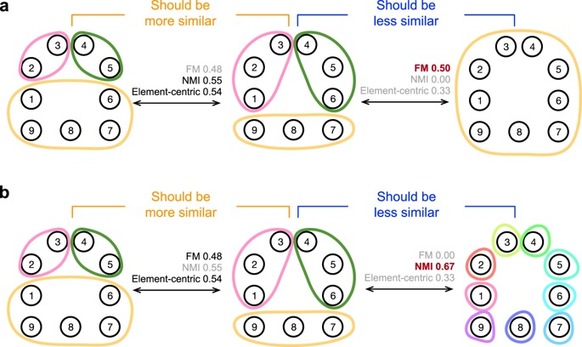
Clustering is one of the most universal approaches for understanding complex data. A pivotal aspect of clustering analysis is quantitatively comparing clusterings; clustering comparison is the basis for many tasks such as clustering evaluation, consensus clustering, and tracking the temporal evolution of clusters. In particular, the extrinsic evaluation of clustering methods requires comparing the uncovered clusterings to planted clusterings or known metadata. Yet, as we demonstrate, existing clustering comparison measures have critical biases which undermine their usefulness, and no measure accommodates both overlapping and hierarchical clusterings. Here we unify the comparison of disjoint, overlapping, and hierarchically structured clusterings by proposing a new element-centric framework: elements are compared based on the relationships induced by the cluster structure, as opposed to the traditional cluster-centric philosophy. We demonstrate that, in contrast to standard clustering similarity measures, our framework does not suffer from critical biases and naturally provides unique insights into how the clusterings differ. We illustrate the strengths of our framework by revealing new insights into the organization of clusters in two applications: the improved classification of schizophrenia based on the overlapping and hierarchical community structure of fMRI brain networks, and the disentanglement of various social homophily factors in Facebook social networks. The universality of clustering suggests far-reaching impact of our framework throughout all areas of science.


Element-centric clustering comparison unifies overlaps and hierarchy
Alexander J. Gates, Ian B. Wood, William P. Hetrick & Yong-Yeol Ahn 
Scientific Reportsvolume 9, Article number: 8574 (2019)

Source: www.nature.com

A free energy principle for a particular physics

This monograph attempts a theory of every ‘thing’ that can be distinguished from other things in a statistical sense. The ensuing statistical independencies, mediated by Markov blankets, speak to a recursive composition of ensembles (of things) at increasingly higher spatiotemporal scales. This decomposition provides a description of small things; e.g., quantum mechanics – via the Schrodinger equation, ensembles of small things – via statistical mechanics and related fluctuation theorems, through to big things – via classical mechanics. These descriptions are complemented with a Bayesian mechanics for autonomous or active things. Although this work provides a formulation of every thing, its main contribution is to examine the implications of Markov blankets for self-organisation to nonequilibrium steady-state. In brief, we recover an information geometry and accompanying free energy principle that allows one to interpret the internal states of something as representing or making inferences about its external states. The ensuing Bayesian mechanics is compatible with quantum, statistical and classical mechanics and may offer a formal description of lifelike particles.


A free energy principle for a particular physics

Karl Friston

Source: arxiv.org

Rank-frequency distribution of natural languages: A difference of probabilities approach

• The dynamics of frequency-rank relations in six languages is analyzed.

• Acceptable agreement is found for the quenched rank frequency data of these languages.

• This approach might find applications in other ranked systems, such as sports.


Rank-frequency distribution of natural languages: A difference of probabilities approach

Germinal Cocho, Rosalío F. Rodríguez, Sergio Sánchez, Jorge Flores, Carlos Pineda, Carlos Gershenson

Physica A: Statistical Mechanics and its Applications
Volume 532, 15 October 2019, 121795

Source: www.sciencedirect.com

Information-theoretic measures of ecosystem change, sustainability, and resilience

We introduce five measures describing the system-wide behaviour of complex ecological systems. Within an information-theoretic framework, these measures account for changes in both species diversity and total biomass to describe (i) overall system change, (ii) sustainability to external pressure, (iii) shift from a baseline state and two types of resilience: (iv) ability to recover from local pressures and (v) overall potential to return to a baseline state. We apply these measures to study the behaviour of three computer models: a large 59-functional groups complex ecological model (Ecopath with Ecosim) of north Western Australia undergoing internal dynamics, a smaller 6-group coral reef model subjected to various combinations of single and multiple stressors and a prey–predator model displaying limit cycles. We demonstrate the state-dependency of properties like resilience and sustainability by showing how these measures change in time as a function of internal dynamics and external forcing. Furthermore, we show how our proposed measures can simplify system analysis and monitoring by providing indicators of changes in system behaviour, sustainability, and resilience.


Information-theoretic measures of ecosystem change, sustainability, and resilience
Fabio Boschetti Karine Prunera Mathew A Vanderklift Damian P Thomson Russell C Babcock Christopher Doropoulos Anna Cresswell Hector Lozano-Montes
ICES Journal of Marine Science, fsz105

Source: academic.oup.com