
Category: Papers

Open-Ended Evolution and Open-Endedness: Editorial Introduction to the Open-Ended Evolution Special Issue

Nature’s spectacular inventiveness, reflected in the enormous diversity of form and function displayed by the biosphere, is a feature of life that distinguishes living most strongly from nonliving. It is, therefore, not surprising that this aspect of life should become a central focus of artificial life. We have known since Darwin that the diversity is produced dynamically, through the process of evolution; this has led life’s creative productivity to be called Open-Ended Evolution (OEE) in the field. This article introduces the first of two special issues on current research on OEE and on the more general concept of open-endedness. Most of the papers presented in these special issues are elaborations of work presented at the Third Workshop on Open-Ended Evolution, held in Tokyo as part of the 2018 Conference on Artificial Life.


Open-Ended Evolution and Open-Endedness: Editorial Introduction to the Open-Ended Evolution Special Issue
Norman Packard, Mark A. Bedau, Alastair Channon, Takashi Ikegami,

https://doi.org/10.1162/artl_e_00282
Artificial Life
Volume 25 | Issue 1 | Winter 2019
p.1-3

Source: www.mitpressjournals.org
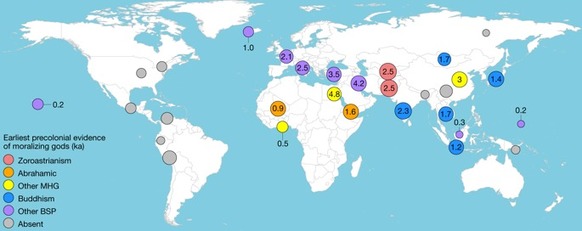
Complex societies precede moralizing gods throughout world history

The origins of religion and of complex societies represent evolutionary puzzles. The ‘moralizing gods’ hypothesis offers a solution to both puzzles by proposing that belief in morally concerned supernatural agents culturally evolved to facilitate cooperation among strangers in large-scale societies. Although previous research has suggested an association between the presence of moralizing gods and social complexity, the relationship between the two is disputed, and attempts to establish causality have been hampered by limitations in the availability of detailed global longitudinal data. To overcome these limitations, here we systematically coded records from 414 societies that span the past 10,000 years from 30 regions around the world, using 51 measures of social complexity and 4 measures of supernatural enforcement of morality. Our analyses not only confirm the association between moralizing gods and social complexity, but also reveal that moralizing gods follow—rather than precede—large increases in social complexity. Contrary to previous predictions, powerful moralizing ‘big gods’ and prosocial supernatural punishment tend to appear only after the emergence of ‘megasocieties’ with populations of more than around one million people. Moralizing gods are not a prerequisite for the evolution of social complexity, but they may help to sustain and expand complex multi-ethnic empires after they have become established. By contrast, rituals that facilitate the standardization of religious traditions across large populations25,26 generally precede the appearance of moralizing gods. This suggests that ritual practices were more important than the particular content of religious belief to the initial rise of social complexity.


Complex societies precede moralizing gods throughout world history
Harvey Whitehouse, Pieter François, Patrick E. Savage, Thomas E. Currie, Kevin C. Feeney, Enrico Cioni, Rosalind Purcell, Robert M. Ross, Jennifer Larson, John Baines, Barend ter Haar, Alan Covey & Peter Turchin
Nature (2019)

Source: www.nature.com

Algorithmic complexity of multiplex networks

Multilayer networks preserve full information about the different interactions among the constituents of a complex system, and have recently proven quite useful in modelling transportation networks, social circles, and the human brain. A fundamental and still open problem is to assess if and when the multilayer representation of a system is a qualitatively better model than the classical single-layer aggreagated network approach. Here we tackle this problem from an algorithmic information theory perspective. We propose an intuitive way to encode a multilayer network into a bit string, and we define the complexity of a multilayer network as the ratio of the Kolmogorov complexity of the bit strings associated to the multilayer and to the corresponding aggregated graph. We find that there exists a maximum amount of additional information that a multilayer model can encode with respect to an equivalent single-layer graph. We show how our measure can be used to obtain low-dimensional representations of multidimensional systems, to cluster multilayer networks into a small set of meaningful super-families, and to detect tipping points in different time-varying multilayer graphs. These results suggest that information-theoretic approaches can be effectively employed in the study of multi-dimensional complex systems, and pave the way to a more systematic analysis of static and time-varying multidimensional complex systems.


Algorithmic complexity of multiplex networks

A. Santoro, V. Nicosia

Source: arxiv.org

Identifying dynamical instabilities in supply networks using generalized modeling

Supply networks need to exhibit stability in order to remain functional. Here, we apply a generalized modeling (GM) approach, which has a strong pedigree in the analysis of dynamical systems, to study the stability of real‐world supply networks. It goes beyond purely structural network analysis approaches by incorporating material flows, which are defining characteristics of supply networks. The analysis focuses on the network of interactions between material flows, providing new conceptualizations to capture key aspects of production and inventory policies. We provide stability analyses of two contrasting real‐world networks—that of an industrial engine manufacturer and an industry‐level network in the luxury goods sector. We highlight the criticality of links with suppliers that involve the dispatch, processing, and return of parts or sub‐assemblies, cyclic motifs that involve separate paths from a common supplier to a common firm downstream, and competing demands of different end products at specific nodes. Based on a critical discussion of our findings in the context of the supply chain management literature, we generate five propositions to advance knowledge and understanding of supply network stability. We discuss the implications of the propositions for the effective management, control, and development of supply networks. The GM approach enables fast screening to identify hidden vulnerabilities in extensive supply networks.


Identifying dynamical instabilities in supply networks using generalized modeling

Güven Demirel Bart L. MacCarthy Daniel Ritterskamp Alan R. Champneys Thilo Gross

Journal of Operations Management

Volume 65, Issue 2 
Special Issue: A Complex Adaptive Systems Paradigm for Operations & Supply Chain Issues
March 2019
Pages 136-159

Source: onlinelibrary.wiley.com

Modeling cocaine traffickers and counterdrug interdiction forces as a complex adaptive system

The US government’s cocaine interdiction mission in the transit zone of Central America is now in its fifth decade despite its long-demonstrated ineffectiveness, both in cost and results. We developed a model that builds an interdisciplinary understanding of the structure and function of narco-trafficking networks and their coevolution with interdiction efforts as a complex adaptive system. The model produced realistic predictions of where and when narco-traffickers move in and around Central America in response to interdiction. The model demonstrated that narco-trafficking is as widespread and difficult to eradicate as it is because of interdiction, and increased interdiction will continue to spread traffickers into new areas, allowing them to continue to move drugs north.


Modeling cocaine traffickers and counterdrug interdiction forces as a complex adaptive system

Nicholas R. Magliocca, Kendra McSweeney, Steven E. Sesnie, Elizabeth Tellman, Jennifer A. Devine, Erik A. Nielsen, Zoe Pearson, and David J. Wrathall
PNAS published ahead of print April 1, 2019 https://doi.org/10.1073/pnas.1812459116 

Source: www.pnas.org