Category: Papers

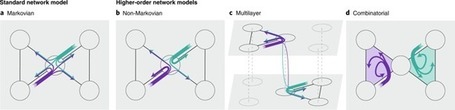
From networks to optimal higher-order models of complex systems

Rich data are revealing that complex dependencies between the nodes of a network may not be captured by models based on pairwise interactions. Higher-order network models go beyond these limitations, offering new perspectives for understanding complex systems.


From networks to optimal higher-order models of complex systems
Renaud Lambiotte, Martin Rosvall & Ingo Scholtes
Nature Physics volume 15, pages 313–320 (2019)

Source: www.nature.com

aka hypergraphs

Formal structure of periodic system of elements

For more than 150 years, the structure of the periodic system of the chemical elements has intensively motivated research in different areas of chemistry and physics. However, there is still no unified picture of what a periodic system is. Herein, based on the relations of order and similarity, we report a formal mathematical structure for the periodic system, which corresponds to an ordered hypergraph. It is shown that the current periodic system of chemical elements is an instance of the general structure. The definition is used to devise a tailored periodic system of polarizability of single covalent bonds, where order relationships are quantified within subsets of similar bonds and among these classes. The generalized periodic system allows envisioning periodic systems in other disciplines of science and humanities.


Formal structure of periodic system of elements
Wilmer Leal and Guillermo Restrepo

Proceedings of the Royal Society A: Mathematical, Physical and Engineering Sciences
Published:03 April 2019 https://doi.org/10.1098/rspa.2018.0581

Source: royalsocietypublishing.org

Analysis and Applications of Complex Social Networks 2018

The research space in complex social networks grows every year as they are systems with many levels of complexity and there is a constant need to challenge our current understanding in the field. The results of the community research efforts enable the understanding of different social phenomena including social structures evolution, communities, spread over networks, and control in and of complex networks. This huge interest in the analysis of large-scale social networks resulted in a lot of new approaches, methods, and techniques but with every advancement in this area, we uncover new challenges and new levels of complexity in the network universe that are far from being explored and addressed. The increasing complexity of the tasks to be performed in terms of network analysis together with the volume, variety of social data about people and their interactions, and velocity with which this data is generated in the online world poses new requirements and challenges on researchers. One of them is how to build accurate methods that would be able to cope with these vast amounts of data. This issue is a result of an attempt to address these emerging challenges with a big emphasis on the applicability of the developed approaches.


Editorial
Analysis and Applications of Complex Social Networks 2018
Katarzyna Musial, Piotr Bródka, and Pasquale De Meo

Complexity
Volume 2019, Article ID 9082573, 2 pages
https://doi.org/10.1155/2019/9082573

Source: www.hindawi.com

Toward understanding the impact of artificial intelligence on labor

Rapid advances in artificial intelligence (AI) and automation technologies have the potential to significantly disrupt labor markets. While AI and automation can augment the productivity of some workers, they can replace the work done by others and will likely transform almost all occupations at least to some degree. Rising automation is happening in a period of growing economic inequality, raising fears of mass technological unemployment and a renewed call for policy efforts to address the consequences of technological change. In this paper we discuss the barriers that inhibit scientists from measuring the effects of AI and automation on the future of work. These barriers include the lack of high-quality data about the nature of work (e.g., the dynamic requirements of occupations), lack of empirically informed models of key microlevel processes (e.g., skill substitution and human–machine complementarity), and insufficient understanding of how cognitive technologies interact with broader economic dynamics and institutional mechanisms (e.g., urban migration and international trade policy). Overcoming these barriers requires improvements in the longitudinal and spatial resolution of data, as well as refinements to data on workplace skills. These improvements will enable multidisciplinary research to quantitatively monitor and predict the complex evolution of work in tandem with technological progress. Finally, given the fundamental uncertainty in predicting technological change, we recommend developing a decision framework that focuses on resilience to unexpected scenarios in addition to general equilibrium behavior.


Toward understanding the impact of artificial intelligence on labor

Morgan R. Frank, David Autor, James E. Bessen, Erik Brynjolfsson, Manuel Cebrian, David J. Deming, Maryann Feldman, Matthew Groh, José Lobo, Esteban Moro, Dashun Wang, Hyejin Youn, and Iyad Rahwan
PNAS

Source: www.pnas.org

Science looks worse because it’s getting better

It is easy to assume that science is more flawed than in the past, given widespread coverage of the reproducibility crisis, perverse incentives and P-value hacking, alongside a proliferation of corrective measures (…). But it could be that we are now seeing more problems simply because we are more alert to them.

Source: www.nature.com