
Category: Papers

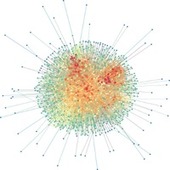
Percolation and the Effective Structure of Complex Networks

Analytical approaches to model the structure of complex networks can be distinguished into two groups according to whether they consider an intensive (e.g., fixed degree sequence and random otherwise) or an extensive (e.g., adjacency matrix) description of the network structure. While extensive approaches—such as the state-of-the-art message passing approximation—typically yield more accurate predictions, intensive approaches provide crucial insights on the role played by any given structural property in the outcome of dynamical processes. Here we introduce an intensive description that yields almost identical predictions to the ones obtained with the message passing approximation using bond percolation as a benchmark. Our approach distinguishes nodes according to two simple statistics: their degree and their position in the core-periphery organization of the network. Our near-exact predictions highlight how accurately capturing the long-range correlations in network structures allows easy and effective compression of real complex network data.


Percolation and the Effective Structure of Complex Networks
Antoine Allard and Laurent Hébert-Dufresne
Phys. Rev. X 9, 011023 – Published 5 February 2019

Source: journals.aps.org

Opinion Mining From Social Media Short Texts: Does Collective Intelligence Beat Deep Learning?

The era of big data has, among others, three characteristics: the huge amounts of data created every day and in every form by everyday people, artificial intelligence tools to mine information from those data and effective algorithms that allow this data mining in real or close to real time. On the other hand, opinion mining in social media is nowadays an important parameter of social media marketing. Digital media giants such as Google and Facebook developed and employed their own tools for that purpose. These tools are based on publicly available software libraries and tools such as Word2Vec (or Doc2Vec) and fasttext, which emphasize topic modeling and extract low-level features using deep learning approaches. So far, researchers have focused their efforts on opinion mining and especially on sentiment analysis of tweets. This trend reflects the availability of the Twitter API that simplifies automatic data (tweet) collection and testing of the proposed algorithms in real situations. However, if we are really interested in realistic opinion mining we should consider mining opinions from social media platforms such as Facebook and Instagram, which are far more popular among everyday people. The basic purpose of this paper is to compare various kinds of low-level features, including those extracted through deep learning, as in fasttext and Doc2Vec, and keywords suggested by the crowd, called crowd lexicon herein, through a crowdsourcing platform. The application target is sentiment analysis of tweets and Facebook comments on commercial products. We also compare several machine learning methods for the creation of sentiment analysis models and conclude that, even in the era of big data, allowing people to annotate (a small portion of) data would allow effective artificial intelligence tools to be developed using the learning by example paradigm.


Opinion Mining From Social Media Short Texts: Does Collective Intelligence Beat Deep Learning?

Nicolas Tsapatsoulis and Constantinos Djouvas

Front. Robot. AI, 22 January 2019 | https://doi.org/10.3389/frobt.2018.00138

Source: www.frontiersin.org

Urban sensing as a random search process

We study a new random search process: the \textit{taxi-drive}. The motivation for this process comes from urban sensing, in which sensors are mounted on moving vehicles such as taxis, allowing urban environments to be opportunistically monitored. Inspired by the movements of real taxis, the taxi-drive is composed of both random and regular parts; passengers are brought to randomly chosen locations via deterministic (i.e. shortest paths) routes. We show through a numerical study that this hybrid motion endows the taxi-drive with advantageous spreading properties. In particular, on certain graph topologies it offers reduced cover times compared to persistent random walks.


Urban sensing as a random search process
Kevin O’Keeffe, Paolo Santi, Brandon Wang, Carlo Ratti

Source: arxiv.org

Ensembles, Dynamics, and Cell Types: Revisiting the Statistical Mechanics Perspective on Cellular Regulation

•50 years Boolean networks as models for gene regulatory networks

•Random Boolean networks near criticality share properties with genetic networks in cells

•Number of attractors scales as the DNA content raised to the 0.63 power, compares well to current estimate from data (0.88)

•Confirms concept of cell types as attractors and predicts number of cell types


Ensembles, Dynamics, and Cell Types: Revisiting the Statistical Mechanics Perspective on Cellular Regulation
Stefan Bornholdt, Stuart Kauffman

Journal of Theoretical Biology

Source: www.sciencedirect.com

Cultural complexity and complexity evolution

We review issues stemming from current models regarding the drivers of cultural complexity and cultural evolution. We disagree with the implication of the treadmill model, based on dual-inheritance theory, that population size is the driver of cultural complexity. The treadmill model reduces the evolution of artifact complexity, measured by the number of parts, to the statistical fact that individuals with high skills are more likely to be found in a larger population than in a smaller population. However, for the treadmill model to operate as claimed, implausibly high skill levels must be assumed. Contrary to the treadmill model, the risk hypothesis for the complexity of artifacts relates the number of parts to increased functional efficiency of implements. Empirically, all data on hunter-gatherer artifact complexity support the risk hypothesis and reject the treadmill model. Still, there are conditions under which increased technological complexity relates to increased population size, but the dependency does not occur in the manner expressed in the treadmill model. Instead, it relates to population size when the support system for the technology requires a large population size. If anything, anthropology and ecology suggest that cultural complexity generates high population density rather than the other way around.


Cultural complexity and complexity evolution
Dwight Read, Claes Andersson

Adaptive Behavior
First Published January 20, 2019 Review Article
https://doi.org/10.1177/1059712318822298

Source: journals.sagepub.com