Category: Papers

On the frequency and severity of interstate wars

Lewis Fry Richardson argued that the frequency and severity of deadly conflicts of all kinds, from homicides to interstate wars and everything in between, followed universal statistical patterns: their frequency followed a simple Poisson arrival process and their severity followed a simple power-law distribution. Although his methods and data in the mid-20th century were neither rigorous nor comprehensive, his insights about violent conflicts have endured. In this chapter, using modern statistical methods and data, we show that Richardson’s original claims appear largely correct, with a few caveats. These facts place important constraints on our understanding of the underlying mechanisms that produce individual wars and periods of peace, and shed light on the persistent debate about trends in conflict.


On the frequency and severity of interstate wars
Aaron Clauset

Source: arxiv.org
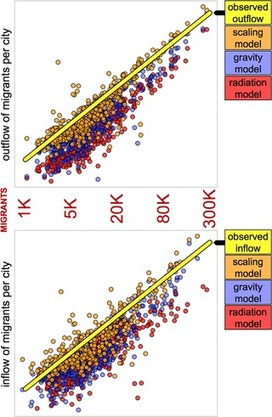
Gravity and scaling laws of city to city migration

Models of human migration provide powerful tools to forecast the flow of migrants, measure the impact of a policy, determine the cost of physical and political frictions and more. Here, we analyse the migration of individuals from and to cities in the US, finding that city to city migration follows scaling laws, so that the city size is a significant factor in determining whether, or not, an individual decides to migrate and the city size of both the origin and destination play key roles in the selection of the destination. We observe that individuals from small cities tend to migrate more frequently, tending to move to similar-sized cities, whereas individuals from large cities do not migrate so often, but when they do, they tend to move to other large cities. Building upon these findings we develop a scaling model which describes internal migration as a two-step decision process, demonstrating that it can partially explain migration fluxes based solely on city size. We then consider the impact of distance and construct a gravity-scaling model by combining the observed scaling patterns with the gravity law of migration. Results show that the scaling laws are a significant feature of human migration and that the inclusion of scaling can overcome the limits of the gravity and the radiation models of human migration.


Prieto Curiel R, Pappalardo L, Gabrielli L, Bishop SR (2018) Gravity and scaling laws of city to city migration. PLoS ONE 13(7): e0199892. https://doi.org/10.1371/journal.pone.0199892

Source: journals.plos.org

Self-referential basis of undecidable dynamics: From the Liar paradox and the halting problem to the edge of chaos

In this paper we explore several fundamental relations between formal systems, algorithms, and dynamical systems, focussing on the roles of undecidability, universality, diagonalization, and self-reference in each of these computational frameworks. Some of these interconnections are well-known, while some are clarified in this study as a result of a fine-grained comparison between recursive formal systems, Turing machines, and Cellular Automata (CAs). In particular, we elaborate on the diagonalization argument applied to distributed computation carried out by CAs, illustrating the key elements of Gödel’s proof for CAs. The comparative analysis emphasizes three factors which underlie the capacity to generate undecidable dynamics within the examined computational frameworks: (i) the program-data duality; (ii) the potential to access an infinite computational medium; and (iii) the ability to implement negation. The considered adaptations of Gödel’s proof distinguish between computational universality and undecidability, and show how the diagonalization argument exploits, on several levels, the self-referential basis of undecidability.


Self-referential basis of undecidable dynamics: From the Liar paradox and the halting problem to the edge of chaos
Mikhail Prokopenko, Michael Harré, JosephLizier, Fabio Boschetti, Pavlos Peppas, Stuart Kauffman

Physics of Life Reviews
Available online 8 January 2019
In Press, Corrected Proof

Source: www.sciencedirect.com

Topological control of synchronization patterns: Trading symmetry for stability

Symmetries are ubiquitous in network systems and have profound impacts on the observable dynamics. At the most fundamental level, many synchronization patterns are induced by underlying network symmetry, and a high degree of symmetry is believed to enhance the stability of identical synchronization. Yet, here we show that the synchronizability of almost any symmetry cluster in a network of identical nodes can be enhanced precisely by breaking its structural symmetry. This counterintuitive effect holds for generic node dynamics and arbitrary network structure and is, moreover, robust against noise and imperfections typical of real systems, which we demonstrate by implementing a state-of-the-art optoelectronic experiment. These results lead to new possibilities for the topological control of synchronization patterns, which we substantiate by presenting an algorithm that optimizes the structure of individual clusters under various constraints.


Topological control of synchronization patterns: Trading symmetry for stability
Phys. Rev. Lett.
Joseph D. Hart, Yuanzhao Zhang, Rajarshi Roy, and Adilson E. Motter

Source: journals.aps.org

Opinion Dynamics and Collective Decisions

We expect that democracy enables us to utilize collective intelligence such that our collective decisions build and enhance social welfare, and such that we accept their distributive and normative consequences. Collective decisions are produced by voting procedures which aggregate individual preferences and judgments. Before and after, individual preferences and judgments change as their underlying attitudes, values, and opinions change through discussion and deliberation. In large groups, these dynamics naturally go beyond the scope of the individual and consequently might show unexpected self-driven macroscopic systems dynamics following socio-physical laws. On the other hand, aggregated information and preferences as communicated through media, polls, political parties, or interest groups, also play a large role in the individual opinion formation process. Further on, actors are also capable of strategic opinion formation in the light of a pending referendum, election or other collective decision. Opinion dynamics and collective decision should thus not only be tackled by social choice, game theory, political and social psychology, but also from a systems dynamics and sociophysics perspective.


Advances in Complex SystemsVol. 21, No. 06n07, 1802002 (2018) Full Access
OPINION DYNAMICS AND COLLECTIVE DECISIONS
JAN LORENZ and MARTIN NEUMANN
https://doi.org/10.1142/S0219525918020022

Source: www.worldscientific.com