
Category: Papers

Taking census of physics

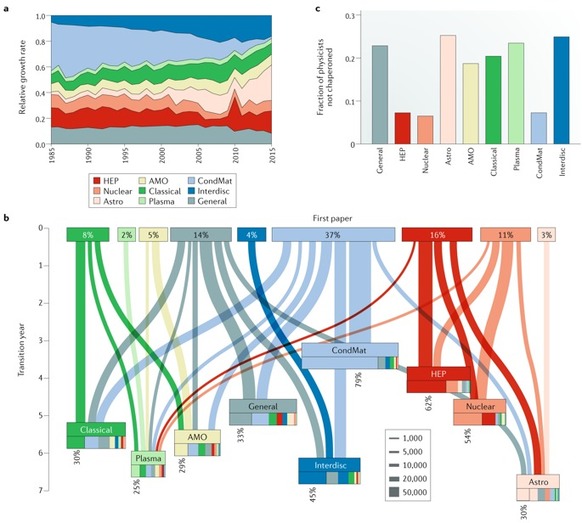
Over the past decades, the diversity of areas explored by physicists has exploded, encompassing new topics from biophysics and chemical physics to network science. However, it is unclear how these new subfields emerged from the traditional subject areas and how physicists explore them. To map out the evolution of physics subfields, here, we take an intellectual census of physics by studying physicists’ careers. We use a large-scale publication data set, identify the subfields of 135,877 physicists and quantify their heterogeneous birth, growth and migration patterns among research areas. We find that the majority of physicists began their careers in only three subfields, branching out to other areas at later career stages, with different rates and transition times. Furthermore, we analyse the productivity, impact and team sizes across different subfields, finding drastic changes attributable to the recent rise in large-scale collaborations. This detailed, longitudinal census of physics can inform resource allocation policies and provide students, editors and scientists with a broader view of the field’s internal dynamics.


Taking census of physics
Federico Battiston, Federico Musciotto, Dashun Wang, Albert-László Barabási, Michael Szell & Roberta Sinatra 
Nature Reviews Physics volume 1, pages89–97 (2019)

Source: www.nature.com
Where Does a Shark’s Skin Get Its Pattern?

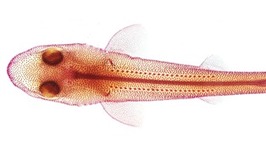
In 1952, well before developmental biologists spoke in terms of Hoxgenes and transcription factors, or even understood DNA’s structure, Alan Turing had an idea. The famed mathematician who hastened the end of World War II by cracking the Enigma code turned his mind to the natural world and devised an elegant mathematical model of pattern formation. His theory outlined how endless varieties of stripes, spots, and scales could emerge from the interaction of two simple, hypothetical chemical agents, or “morphogens.”

Decades passed before biologists seriously considered that this mathematical theory could in fact explain myriad biological patterns. The development of mammalian hair, the feathers of birds, and even those ridges on the roof of your mouth all stem from Turing-like mechanisms.

Source: nautil.us

Pull out all the stops: Textual analysis via punctuation sequences

Whether enjoying the lucid prose of a favorite author or slogging through some other writer’s cumbersome, heavy-set prattle (full of parentheses, em-dashes, compound adjectives, and Oxford commas), readers will notice stylistic signatures not only in word choice and grammar, but also in punctuation itself. Indeed, visual sequences of punctuation from different authors produce marvelously different (and visually striking) sequences. Punctuation is a largely overlooked stylistic feature in “stylometry”, the quantitative analysis of written text. In this paper, we examine punctuation sequences in a corpus of literary documents and ask the following questions: Are the properties of such sequences a distinctive feature of different authors? Is it possible to distinguish literary genres based on their punctuation sequences? Do the punctuation styles of authors evolve over time? Are we on to something interesting in trying to do stylometry without words, or are we full of sound and fury (signifying nothing)?


Pull out all the stops: Textual analysis via punctuation sequences
Alexandra N. M. Darmon Marya Bazzi Sam D. Howison Mason Porter

Source: osf.io

Causal deconvolution by algorithmic generative models

New paper in Nature Machine Intelligence and a video produced by Nature shows how small programs can help deconvolve signals and data: https://www.nature.com/articles/s42256-018-0005-0 and https://www.youtube.com/watch?v=rkmz7DAA-t8


"Most machine learning approaches extract statistical features from data, rather than the underlying causal mechanisms. A different approach analyses information in a general way by extracting recursive patterns from data using generative models under the paradigm of computability and algorithmic information theory.


Complex behaviour emerges from interactions between objects produced by different generating mechanisms. Yet to decode their causal origin(s) from observations remains one of the most fundamental challenges in science. This paper introduces a universal, unsupervised and parameter-free model-oriented approach, based on the seminal concept and the first principles of algorithmic probability, to decompose an observation into its most likely algorithmic generative models."

Source: www.nature.com

Morphogenesis in robot swarms

Morphogenesis allows millions of cells to self-organize into intricate structures with a wide variety of functional shapes during embryonic development. This process emerges from local interactions of cells under the control of gene circuits that are identical in every cell, robust to intrinsic noise, and adaptable to changing environments. Constructing human technology with these properties presents an important opportunity in swarm robotic applications ranging from construction to exploration. Morphogenesis in nature may use two different approaches: hierarchical, top-down control or spontaneously self-organizing dynamics such as reaction-diffusion Turing patterns. Here, we provide a demonstration of purely self-organizing behaviors to create emergent morphologies in large swarms of real robots. The robots achieve this collective organization without any self-localization and instead rely entirely on local interactions with neighbors. Results show swarms of 300 robots that self-construct organic and adaptable shapes that are robust to damage. This is a step toward the emergence of functional shape formation in robot swarms following principles of self-organized morphogenetic engineering.


Morphogenesis in robot swarms
I. Slavkov, D. Carrillo-Zapata, N. Carranza, X. Diego, F. Jansson, J. Kaandorp, S. Hauert, and J. Sharpe

Science Robotics 19 Dec 2018:
Vol. 3, Issue 25, eaau9178
DOI: 10.1126/scirobotics.aau9178

Source: robotics.sciencemag.org