
Category: Papers

How algorithmic popularity bias hinders or promotes quality

Algorithms that favor popular items are used to help us select among many choices, from top-ranked search engine results to highly-cited scientific papers. The goal of these algorithms is to identify high-quality items such as reliable news, credible information sources, and important discoveries–in short, high-quality content should rank at the top. Prior work has shown that choosing what is popular may amplify random fluctuations and lead to sub-optimal rankings. Nonetheless, it is often assumed that recommending what is popular will help high-quality content “bubble up” in practice. Here we identify the conditions in which popularity may be a viable proxy for quality content by studying a simple model of a cultural market endowed with an intrinsic notion of quality. A parameter representing the cognitive cost of exploration controls the trade-off between quality and popularity. Below and above a critical exploration cost, popularity bias is more likely to hinder quality. But we find a narrow intermediate regime of user attention where an optimal balance exists: choosing what is popular can help promote high-quality items to the top. These findings clarify the effects of algorithmic popularity bias on quality outcomes, and may inform the design of more principled mechanisms for techno-social cultural markets.


How algorithmic popularity bias hinders or promotes quality
Giovanni Luca Ciampaglia, Azadeh Nematzadeh, Filippo Menczer & Alessandro Flammini
Scientific Reports volume 8, Article number: 15951 (2018)

Source: www.nature.com
Scale-free Networks Well Done

We bring rigor to the vibrant activity of detecting power laws in empirical degree distributions in real-world networks. We first provide a rigorous definition of power-law distributions, equivalent to the definition of regularly varying distributions in statistics. This definition allows the distribution to deviate from a pure power law arbitrarily but without affecting the power-law tail exponent. We then identify three estimators of these exponents that are proven to be statistically consistent — that is, converging to the true exponent value for any regularly varying distribution — and that satisfy some additional niceness requirements. Finally, we apply these estimators to a representative collection of synthetic and real-world data. According to their estimates, real-world scale-free networks are definitely not as rare as one would conclude based on the popular but unrealistic assumption that real-world data comes from power laws of pristine purity, void of noise and deviations.


Scale-free Networks Well Done
Ivan Voitalov, Pim van der Hoorn, Remco van der Hofstad, Dmitri Krioukov

Source: arxiv.org

Anticipating Cryptocurrency Prices Using Machine Learning

Machine learning and AI-assisted trading have attracted growing interest for the past few years. Here, we use this approach to test the hypothesis that the inefficiency of the cryptocurrency market can be exploited to generate abnormal profits. We analyse daily data for 1,681 cryptocurrencies for the period between Nov. 2015 and Apr. 2018. We show that simple trading strategies assisted by state-of-the-art machine learning algorithms outperform standard benchmarks. Our results show that nontrivial, but ultimately simple, algorithmic mechanisms can help anticipate the short-term evolution of the cryptocurrency market.


Anticipating Cryptocurrency Prices Using Machine Learning
Laura Alessandretti, Abeer ElBahrawy, Luca Maria Aiello, and Andrea Baronchelli

Complexity
Volume 2018, Article ID 8983590, 16 pages
https://doi.org/10.1155/2018/8983590

Source: www.hindawi.com

Communication in Online Social Networks Fosters Cultural Isolation

Online social networks play an increasingly important role in communication between friends, colleagues, business partners, and family members. This development sparked public and scholarly debate about how these new platforms affect dynamics of cultural diversity. Formal models of cultural dissemination are powerful tools to study dynamics of cultural diversity but they are based on assumptions that represent traditional dyadic, face-to-face communication, rather than communication in online social networks. Unlike in models of face-to-face communication, where actors update their cultural traits after being influenced by one of their network contacts, communication in online social networks is often characterized by a one-to-many structure, in that users emit messages directly to a large number of network contacts. Using analytical tools and agent-based simulation, we show that this seemingly subtle difference can have profound implications for emergent dynamics of cultural dissemination. In particular, we show that within the framework of our model online communication fosters cultural diversity to a larger degree than offline communication and it increases chances that individuals and subgroups become culturally isolated from their network contacts.


Communication in Online Social Networks Fosters Cultural Isolation
Marijn A. Keijzer, Michael Mäs, and Andreas Flache

Complexity
Volume 2018, Article ID 9502872, 18 pages
https://doi.org/10.1155/2018/9502872

Source: www.hindawi.com

Negative Representation and Instability in Democratic Elections

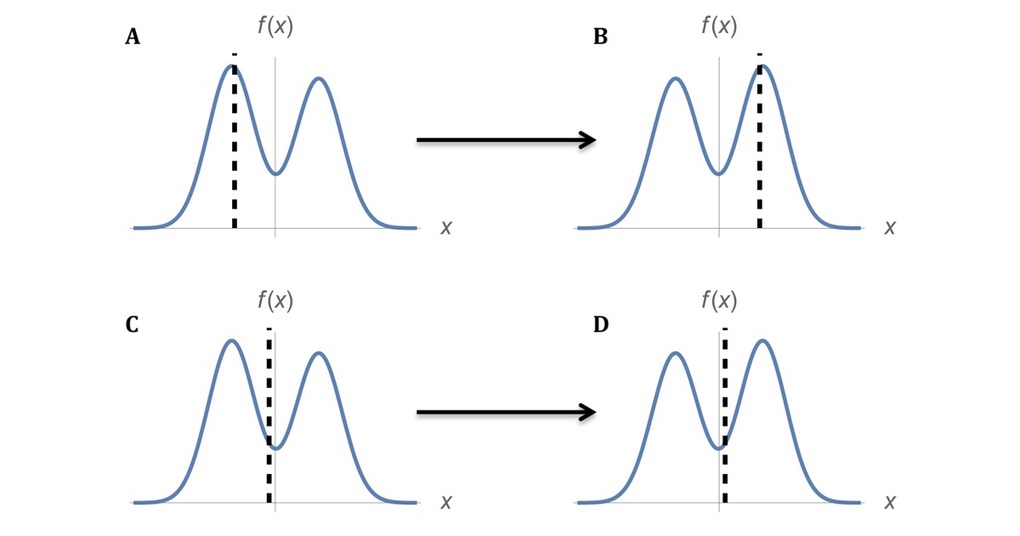
Motivated by the troubling rise of political extremism and instability throughout the democratic world, we present a novel mathematical characterization of the nature of political representation in democratic elections. We define the concepts of negative representation, in which a shift in electorate opinions produces a shift in the election outcome in the opposite direction, and electoral instability, in which an arbitrarily small change in opinion causes a large change in election outcome. Under very general conditions, we prove that unstable elections necessarily contain negatively represented opinions. Furthermore, increasing polarization of the electorate can drive elections through a transition from a stable to an unstable regime, analogous to the phase transition by which some materials become ferromagnetic below their critical temperatures. In this unstable regime, a large fraction of political opinions are negatively represented. Empirical data suggest that United States presidential elections underwent such a phase transition in the 1970s and have since become increasingly unstable.


Alexander Siegenfeld, Yaneer Bar-Yam, Negative representation and instability in democratic elections, arXiv:1810.11489 (October 29, 2018).

Source: www.necsi.edu

See also video: http://www.necsi.edu/research/social/negative-representation-video