

Category: Papers

Semantic information, agency, & physics

Shannon information theory provides various measures of so-called syntactic information, which reflect the amount of statistical correlation between systems. By contrast, the concept of ‘semantic information’ refers to those correlations which carry significance or ‘meaning’ for a given system. Semantic information plays an important role in many fields, including biology, cognitive science and philosophy, and there has been a long-standing interest in formulating a broadly applicable and formal theory of semantic information. In this paper, we introduce such a theory. We define semantic information as the syntactic information that a physical system has about its environment which is causally necessary for the system to maintain its own existence. ‘Causal necessity’ is defined in terms of counter-factual interventions which scramble correlations between the system and its environment, while ‘maintaining existence’ is defined in terms of the system’s ability to keep itself in a low entropy state. We also use recent results in non-equilibrium statistical physics to analyse semantic information from a thermodynamic point of view. Our framework is grounded in the intrinsic dynamics of a system coupled to an environment, and is applicable to any physical system, living or otherwise. It leads to formal definitions of several concepts that have been intuitively understood to be related to semantic information, including ‘value of information’, ‘semantic content’ and ‘agency’.


Semantic information, autonomous agency and non-equilibrium statistical physics
Artemy Kolchinsky, David H. Wolpert

Interface Focus
Published 19 October 2018.DOI: 10.1098/rsfs.2018.0041

Source: rsfs.royalsocietypublishing.org
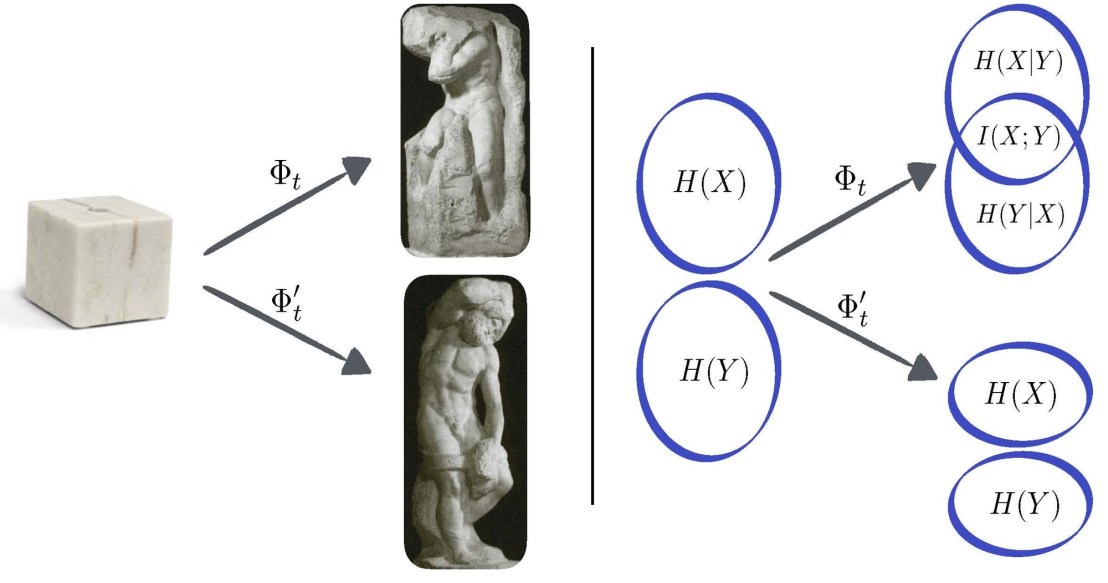
An Information-Theoretic Approach to Self-Organisation: Emergence of Complex Interdependencies in Coupled Dynamical Systems

Self-organisation lies at the core of fundamental but still unresolved scientific questions, and holds the promise of de-centralised paradigms crucial for future technological developments. While self-organising processes have been traditionally explained by the tendency of dynamical systems to evolve towards specific configurations, or attractors, we see self-organisation as a consequence of the interdependencies that those attractors induce. Building on this intuition, in this work we develop a theoretical framework for understanding and quantifying self-organisation based on coupled dynamical systems and multivariate information theory. We propose a metric of global structural strength that identifies when self-organisation appears, and a multi-layered decomposition that explains the emergent structure in terms of redundant and synergistic interdependencies. We illustrate our framework on elementary cellular automata, showing how it can detect and characterise the emergence of complex structures.


An Information-Theoretic Approach to Self-Organisation: Emergence of Complex Interdependencies in Coupled Dynamical Systems
Fernando Rosas, Pedro A.M. Mediano, Martín Ugarte and Henrik J. Jensen

Entropy 2018, 20(10), 793; https://doi.org/10.3390/e20100793

Source: www.mdpi.com

Thermodynamics of urban transformations

Urban transformations within large and growing metropolitan areas often generate critical dynamics affecting social interactions, transport connectivity and income flow distribution. We develop a statistical–mechanical model of urban transformations, exemplified for Greater Sydney, and derive a thermodynamic description highlighting critical regimes. We consider urban dynamics at two time scales: fast dynamics for the distribution of population and income, modelled via the maximum entropy principle, and slower dynamics evolving the urban structure under spatially distributed competition. We identify phase transitions between dispersed and polycentric phases, induced by varying the social disposition—a factor balancing the suburbs’ attractiveness—in contrast with the travel impedance. Using the Fisher information, we identify critical thresholds and quantify the thermodynamic cost of urban transformation, as the minimal work required to vary the underlying parameter. Finally, we introduce the notion of thermodynamic efficiency of urban transformation, as the ratio of the order gained during a change to the amount of required work, showing that this measure is maximized at criticality.


On critical dynamics and thermodynamic efficiency of urban transformations
Emanuele Crosato, Ramil Nigmatullin, Mikhail Prokopenko

Open Society

Published 17 October 2018.DOI: 10.1098/rsos.180863

Source: rsos.royalsocietypublishing.org

From Louvain to Leiden: guaranteeing well-connected communities

Community detection is often used to understand the structure of large and complex networks. One of the most popular algorithms for uncovering community structure is the so-called Louvain algorithm. We show that this algorithm has a major defect that largely went unnoticed until now: the Louvain algorithm may yield arbitrarily badly connected communities. In the worst case, communities may even be disconnected, especially when running the algorithm iteratively. In our experimental analysis, we observe that up to 25% of the communities are badly connected and up to 16% are disconnected. This may present serious issues in subsequent analyses. To address this problem, we introduce the Leiden algorithm. We prove that the Leiden algorithm yields communities that are guaranteed to be connected. In addition, we prove that, when the Leiden algorithm is applied iteratively, it converges to a partition in which all subsets of all communities are locally optimally assigned. Furthermore, by relying on a fast local move approach, the Leiden algorithm runs faster than the Louvain algorithm. We demonstrate the performance of the Leiden algorithm for several benchmark and real-world networks. We find that the Leiden algorithm is faster than the Louvain algorithm and uncovers better partitions, in addition to providing explicit guarantees. Based on our results, we conclude that the Leiden algorithm is preferable to the Louvain algorithm.


From Louvain to Leiden: guaranteeing well-connected communities
Vincent Traag, Ludo Waltman, Nees Jan van Eck

Source: arxiv.org

Connectivity and complex systems: learning from a multi-disciplinary perspective

In recent years, parallel developments in disparate disciplines have focused on what has come to be termed connectivity; a concept used in understanding and describing complex systems. Conceptualisations and operationalisations of connectivity have evolved largely within their disciplinary boundaries, yet similarities in this concept and its application among disciplines are evident. However, any implementation of the concept of connectivity carries with it both ontological and epistemological constraints, which leads us to ask if there is one type or set of approach(es) to connectivity that might be applied to all disciplines. In this review we explore four ontological and epistemological challenges in using connectivity to understand complex systems from the standpoint of widely different disciplines. These are: (i) defining the fundamental unit for the study of connectivity; (ii) separating structural connectivity from functional connectivity; (iii) understanding emergent behaviour; and (iv) measuring connectivity. We draw upon discipline-specific insights from Computational Neuroscience, Ecology, Geomorphology, Neuroscience, Social Network Science and Systems Biology to explore the use of connectivity among these disciplines. We evaluate how a connectivity-based approach has generated new understanding of structural-functional relationships that characterise complex systems and propose a ‘common toolbox’ underpinned by network-based approaches that can advance connectivity studies by overcoming existing constraints.


Connectivity and complex systems: learning from a multi-disciplinary perspective
Laura Turnbull, Marc-Thorsten Hütt, Andreas A. Ioannides, Stuart Kininmonth, Ronald Poeppl, Klement Tockner, Louise J. Bracken, Saskia Keesstra, Lichan Liu, Rens Masselink and Anthony J. Parsons
Applied Network Science 2018 3:11
https://doi.org/10.1007/s41109-018-0067-2

Source: appliednetsci.springeropen.com