Category: Papers

The Standard Genetic Code can Evolve from a Two-Letter GC Code Without Information Loss or Costly Reassignments

It is widely agreed that the standard genetic code must have been preceded by a simpler code that encoded fewer amino acids. How this simpler code could have expanded into the standard genetic code is not well understood because most changes to the code are costly. Taking inspiration from the recently synthesized six-letter code, we propose a novel hypothesis: the initial genetic code consisted of only two letters, G and C, and then expanded the number of available codons via the introduction of an additional pair of letters, A and U. Various lines of evidence, including the relative prebiotic abundance of the earliest assigned amino acids, the balance of their hydrophobicity, and the higher GC content in genome coding regions, indicate that the original two nucleotides were indeed G and C. This process of code expansion probably started with the third base, continued with the second base, and ended up as the standard genetic code when the second pair of letters was introduced into the first base. The proposed process is consistent with the available empirical evidence, and it uniquely avoids the problem of costly code changes by positing instead that the code expanded its capacity via the creation of new codons with extra letters.


The Standard Genetic Code can Evolve from a Two-Letter GC Code Without Information Loss or Costly Reassignments

Alejandro Frank, Tom Froese

Origins of Life and Evolution of Biospheres
June 2018, Volume 48, Issue 2, pp 259–272

Source: link.springer.com

Supplemented Alkaline Phosphatase Supports the Immune Response in Patients Undergoing Cardiac Surgery: Clinical and Computational Evidence

Alkaline phosphatase (AP) is an enzyme that exhibits anti-inflammatory effects by dephosphorylating inflammation triggering moieties (ITMs) like bacterial lipopolysaccharides and extracellular nucleotides. AP administration aims to prevent and treat peri- and post-surgical ischemia reperfusion injury in cardiothoracic surgery patients. Recent studies reported that intravenous bolus administration and continuous infusion of AP in patients undergoing coronary artery bypass grafting with cardiac valve surgery induce an increased release of liver-type “tissue non-specific alkaline phosphatase” (TNAP) into the bloodstream. The release of liver-type TNAP into circulation could be the body’s way of strengthening its defense against a massive ischemic insult. However, the underlying mechanism behind the induction of TNAP is still unclear. To obtain a deeper insight into the role of AP during surgery, we developed a mathematical model of systemic inflammation that clarifies the relation between supplemented AP and TNAP and describes a plausible induction mechanism of TNAP in patients undergoing cardiothoracic surgery. The model was validated against clinical data from patients treated with bovine Intestinal AP (bIAP treatment) or without AP (placebo treatment), in addition to standard care procedures. We performed additional in-silico experiments adding a secondary source of ITMs after surgery, as observed in some patients with complications, and predicted the response to different AP treatment regimens. Our results show a strong protective effect of supplemented AP for patients with complications. The model provides evidence of the existence of an induction mechanism of liver-type tissue non-specific alkaline phosphatase, triggered by the supplementation of AP in patients undergoing cardiac surgery. To the best of our knowledge this is the first time that a quantitative and validated numerical model of systemic inflammation under clinical treatment conditions is presented.


Alva Presbitero, Emiliano Mancini, Ruud Brands, Valeria V. Krzhizhanovskaya, and Peter M. A. Sloot

Supplemented Alkaline Phosphatase Supports the Immune Response in Patients Undergoing Cardiac Surgery: Clinical and Computational Evidence
Front. Immunol., 11 October 2018 | https://doi.org/10.3389/fimmu.2018.02342

Source: www.frontiersin.org

Learning from Mixed Signals in Online Innovation Communities

We study how contributors to innovation contests improve their performance through direct experience and by observing others as they synthesize learnable signals from different sources. Our research draws on a 10-year panel of more than 55,000 individuals participating in a firm-hosted online innovation community sponsoring creative t-shirt design contests. Our data set contains almost 180,000 submissions that reflect signals of direct performance evaluation from both the community and the firm. Our data set also contains almost 150 million ratings that reflect signals for learning from observing the completed work of others. We have three key findings. First, we find a period of initial investment with decreased performance. This is because individuals struggle to synthesize learnable signals from early performance evaluation. This finding is contrary to other studies that report faster learning from early direct experience when improvements are easiest to achieve. Second, we find that individuals consistently improve their performance from observing others’ good examples. However, whether they improve from observing others’ bad examples depends on their ability to correctly recognize that work as being of low quality. Third, we find that individuals can successfully integrate signals about what is valued by the firm hosting the community, not just about what is valued by the community. We thus provide important insights into the mechanisms of how individuals learn in crowdsourced innovation and provide important qualifications for the often-heralded theme of “learning from failures.”

Source: pubsonline.informs.org

The Resilience of Public Policies in Economic Development

This paper studies the resilience of public policies that governments design for catalyzing economic development. This property depends on the extent to which behavioral heuristics and spillover effects allow policymakers to attain their original goals when a particular policy cannot be funded as originally planned. This scenario takes place, for example, when unanticipated events such as natural disasters or political turmoil obstruct the use of resources to advance certain policy issues, e.g., infrastructure or labor reforms. Here, we analyze how the adaptive capacity of the policy-making process generates resilience in the face of disruptions. In order to estimate the allocation of resources across policies, we employ a computational model that accounts for diverse social mechanisms, for example, coevolutionary learning and network interdependencies. In our simulations, we use a data set of 117 countries on 79 development indicators over an 11-year period. Then, we calculate a resilience score corresponding to each development indicator via counter-factual analysis of policy disruptions. Next, we assess whether some development strategies produce resilient/fragile policy profiles. Finally, by studying the relationship between policy resilience and policy priority, we determine which issues are bottlenecks to economic development.


The Resilience of Public Policies in Economic Development
Gonzalo Castañeda and Omar A. Guerrero

Complexity
Volume 2018, Article ID 9672849, 15 pages
https://doi.org/10.1155/2018/9672849

Source: www.hindawi.com

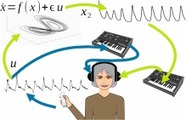
Entraining chaotic dynamics: A novel movement sonification paradigm could promote generalization

Tasks encountered in daily living may have instabilities and more dimensions than are sampled by the senses such as when carrying a cup of coffee and only the surface motion and overall momentum are sensed, not the fluid dynamics. Anticipating non-periodic dynamics is difficult but not impossible because mutual coordination allows for chaotic processes to synchronize to each other and become periodic. A chaotic oscillator with random period and amplitude affords being stabilized onto a periodic trajectory by a weak input if the driver incorporates information about the oscillator. We studied synchronization with predictable and unpredictable stimuli where the unpredictable stimuli could be non-interactive or interactive. The latter condition required learning to control a chaotic system. We expected better overall performance with the predictable but more learning and generalization with unpredictable interactive stimuli. Participants practiced an auditory-motor synchronization task by matching their sonified hand movements to sonified tutors: the Non-Interactive Predictable tutor (NI-P) was a sinusoid, the Non-Interactive Unpredictable (NI-U) was a chaotic system, the Interactive Unpredictable (I-U) was the same chaotic system with an added weak input from the participant’s movement. Different pre/post-practice stimuli evaluated generalization. Quick improvement was seen in NI-P. Synchronization, dynamic similarity, and causal interaction increased with practice in I-U but not in NI-U. Generalization was seen for few pre-post stimuli in NI-P, none in NI-U, and most stimuli in I-U. Synchronization with novel chaotic dynamics is challenging but mutual interaction enables the behavioral control of such dynamics and the practice of complex motor skills.


Entraining chaotic dynamics: A novel movement sonification paradigm could promote generalization
Dobromir Dotov, Tom Froese

Human Movement Science
Volume 61, October 2018, Pages 27-41

Source: www.sciencedirect.com