

Category: Papers

The Relevance of Informational Infrastructures in Future Cities

Cities around the world are installing digital architectures of sensors, computational cores and telecommunications in the urban fabric, transforming existing infrastructure systems into multi-functional informational and services platforms in the process. The fast pace of digitization is often hard for cities to fathom, many of which are challenged by a silent privatization of the informational value of public spaces and the under-development of the potential of 21st century digital infrastructures due to a mono functional non-inclusive process of design. This is compounded by the power behind large-scale data ecosystems, which when paired with technologies such as machine learning will have profound impact over our future urban services and lifestyles. Cities need to adapt their design mentality and institutional models, but it is through social participation, and open technology standards that true inclusive synthesis of the future digital systems that enable our interactions with cities and allow for the myriad of new services and experiences can be achieved.


The Relevance of Informational Infrastructures in Future Cities
Ricardo Alvarez

The Journal of Field Actions

Special Issue 17 | 2017 : Artificial Intelligence and Robotics in the City

Source: journals.openedition.org
Topography of epithelial–mesenchymal plasticity

Cells can change their phenotype from epithelial to mesenchymal during development and in cancer progression, where this transition is often associated with metastasis and poor disease prognosis. Here we show this process involves the transit through a multitude of metastable hybrid phenotypes in a way that is similar to the driven dynamics of disordered materials. Our method shows that highly aggressive hybrid epithelial/mesenchymal cell phenotypes are located in metastable regions that can easily switch under external and internal perturbations. We propose a general mapping strategy that can be used for other pathways, providing a useful tool to visualize the ever increasing number of gene expression data obtained from single cells and tissues.


Topography of epithelial–mesenchymal plasticity
Francesc Font-Clos, Stefano Zapperi, and Caterina A. M. La Porta
PNAS May 21, 2018. 201722609

Source: www.pnas.org

Addressing the minimum fleet problem in on-demand urban mobility

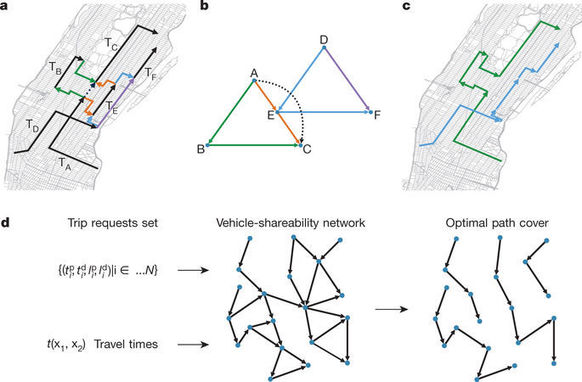
Information and communication technologies have opened the way to new solutions for urban mobility that provide better ways to match individuals with on-demand vehicles. However, a fundamental unsolved problem is how best to size and operate a fleet of vehicles, given a certain demand for personal mobility. Previous studies1,2,3,4,5 either do not provide a scalable solution or require changes in human attitudes towards mobility. Here we provide a network-based solution to the following ‘minimum fleet problem’, given a collection of trips (specified by origin, destination and start time), of how to determine the minimum number of vehicles needed to serve all the trips without incurring any delay to the passengers. By introducing the notion of a ‘vehicle-sharing network’, we present an optimal computationally efficient solution to the problem, as well as a nearly optimal solution amenable to real-time implementation. We test both solutions on a dataset of 150 million taxi trips taken in the city of New York over one year6. The real-time implementation of the method with near-optimal service levels allows a 30 per cent reduction in fleet size compared to current taxi operation. Although constraints on driver availability and the existence of abnormal trip demands may lead to a relatively larger optimal value for the fleet size than that predicted here, the fleet size remains robust for a wide range of variations in historical trip demand. These predicted reductions in fleet size follow directly from a reorganization of taxi dispatching that could be implemented with a simple urban app; they do not assume ride sharing7,8,9, nor require changes to regulations, business models, or human attitudes towards mobility to become effective. Our results could become even more relevant in the years ahead as fleets of networked, self-driving cars become commonplace10,11,12,13,14.


Addressing the minimum fleet problem in on-demand urban mobility
M. M. Vazifeh, P. Santi, G. Resta, S. H. Strogatz & C. Ratti
Nature volume 557, pages 534–538 (2018)
doi:10.1038/s41586-018-0095-1

Source: www.nature.com

Predicting the temporal activity patterns of new venues

Estimating revenue and business demand of a newly opened venue is paramount as these early stages often involve critical decisions such as first rounds of staffing and resource allocation. Traditionally, this estimation has been performed through coarse-grained measures such as observing numbers in local venues or venues at similar places (e.g., coffee shops around another station in the same city). The advent of crowdsourced data from devices and services carried by individuals on a daily basis has opened up the possibility of performing better predictions of temporal visitation patterns for locations and venues. In this paper, using mobility data from Foursquare, a location-centric platform, we treat venue categories as proxies for urban activities and analyze how they become popular over time. The main contribution of this work is a prediction framework able to use characteristic temporal signatures of places together with k-nearest neighbor metrics capturing similarities among urban regions, to forecast weekly popularity dynamics of a new venue establishment in a city neighborhood. We further show how we are able to forecast the popularity of the new venue after one month following its opening by using locality and temporal similarity as features. For the evaluation of our approach we focus on London. We show that temporally similar areas of the city can be successfully used as inputs of predictions of the visit patterns of new venues, with an improvement of 41% compared to a random selection of wards as a training set for the prediction task. We apply these concepts of temporally similar areas and locality to the real-time predictions related to new venues and show that these features can effectively be used to predict the future trends of a venue. Our findings have the potential to impact the design of location-based technologies and decisions made by new business owners.


Predicting the temporal activity patterns of new venues
Krittika D’Silva, Anastasios Noulas, Mirco Musolesi, Cecilia Mascolo and Max Sklar
EPJ Data Science20187:13
https://doi.org/10.1140/epjds/s13688-018-0142-z

Source: epjdatascience.springeropen.com

Cooperative Object Transport in Multi-Robot Systems: A Review of the State-of-the-Art

In recent years, there has been a growing interest in designing multi-robot systems (hereafter MRSs) to provide cost effective, fault-tolerant and reliable solutions to a variety of automated applications. Here, we review recent advancements in MRSs specifically designed for cooperative object transport, which requires the members of MRSs to coordinate their actions to transport objects from a starting position to a final destination. To achieve cooperative object transport, a wide range of transport, coordination and control strategies have been proposed. Our goal is to provide a comprehensive summary for this relatively heterogeneous and fast-growing body of scientific literature. While distilling the information, we purposefully avoid using hierarchical dichotomies, which have been traditionally used in the field of MRSs. Instead, we employ a coarse-grain approach by classifying each study based on the transport strategy used; pushing-only, grasping and caging. We identify key design constraints that may be shared among these studies despite considerable differences in their design methods. In the end, we discuss several open challenges and possible directions for future work to improve the performance of the current MRSs. Overall, we hope to increasethe visibility and accessibility of the excellent studies in the field and provide a framework that helps the reader to navigate through them more effectively.


Cooperative Object Transport in Multi-Robot Systems: A Review of the State-of-the-Art

Elio Tuci, Muhanad H. M. Alkilabi and Otar Akanyeti

Front. Robot. AI, 25 May 2018 | https://doi.org/10.3389/frobt.2018.00059

Source: www.frontiersin.org