
Social media often goes very wrong. Making it right requires a vision for how social media can help, not harm, society.
Six or Seven Things Social Media Can Do For Democracy
Ethan Zuckerman
Source: medium.com
Networking the complexity community since 1999
Category: Papers
Social media often goes very wrong. Making it right requires a vision for how social media can help, not harm, society.
Six or Seven Things Social Media Can Do For Democracy
Ethan Zuckerman
Source: medium.com
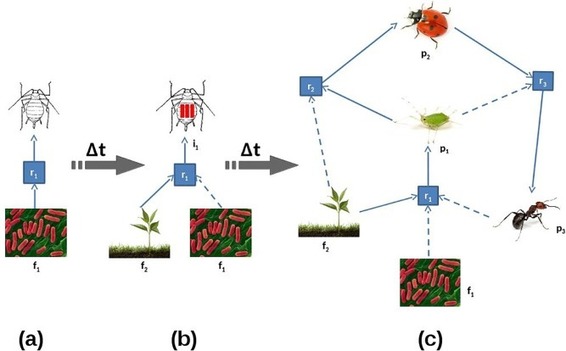
The utilisation of the ecospace and the change in diversity through time has been suggested to be due to the effect of niche partitioning, as a global long-term pattern in the fossil record. However, niche partitioning, as a way to coexist, could be a limited means to share the environmental resources and condition during evolutionary time. In fact, a physical limit impedes a high partitioning without a high restriction of the niche’s variables. Here, we propose that niche emergence, rather than niche partitioning, is what mostly drives ecological diversity. In particular, we view ecosystems in terms of autocatalytic sets: catalytically closed and self-sustaining reaction (or interaction) networks. We provide some examples of such ecological autocatalytic networks, how this can give rise to an expanding process of niche emergence (both in time and space), and how these networks have evolved over time (so-called evoRAFs). Furthermore, we use the autocatalytic set formalism to show that it can be expected to observe a power-law in the size distribution of extinction events in ecosystems. In short, we elaborate on our earlier argument that new species create new niches, and that biodiversity is therefore an autocatalytic process.
Niche emergence as an autocatalytic process in the evolution of ecosystems
Roberto Cazzolla Gatti, Brian Fath, Wim Hordijk, Stuart Kauffman, Robert Ulanowicz
Journal of Theoretical Biology
Source: www.sciencedirect.com
The emerging field at the intersection of quantitative biology, network modeling, and control theory has enjoyed significant progress in recent years. This Special Issue brings together a selection of papers on complementary approaches to observe, identify, and control biological and biologically inspired networks. These approaches advance the state of the art in the field by addressing challenges common to many such networks, including high dimensionality, strong nonlinearity, uncertainty, and limited opportunities for observation and intervention. Because these challenges are not unique to biological systems, it is expected that many of the results presented in these contributions will also find applications in other domains, including physical, social, and technological networks.
Guest Editorial: Special Issue on Approaches to Control Biological and Biologically Inspired Networks
Reka Albert ; John Baillieul ; Adilson E. Motter
IEEE Transactions on Control of Network Systems ( Early Access )
Source: ieeexplore.ieee.org
This essay aims to outline a scientific approach to the investigation of consciousness emphasizing achievements and promise of hardcore bottom-up biology. We propose to contemplate what would be the minimal requirements of consciousness in the simplest of life forms. We show that, starting from the molecular nuts and bolts of such life forms, it is the extreme multitudinousness of the moving material components forming consciousness, and their organized swarming, that appears outstanding. This is in stark contrast with the impression obtained from introspection that consciousness is a single, unconstrained, immaterial stream.
The biology of consciousness from the bottom up
Claude MJ Braun, Shaun Lovejoy
Adaptive Behavior
Vol 26, Issue 3, 2018
Source: journals.sagepub.com
Information that is normally accessed through a sensory modality (substituted modality, e.g., vision) is provided by sensory substitution devices (SSDs) through an alternative modality such as hearing or touch (i.e., substituting modality). SSDs usually support disabled users by replacing sensory inputs that have been lost, but they also offer a unique opportunity to study adaptation and flexibility in human perception. Current debates in sensory substitution (SS) literature focus mostly on its neural correlates and behavioural consequences. In particular, studies have demonstrated the neural plasticity of the visual brain regions that are activated by the substituting modality. Participants also adapt to using the devices for a broad spectrum of cognitive tasks that usually require sight. However, little is known about the SS experience. Also, there is no agreement on how the phenomenology of SS should be studied. Here, we offer guidelines for the methodology of studies investigating behavioural adaptation to SS and the effects of this adaptation on the subjective SS experience. We also discuss factors that may influence the results of SS studies: (1) the type of SSD, (2) the effects of training, (3) the role of sensory deprivation, (4) the role of the experimental environment, (5) the role of the tasks participants follow, and (6) the characteristics of the participants. In addition, we propose combining qualitative and quantitative methods and discuss how this should be achieved when studying the neural, behavioural, and experiential consequences of SS.
Guidelines for quantitative and qualitative studies of sensory substitution experience
Weronika Kałwak, Magdalena Reuter, Marta Łukowska, Bartosz Majchrowicz, Michał Wierzchoń
Adaptive Behavior
Vol 26, Issue 3, 2018
Source: journals.sagepub.com

