
Category: Papers

Evolution of Neural Dynamics in an Ecological Model

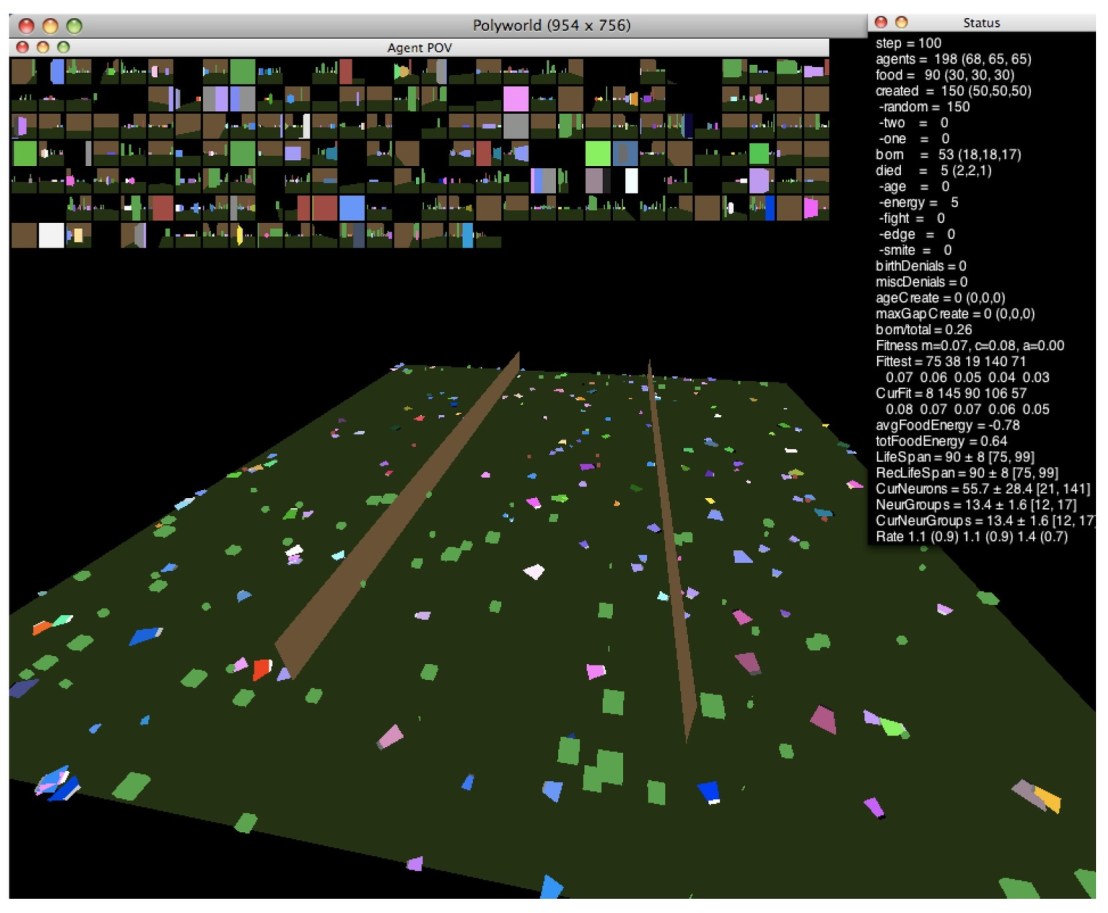
What is the optimal level of chaos in a computational system? If a system is too chaotic, it cannot reliably store information. If it is too ordered, it cannot transmit information. A variety of computational systems exhibit dynamics at the “edge of chaos”, the transition between the ordered and chaotic regimes. In this work, we examine the evolved neural networks of Polyworld, an artificial life model consisting of a simulated ecology populated with biologically inspired agents. As these agents adapt to their environment, their initially simple neural networks become increasingly capable of exhibiting rich dynamics. Dynamical systems analysis reveals that natural selection drives these networks toward the edge of chaos until the agent population is able to sustain itself. After this point, the evolutionary trend stabilizes, with neural dynamics remaining on average significantly far from the transition to chaos.


Evolution of Neural Dynamics in an Ecological Model
Steven Williams and Larry Yaeger

Geosciences 2017, 7(3), 49; https://doi.org/10.3390/geosciences7030049

Source: www.mdpi.com

Lévy flight movements prevent extinctions and maximize population abundances in fragile Lotka–Volterra systems

The ubiquity of scale-free mobility in nature, as observed in systems ranging from microorganisms to fishing boats, has stimulated a number of foraging theories and individual-based random search models. Here, we unveil an essential yet unexplored property of multiple-scale motion, which relates to the stability of entire populations. We use Lotka–Volterra models to predict that foragers diffusing normally tend to go extinct in fragile fragmented ecosystems, whereas their populations become resilient to degraded conditions and have maximized abundances when individuals perform scale-free Lévy flights. Our analytical and simulated results shift the scope of multiple-scale foraging from the individual level to the scales of collective phenomena that are of primary interest in conservation biology.

Lévy flight movements prevent extinctions and maximize population abundances in fragile Lotka–Volterra systems
Teodoro Dannemann, Denis Boyer and Octavio Miramontes
PNAS March 26, 2018. 201719889; published ahead of print March 26, 2018. https://doi.org/10.1073/pnas.1719889115

Source: www.pnas.org

Having one eye better than the other may explain ants’ left bias

Unlike Derek Zoolander, ants don’t have any difficulty turning left. New research from the University of Bristol has now found rock ants often have one eye slightly better than the other, which could help explain why most of them prefer to turn left, given the choice.

Source: www.bristol.ac.uk

Free agents

For more than half a century, U.S. government officials have considered disaster scenarios, such as the consequences of a nuclear bomb going off in Washington, D.C. Only now, instead of following fixed story lines and predictions assembled ahead of time, they are using computers to play what-if with an entire artificial society: an advanced type of computer simulation called an agent-based model. Today’s version of the nuclear attack model includes a digital simulation of every building in the area affected by the bomb, as well as every road, power line, hospital, and even cell tower. The model includes weather data to simulate the fallout plume. And the scenario is peopled with some 730,000 agents. Each agent is an autonomous subroutine that responds in reasonably human ways to other agents and the evolving disaster by switching among multiple modes of behavior. The point of such models is to avoid describing human affairs from the top down with fixed equations, as is traditionally done in such fields as economics and epidemiology. Instead, outcomes such as a financial crash or the spread of a disease emerge from the bottom up, through the interactions of many individuals, leading to a real-world richness and spontaneity that is hard to simulate otherwise. The models tend to be big, computation-wise—forcing the agents to be relatively simple-minded. But computers keep getting bigger and more powerful, as do the data sets used to populate and calibrate the models. In fields as diverse as economics, transportation, public health, and urban planning, more and more decision-makers are taking agent-based models seriously.


Free agents
M. Mitchell Waldrop

Science  13 Apr 2018:
Vol. 360, Issue 6385, pp. 144-147
DOI: 10.1126/science.360.6385.144

Source: science.sciencemag.org

A delicate balance

The vast majority of the nearly half-million infants born prematurely in the United States are given antibiotics, even without evidence of infection. Many preemies are kept on the drugs after blood tests say they are not sick. Yet that practice, once considered the best way to protect a hospital’s most vulnerable patients, is now being challenged. Some studies suggest that even while helping fight certain infections, those drugs may encourage others by wiping out an infant’s developing gut microbiome. Disrupting that microbial ecosystem may also promote a host of problems later in life, such as asthma and obesity. And recent research indicates that long after preemies leave the neonatal intensive care unit, they can harbor many antibiotic-resistant microorganisms, potentially endangering not only themselves, but also the wider population.


A delicate balance
Marla Broadfoot

Science  06 Apr 2018:
Vol. 360, Issue 6384, pp. 18-20
DOI: 10.1126/science.360.6384.18

Source: science.sciencemag.org