
Category: Papers

Latin America’s lost histories revealed

If you walked the cobblestone streets and bustling markets of 16th and 17th century Mexico City, you would see people born all over the world: Spanish settlers, indigenous Americans, Africans, and Asians. All these populations met and mingled for the first time in colonial Latin America. Historical documents describe this cultural mixture, but now, international teams of researchers are enriching our view of colonial Latin America by analyzing the genomes of today’s people. Aided by sophisticated statistics and worldwide genetic databases, they can tease apart ancestry and population mixing with more nuance than ever before. The results, reported at a meeting this week and in a preprint, tell stories that have been largely forgotten or were never recorded in historical documents. From the immigration of enslaved Filipinos and Africans to that of formerly Jewish families forbidden to travel to the colonies, hidden histories are emerging.


Latin America’s lost histories revealed
Lizzie Wade

Science 13 Apr 2018:
Vol. 360, Issue 6385, pp. 137-138
DOI: 10.1126/science.360.6385.137

Source: science.sciencemag.org
Methods for quantifying effects of social unrest using credit card transaction data

Societal unrest and similar events are important for societies, but it is often difficult to quantify their effects on individuals, hindering a timely and effective policy-making in emergencies and in particular localized social shocks such as protests. Traditionally, effects are assessed through economic indicators or surveys with relatively low temporal and spatial resolutions. In this work, we compute two behavioral indexes, based on the use of credit card transaction data, for measuring the economic effects of a series of protests on consumer actions and personal consumption. Using data from a metropolitan area in an OECD country, we show that protests affect consumers’ shopping frequency and spending, but in noticeably different ways. The effects show strong temporal and spatial patterns, vary between neighborhoods and customers of different socio-demographical characteristics as well as between merchants of different categories, and suggest interesting subtleties in purchase behavior such as displaced or delayed shopping activities. Our method can generally serve for the real-time monitoring of the effects of major social shocks or events on urban economy and consumer sentiment, providing high-resolution and cost-effective measurement tools to complement traditional economic indicators.


Methods for quantifying effects of social unrest using credit card transaction data

Xiaowen Dong, Joachim Meyer, Erez Shmueli, Burçin Bozkaya and Alex Pentland
EPJ Data Science20187:8
https://doi.org/10.1140/epjds/s13688-018-0136-x

Source: epjdatascience.springeropen.com

The Silurian Hypothesis: Would it be possible to detect an industrial civilization in the geological record?

If an industrial civilization had existed on Earth many millions of years prior to our own era, what traces would it have left and would they be detectable today? We summarize the likely geological fingerprint of the Anthropocene, and demonstrate that while clear, it will not differ greatly in many respects from other known events in the geological record. We then propose tests that could plausibly distinguish an industrial cause from an otherwise naturally occurring climate event.


The Silurian Hypothesis: Would it be possible to detect an industrial civilization in the geological record?
Gavin A. Schmidt, Adam Frank

Source: arxiv.org

Population Structure Promotes the Evolution of Intuitive Cooperation and Inhibits Deliberation

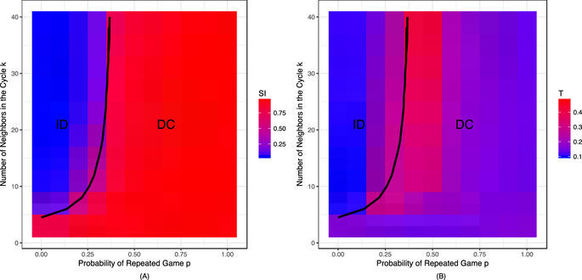
Spatial structure is one of the most studied mechanisms in evolutionary game theory. Here, we explore the consequences of spatial structure for a question which has received considerable empirical and theoretical attention in recent years, but has not yet been studied from a network perspective: whether cooperation relies on intuitive predispositions or deliberative self-control. We examine this question using a model which integrates the “dual-process” framework from cognitive science with evolutionary game theory, and considers the evolution of agents who are embedded within a social network and only interact with their neighbors. In line with past work in well-mixed populations, we find that selection favors either the intuitive defector strategy which never deliberates, or the dual-process cooperator strategy which intuitively cooperates but uses deliberation to switch to defection when doing so is payoff-maximizing. We find that sparser networks (i.e., smaller average degree) facilitate the success of dual-process cooperators over intuitive defectors, while also reducing the level of deliberation that dual-process cooperators engage in; and that these results generalize across different kinds of networks. These observations demonstrate the important role that spatial structure can have not just on the evolution of cooperation, but on the co-evolution of cooperation and cognition.


Population Structure Promotes the Evolution of Intuitive Cooperation and Inhibits Deliberation

Mohsen Mosleh & David G. Rand

Scientific Reports

volume 8, Article number: 6293 (2018)
doi:10.1038/s41598-018-24473-1

Source: www.nature.com

Synergy from reproductive division of labor and genetic complexity drive the evolution of sex

Computer experiments that mirror the evolutionary dynamics of sexual and asexual organisms as they occur in nature were used to test features proposed to explain the evolution of sexual recombination. Results show that this evolution is better described as a network of interactions between possible sexual forms, including diploidy, thelytoky, facultative sex, assortation, bisexuality, and division of labor between the sexes, rather than a simple transition from parthenogenesis to sexual recombination. Diploidy was shown to be fundamental for the evolution of sex; bisexual reproduction emerged only among anisogamic diploids with a synergistic division of reproductive labor; and facultative sex was more likely to evolve among haploids practicing assortative mating. Looking at the evolution of sex as a complex system through individual-based simulations explains better the diversity of sexual strategies known to exist in nature, compared to classical analytical models.


Synergy from reproductive division of labor and genetic complexity drive the evolution of sex

Klaus Jaffe

Journal of Biological Physics

Source: link.springer.com