
Category: Papers

Resisting Influence: How the Strength of Predispositions to Resist Control Can Change Strategies for Optimal Opinion Control in the Voter Model

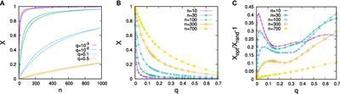
In this paper, we investigate influence maximization, or optimal opinion control, in a modified version of the two-state voter dynamics in which a native state and a controlled or influenced state are accounted for. We include agent predispositions to resist influence in the form of a probability q with which agents spontaneously switch back to the native state when in the controlled state. We argue that in contrast to the original voter model, optimal control in this setting depends on q: For low strength of predispositions q, optimal control should focus on hub nodes, but for large q, optimal control can be achieved by focusing on the lowest degree nodes. We investigate this transition between hub and low-degree node control for heterogeneous undirected networks and give analytical and numerical arguments for the existence of two control regimes.


Resisting Influence: How the Strength of Predispositions to Resist Control Can Change Strategies for Optimal Opinion Control in the Voter Model

Markus Brede, Valerio Restocchi and Sebastian Stein


Front. Robot. AI, 17 April 2018 | https://doi.org/10.3389/frobt.2018.00034

Source: www.frontiersin.org

How Criticality of Gene Regulatory Networks Affects the Resulting Morphogenesis under Genetic Perturbations

Whereas the relationship between criticality of gene regulatory networks (GRNs) and dynamics of GRNs at a single-cell level has been vigorously studied, the relationship between the criticality of GRNs and system properties at a higher level has not been fully explored. Here we aim at revealing a potential role of criticality of GRNs in morphogenesis, which is hard to uncover through the single-cell-level studies, especially from an evolutionary viewpoint. Our model simulated the growth of a cell population from a single seed cell. All the cells were assumed to have identical intracellular GRNs. We induced genetic perturbations to the GRN of the seed cell by adding, deleting, or switching a regulatory link between a pair of genes. From numerical simulations, we found that the criticality of GRNs facilitated the formation of nontrivial morphologies when the GRNs were critical in the presence of the evolutionary perturbations. Moreover, the criticality of GRNs produced topologically homogeneous cell clusters by adjusting the spatial arrangements of cells, which led to the formation of nontrivial morphogenetic patterns. Our findings correspond to an epigenetic viewpoint that heterogeneous and complex features emerge from homogeneous and less complex components through the interactions among them. Thus, our results imply that highly structured tissues or organs in morphogenesis of multicellular organisms might stem from the criticality of GRNs.


How Criticality of Gene Regulatory Networks Affects the Resulting Morphogenesis under Genetic Perturbations
Hyobin Kim and Hiroki Sayama
Artificial Life
https://doi.org/10.1162/artl_a_00262

Source: www.mitpressjournals.org

Financial networks and stress testing: Challenges and new research avenues for systemic risk analysis and financial stability implications

Network models, stress testing methods and early warning systems are attracting growing interest both among scholars and practitioners. In this short paper, we illustrate some of the insights they have to offer both in terms of new fundamental scientific understanding of the emergence systemic risk and in terms of concrete applications to the policy areas of financial stability and macro-prudential policy. Finally, we discuss new research pathways to address the challenging questions still open, including multiplex networks, big financial data, and climate-finance.


Financial networks and stress testing: Challenges and new research avenues for systemic risk analysis and financial stability implications
Stefano Battiston, Serafin Martinez-Jaramillo

Journal of Financial Stability
Volume 35, April 2018, Pages 6-16

Source: www.sciencedirect.com

See Also: Special Issue: Network models, stress testing and other tools for financial stability monitoring and acroprudential policy design and implementation
Edited by Dr Serafín Martínez Jaramillo, Dr.Stefano Battiston
Volume 35, Pages 1-242 (April 2018)

Behavior Classification for Turing Machines

A classification for Turing machines is described. Quantitative descriptors for Turing machine behavior are used for measuring repetitiveness, periodicity, complexity and entropy. These descriptors allowed identifying several kinds of behavior for Turing machines, using an approach based on machine learning. The classification was tested and generality was probed over different configurations of Turing machines.

Source: www.complex-systems.com

Reservoir Computing Using Nonuniform Binary Cellular Automata

The reservoir computing (RC) paradigm utilizes a dynamical system (a reservoir) and a linear classifier (a readout layer) to process data from sequential classification tasks. In this paper, the usage of cellular automata (CAs) as a reservoir is investigated. The use of CAs in RC has been showing promising results. In this paper, it is shown that some cellular automaton (CA) rules perform better than others and the reservoir performance is improved by increasing the size of the CA reservoir itself. In addition, the usage of parallel loosely coupled (nonuniform) CA reservoirs, where each reservoir has a different CA rule, is investigated. The experiments performed on nonuniform CA reservoirs provide valuable insights into CA reservoir design. The results herein show that some rules do not work well together, while other combinations work remarkably well. This suggests that nonuniform CAs could represent a powerful tool for novel CA reservoir implementations.

Source: www.complex-systems.com