Category: Papers

Neutron-Star Collision Shakes Space-Time and Lights Up the Sky

In the days after Aug. 17, astronomers made successful observations of the colliding neutron stars with optical, radio, X-ray, gamma-ray, infrared and ultraviolet telescopes. The enormous collaborative effort, detailed today in dozens of papers appearing simultaneously in Physical Review Letters, Nature, Science, Astrophysical Journal Letters and other journals, has not only allowed astrophysicists to piece together a coherent account of the event, but also to answer longstanding questions in astrophysics.

Source: www.quantamagazine.org

Evolution and Devolution of Social Complexity: Why Do We Care?

Over the past 10,000 years human societies evolved from “simple” – small egalitarian groups, integrated by face-to-face interactions – to “complex” – huge anonymous societies of millions, characterized by great differentials in wealth and power, extensive division of labor, elaborate governance structures, and sophisticated information systems. What were the evolutionary processes that brought about such an enormous increase in social scale and complexity?

We also need to understand why social forces that hold huge human societies together sometimes fail to do so. Complex societies collapsed on numerous occasions in the past, and may be at risk today. There are clear signs that even industrialized, wealthy, and democratic Western societies, that seemed to be immune to collapse until recently, are becoming less stable. Research on social complexity will bring understanding that is of direct value to our societies and human well-being.

Source: peterturchin.com

Mobility can promote the evolution of cooperation via emergent self-assortment dynamics

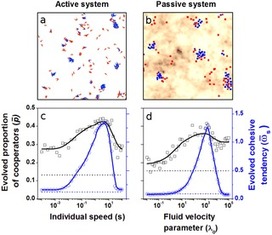
Cooperation among animals is ubiquitous. In a cooperative interaction, the cooperator confers a benefit to its partner at a personal cost. How does natural selection favour such a costly behaviour? Classical theories argue that cooperative interactions among genetic relatives, reciprocal cooperators, or among individuals within groups in viscous population structures are necessary to maintain cooperation. However, many organisms are mobile, and live in dynamic (fission-fusion) groups that constantly merge and split. In such populations, the above mechanisms may be inadequate to explain cooperation. Here, we develop a minimal model that explicitly accounts for mobility and cohesion among organisms. We find that mobility can support cooperation via emergent dynamic groups, even in the absence of previously known mechanisms. Our results may offer insights into the evolution of cooperation in animals that live in fission fusion groups, such as birds, fish or mammals, or microbes living in turbulent media, such as in oceans or in the bloodstreams of animal hosts.


Joshi J, Couzin ID, Levin SA, Guttal V (2017) Mobility can promote the evolution of cooperation via emergent self-assortment dynamics. PLoS Comput Biol13(9): e1005732. https://doi.org/10.1371/journal.pcbi.1005732

Source: journals.plos.org

Resilience management during large-scale epidemic outbreaks

Assessing and managing the impact of large-scale epidemics considering only the individual risk and severity of the disease is exceedingly difficult and could be extremely expensive. Economic consequences, infrastructure and service disruption, as well as the recovery speed, are just a few of the many dimensions along which to quantify the effect of an epidemic on society’s fabric. Here, we extend the concept of resilience to characterize epidemics in structured populations, by defining the system-wide critical functionality that combines an individual’s risk of getting the disease (disease attack rate) and the disruption to the system’s functionality (human mobility deterioration). By studying both conceptual and data-driven models, we show that the integrated consideration of individual risks and societal disruptions under resilience assessment framework provides an insightful picture of how an epidemic might impact society. In particular, containment interventions intended for a straightforward reduction of the risk may have net negative impact on the system by slowing down the recovery of basic societal functions. The presented study operationalizes the resilience framework, providing a more nuanced and comprehensive approach for optimizing containment schemes and mitigation policies in the case of epidemic outbreaks.


Resilience management during large-scale epidemic outbreaks
Emanuele Massaro, Alexander Ganin, Nicola Perra, Igor Linkov, Alessandro Vespignani

Source: arxiv.org

The Strength of Absent Ties: Social Integration via Online Dating

We used to marry people to which we were somehow connected to: friends of friends, schoolmates, neighbours. Since we were more connected to people similar to us, we were likely to marry someone from our own race.
However, online dating has changed this pattern: people who meet online tend to be complete strangers. Given that one-third of modern marriages start online, we investigate theoretically, using random graphs and matching theory, the effects of those previously absent ties in the diversity of modern societies.
We find that when a society benefits from previously absent ties, social integration occurs rapidly, even if the number of partners met online is small. Our findings are consistent with the sharp increase in interracial marriages in the U.S. in the last two decades.


The Strength of Absent Ties: Social Integration via Online Dating
Josue Ortega, Philipp Hergovich

Source: arxiv.org