Category: Papers

Effects of motion in structured populations

In evolutionary processes, population structure has a substantial effect on natural selection. Here, we analyse how motion of individuals affects constant selection in structured populations. Motion is relevant because it leads to changes in the distribution of types as mutations march towards fixation or extinction. We describe motion as the swapping of individuals on graphs, and more generally as the shuffling of individuals between reproductive updates. Beginning with a one-dimensional graph, the cycle, we prove that motion suppresses natural selection for death–birth (DB) updating or for any process that combines birth–death (BD) and DB updating. If the rule is purely BD updating, no change in fixation probability appears in the presence of motion. We further investigate how motion affects evolution on the square lattice and weighted graphs. In the case of weighted graphs, we find that motion can be either an amplifier or a suppressor of natural selection. In some cases, whether it is one or the other can be a function of the relative reproductive rate, indicating that motion is a subtle and complex attribute of evolving populations. As a first step towards understanding less restricted types of motion in evolutionary graph theory, we consider a similar rule on dynamic graphs induced by a spatial flow and find qualitatively similar results, indicating that continuous motion also suppresses natural selection.


Effects of motion in structured populations
Madison S. Krieger, Alex McAvoy, Martin A. Nowak
Published 4 October 2017.DOI: 10.1098/rsif.2017.0509

Source: rsif.royalsocietypublishing.org
Where is technology taking the economy?

We are creating an intelligence that is external to humans and housed in the virtual economy. This is bringing us into a new economic era—a distributive one—where different rules apply.


Where is technology taking the economy?
By W. Brian Arthur

McKinsey Quaterly

Source: www.mckinsey.com

The shape of collaborations

The structure of scientific collaborations has been the object of intense study both for its importance for innovation and scientific advancement, and as a model system for social group coordination and formation thanks to the availability of authorship data. Over the last years, complex networks approach to this problem have yielded important insights and shaped our understanding of scientific communities. In this paper we propose to complement the picture provided by network tools with that coming from using simplicial descriptions of publications and the corresponding topological methods. We show that it is natural to extend the concept of triadic closure to simplicial complexes and show the presence of strong simplicial closure. Focusing on the differences between scientific fields, we find that, while categories are characterized by different collaboration size distributions, the distributions of how many collaborations to which an author is able to participate is conserved across fields pointing to underlying attentional and temporal constraints. We then show that homological cycles, that can intuitively be thought as hole in the network fabric, are an important part of the underlying community linking structure.


The shape of collaborations
Alice PataniaEmail authorView ORCID ID profile, Giovanni Petri and Francesco Vaccarino
EPJ Data Science20176:18
https://doi.org/10.1140/epjds/s13688-017-0114-8

Source: epjdatascience.springeropen.com

Data-driven modeling of collaboration networks: a cross-domain analysis

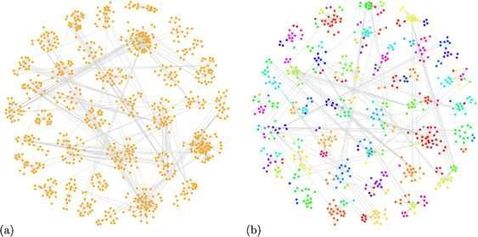
We analyze large-scale data sets about collaborations from two different domains: economics, specifically 22,000 R&D alliances between 14,500 firms, and science, specifically 300,000 co-authorship relations between 95,000 scientists. Considering the different domains of the data sets, we address two questions: (a) to what extent do the collaboration networks reconstructed from the data share common structural features, and (b) can their structure be reproduced by the same agent-based model. In our data-driven modeling approach we use aggregated network data to calibrate the probabilities at which agents establish collaborations with either newcomers or established agents. The model is then validated by its ability to reproduce network features not used for calibration, including distributions of degrees, path lengths, local clustering coefficients and sizes of disconnected components. Emphasis is put on comparing domains, but also sub-domains (economic sectors, scientific specializations). Interpreting the link probabilities as strategies for link formation, we find that in R&D collaborations newcomers prefer links with established agents, while in co-authorship relations newcomers prefer links with other newcomers. Our results shed new light on the long-standing question about the role of endogenous and exogenous factors (i.e., different information available to the initiator of a collaboration) in network formation.


Data-driven modeling of collaboration networks: a cross-domain analysis
Mario V Tomasello, Giacomo VaccarioEmail authorView ORCID ID profile and Frank Schweitzer
EPJ Data Science20176:22
https://doi.org/10.1140/epjds/s13688-017-0117-5

Source: epjdatascience.springeropen.com

Estimating local commuting patterns from geolocated Twitter data

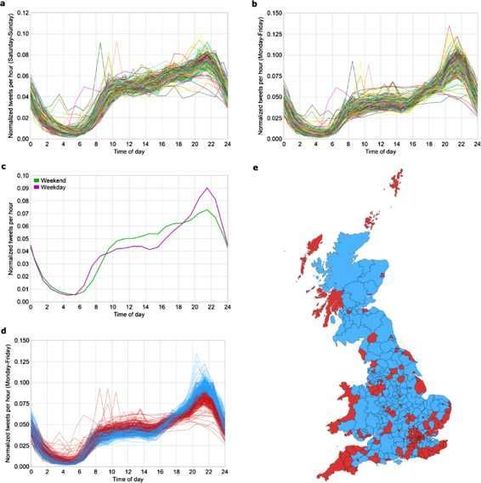
The emergence of large stores of transactional data generated by increasing use of digital devices presents a huge opportunity for policymakers to improve their knowledge of the local environment and thus make more informed and better decisions. A research frontier is hence emerging which involves exploring the type of measures that can be drawn from data stores such as mobile phone logs, Internet searches and contributions to social media platforms and the extent to which these measures are accurate reflections of the wider population. This paper contributes to this research frontier, by exploring the extent to which local commuting patterns can be estimated from data drawn from Twitter. It makes three contributions in particular. First, it shows that heuristics applied to geolocated Twitter data offer a good proxy for local commuting patterns; one which outperforms the current best method for estimating these patterns (the radiation model). This finding is of particular significance because we make use of relatively coarse geolocation data (at the city level) and use simple heuristics based on frequency counts. Second, it investigates sources of error in the proxy measure, showing that the model performs better on short trips with higher volumes of commuters; it also looks at demographic biases but finds that, surprisingly, measurements are not significantly affected by the fact that the demographic makeup of Twitter users differs significantly from the population as a whole. Finally, it looks at potential ways of going beyond simple frequency heuristics by incorporating temporal information into models.


Estimating local commuting patterns from geolocated Twitter data
Graham McNeill, Jonathan Bright, and Scott A Hale

EPJ Data Science 2017 6:24

https://doi.org/10.1140/epjds/s13688-017-0120-x

Source: epjdatascience.springeropen.com