
Category: Papers

Rapid rise and decay in petition signing

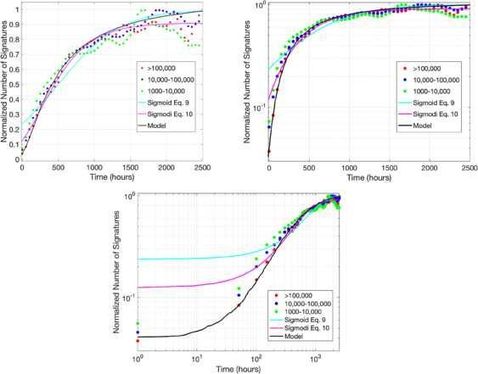
Contemporary collective action, much of which involves social media and other Internet-based platforms, leaves a digital imprint which may be harvested to better understand the dynamics of mobilization. Petition signing is an example of collective action which has gained in popularity with rising use of social media and provides such data for the whole population of petition signatories for a given platform. This paper tracks the growth curves of all 20,000 petitions to the UK government petitions website (http://epetitions.direct.gov.uk) and 1,800 petitions to the US White House site (https://petitions.whitehouse.gov), analyzing the rate of growth and outreach mechanism. Previous research has suggested the importance of the first day to the ultimate success of a petition, but has not examined early growth within that day, made possible here through hourly resolution in the data. The analysis shows that the vast majority of petitions do not achieve any measure of success; over 99 percent fail to get the 10,000 signatures required for an official response and only 0.1 percent attain the 100,000 required for a parliamentary debate (0.7 percent in the US). We analyze the data through a multiplicative process model framework to explain the heterogeneous growth of signatures at the population level. We define and measure an average outreach factor for petitions and show that it decays very fast (reducing to 0.1% after 10 hours in the UK and 30 hours in the US). After a day or two, a petition’s fate is virtually set. The findings challenge conventional analyses of collective action from economics and political science, where the production function has been assumed to follow an S-shaped curve.


Rapid rise and decay in petition signing
Taha YasseriEmail author, Scott A Hale and Helen Z Margetts
EPJ Data Science20176:20
https://doi.org/10.1140/epjds/s13688-017-0116-6

Source: epjdatascience.springeropen.com

Complexity of evolutionary equilibria in static fitness landscapes

Experiments show that fitness landscapes can have a rich combinatorial structure due to epistasis and yet theory assumes that local peaks can be reached quickly. I introduce a distinction between easy landscapes where local fitness peaks can be found in a moderate number of steps and hard landscapes where finding evolutionary equilibria requires an infeasible amount of time. Hard examples exist even among landscapes with no reciprocal sign epistasis; on these, strong selection weak mutation dynamics cannot find the unique peak in polynomial time. On hard rugged fitness landscapes, no evolutionary dynamics — even ones that do not follow adaptive paths — can find a local fitness peak quickly; and the fitness advantage of nearby mutants cannot drop off exponentially fast but has to follow a power-law that long term evolution experiments have associated with unbounded growth in fitness. I present candidates for hard landscapes at scales from singles genes, to microbes, to complex organisms with costly learning (Baldwin effect). Even though hard landscapes are static and finite, local evolutionary equilibrium cannot be assumed.

Source: www.biorxiv.org

Reliable uncertainties in indirect measurements

In this article we present very intuitive, easy to follow, yet mathematically rigorous, approach to the so called data fitting process. Rather than minimizing the distance between measured and simulated data points, we prefer to find such an area in searched parameters’ space that generates simulated curve crossing as many acquired experimental points as possible, but at least half of them. Such a task is pretty easy to attack with interval calculations. The problem is, however, that interval calculations operate on guaranteed intervals, that is on pairs of numbers determining minimal and maximal values of measured quantity while in vast majority of cases our measured quantities are expressed rather as a pair of two other numbers: the average value and its standard deviation. Here we propose the combination of interval calculus with basic notions from probability and statistics. This approach makes possible to obtain the results in familiar form as reliable values of searched parameters, their standard deviations, and their correlations as well. There are no assumptions concerning the probability density distributions of experimental values besides the obvious one that their variances are finite. Neither the symmetry of uncertainties of experimental distributions is required (assumed) nor those uncertainties have to be `small.’ As a side effect, outliers are quietly and safely ignored, even if numerous.


Reliable uncertainties in indirect measurements
Marek W. Gutowski

Source: arxiv.org

Algorithmically probable mutations reproduce aspects of evolution such as convergence rate, genetic memory, modularity, diversity explosions, and mass extinction

We show that if evolution is algorithmic in any form and can thus be considered a program in software space, the emergence of a natural algorithmic probability distribution has the potential to become an accelerating mechanism. We simulate the application of algorithmic mutations to binary matrices based on numerical approximations to algorithmic probability, comparing the evolutionary speed to the alternative hypothesis of uniformly distributed mutations for a series of matrices of varying complexity. When the algorithmic mutation produces unfit organisms—because mutations may lead to, for example, syntactically useless evolutionary programs—massive extinctions may occur. We show that modularity provides an evolutionary advantage also evolving a genetic memory. We demonstrate that such regular structures are preserved and carried on when they first occur and can also lead to an accelerated production of diversity and extinction, possibly explaining natural phenomena such as periods of accelerated growth of the number of species (e.g. the Cambrian explosion) and the occurrence of massive extinctions (e.g. the End Triassic) whose causes are a matter of considerable debate. The approach introduced here appears to be a better approximation to actual biological evolution than models based upon the application of mutation from uniform probability distributions, and because evolution by algorithmic probability converges faster to regular structures (both artificial and natural, as tested on a small biological network), it also approaches a formal version of open-ended evolution based on previous results. The results validate the motivations and results of Chaitin’s Metabiology programme. We also show that the procedure has the potential to significantly accelerate solving optimization problems in the context of artificial evolutionary algorithms.


Algorithmically probable mutations reproduce aspects of evolution such as convergence rate, genetic memory, modularity, diversity explosions, and mass extinction

Santiago Hernández-Orozco, Hector Zenil, Narsis A. Kiani

Click here to edit the content

Source: arxiv.org

Reshaping Business With Artificial Intelligence

Expectations for artificial intelligence (AI) are sky-high, but what are businesses actually doing now? The goal of this report is to present a realistic baseline that allows companies to compare their AI ambitions and efforts. Building on data rather than conjecture, the research is based on a global survey of more than 3,000 executives, managers, and analysts across industries and in-depth interviews with more than 30 technology experts and executives.

Source: sloanreview.mit.edu